Why is it the best choice for aircraft wing fatigue monitoring?
In the aerospace sector, aircraft wings are susceptible to structural fatigue due to complex aerodynamic loads and alternating stresses. Compared to traditional electrical strain gauges (such as resistance strain gauges), Fiber Bragg Grating (FBG) based fiber optic sensing technology exhibits several irreplaceable technical advantages in wing fatigue and Structural Health Monitoring (SHM):
1. Physical Mechanism and Engineering Technical Advantages
- Inherent Immunity to Electromagnetic Interference and Lightning Safety: Fiber optic sensors use light waves as the signal carrier and quartz glass as the medium, containing no metallic wires. They are completely immune to complex airborne electromagnetic radiation, radar signals, and electromagnetic pulses (EMI/EMP) generated by lightning strikes. This overcomes the issues of signal interference and potential electrical discharge hazards associated with electrical signals in extreme environments.
- High Fatigue Life and Corrosion Resistance: Traditional metal strain gauges are prone to delamination of the adhesive layer, fatigue failure of the metal, or oxidation and corrosion under millions of alternating load cycles. Quartz fibers, combined with specialized packaging technology, offer extremely high fatigue limits and chemical stability, enabling long-term monitoring with a lifespan comparable to that of the wing structure.
- Minimal Size and Mass Load: Fiber optic sensors have a very small outer diameter (typically between 0.7\ \text{mm} and 1.1\ \text{mm}) and are extremely lightweight. They can be surface-mounted on the metallic/composite material of the wing or seamlessly embedded within carbon fiber reinforced polymer (CFRP) laminates without altering the wing’s aerodynamic profile or structural stress distribution.
- Wavelength Encoding and High Stability: FBG sensors convert micro-strain variations into shifts in the Bragg reflection wavelength \Delta \lambda_B. Wavelength, as an absolute physical quantity, is unaffected by light source power fluctuations, fiber bending losses, or connector insertion losses. They possess good zero-point stability, enabling high-precision continuous measurement of micro-strains (\mu\varepsilon).
- Wavelength Division Multiplexing and Quasi-Distributed Arrays: Utilizing Wavelength Division Multiplexing (WDM) technology, multiple FBG sensors with different center wavelengths \lambda_B can be written in series on a single single-mode fiber. A single fiber channel is sufficient to map the stress and strain distribution gradients over a large area of the wing’s main spar, wing box, and wing surface, significantly reducing the weight and complexity of onboard wiring harnesses.
2. Official OFSCN® Strain Sensing Product Selection
For aerospace wing and composite structure strain and fatigue monitoring requirements, Beijing Dacheng Yongsheng Technology Co., Ltd. (OFSCN®) offers a variety of professionally packaged fiber Bragg grating strain sensors:
- OFSCN® Alloy Tube Packaged Fiber Bragg Grating strain sensor
This sensor features fiber gratings packaged in a highly elastic alloy tube with a lightweight outer diameter (default \le 1.1\ \text{mm}). It offers a high fatigue limit and excellent longitudinal strain transfer efficiency, making it suitable for micro-strain and cyclic fatigue monitoring in critical stress areas of wing structures.


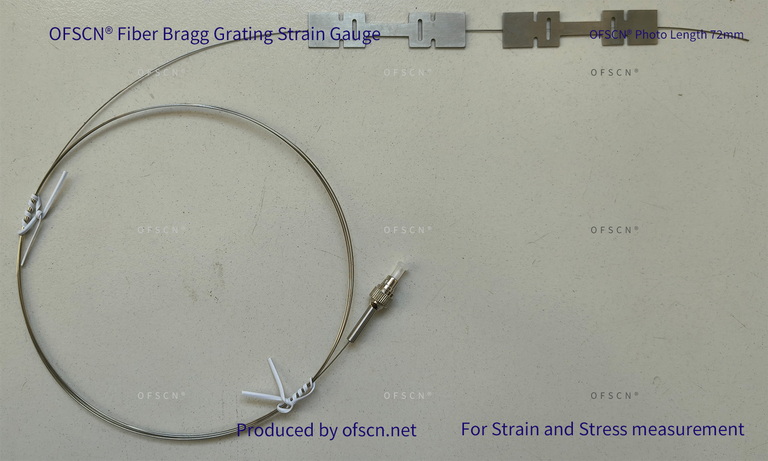
- OFSCN® Fiber Bragg Grating Strain Gauge
Utilizing an I-beam shaped stainless steel or aluminum alloy piece, this sensor supports surface bonding or spot welding installation. It offers selectable gauge lengths (e.g., 3.6\ \text{cm}, 7.2\ \text{cm}) and a default strain range of \ge 10000\ \mu\varepsilon. It is ideal for precise and rapid deployment in areas of concentrated stress on the wing surface.
- OFSCN® Polymer-encapsulated Fiber Bragg Grating Strain Sensor (0.7mm/1.2mm diameter)
Packaged with polymer materials, this sensor has an outer diameter as small as \le 0.7\ \text{mm}. It is highly suitable for direct embedding within the carbon fiber reinforced polymer (CFRP) of wings, allowing real-time detection of internal interlaminar shear and fatigue damage.
