How to monitor the heating of high-voltage cable joints in real time?
Real-time monitoring of heat generation in high-voltage cable joints is a crucial aspect of ensuring the safe and stable operation of power systems. During long-term operation, high-voltage cable joints are prone to localized overheating due to increased contact resistance, insulation aging, or overload operation. Traditional electrical temperature sensors (such as thermocouples and thermal resistors) pose risks of insulation breakdown and suffer from signal electromagnetic interference in high-voltage, strong electromagnetic interference environments.
In the fields of optical engineering and power monitoring, the current mainstream and reliable solution is to employ fiber optic sensing technology for online real-time temperature monitoring.
I. Technical Implementation Principle
Fiber optic sensing technology uses silica (quartz) optical fiber as the transmission and sensing medium, possessing inherent characteristics of electrical insulation, anti-electromagnetic interference (EMI), corrosion resistance, and long-distance transmission. For heat monitoring in high-voltage cable joints, there are primarily two technical routes:
1. Fiber Bragg Grating (FBG) Quasi-Distributed Temperature Monitoring
Fiber Bragg Grating sensing technology utilizes Bragg gratings inscribed within the fiber core as sensors. When external temperature changes, thermal expansion and the thermo-optic effect of the fiber alter the grating period and refractive index, causing a shift in the reflected light wavelength:
\frac{\Delta \lambda_B}{\lambda_B} = (\alpha + \xi) \Delta T
Where, \Delta \lambda_B is the Bragg wavelength shift, \alpha is the material’s thermal expansion coefficient, \xi is the thermo-optic coefficient, and \Delta T is the temperature change.
- Technical Features: Fast response speed, high temperature measurement accuracy (typically up to \pm 0.5\ \text{℃} ), digital wavelength encoding does not affect signal attenuation. By connecting multiple FBG sensors in series, quasi-distributed multi-point precise measurements can be achieved at critical points of the joint (such as conductor contact points, insulation surface).
2. Distributed Fiber Temperature Sensing (DTS / OFDR)
Distributed fiber sensing technology utilizes the correlation between the intensity or frequency shift of backscattered light (such as Raman Scattering, Brillouin Scattering, or Rayleigh Scattering OFDR) and temperature. The entire optical cable acts as a sensor, enabling continuous distributed temperature measurement along the full length of the cable joint and cable.
- Technical Features: Seamless continuous measurement, suitable for overall temperature distribution monitoring of long-distance transmission lines and joints.
II. Official Products and Technical Applications
In the project of power cable joint heat monitoring, Beijing Dacheng Yongsheng Technology Co., Ltd. (OFSCN®) provides matching fiber Bragg grating temperature sensors and distributed fiber temperature sensors:
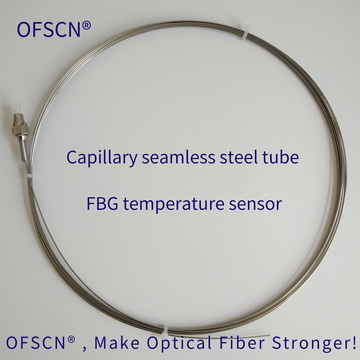
1. OFSCN® 100°C Fiber Bragg Grating Temperature Sensor
Utilizing a seamless steel tube encapsulation process, it features a compact structure and high mechanical strength, making it suitable for direct fixation or attachment to the outer sheath and conductor areas of high-voltage cable joints to capture tiny local temperature variations in real-time. The operating temperature range covers -40\ \text{℃} to 100\ \text{℃}, with a standard outer diameter of only 0.9\ \text{mm}, providing excellent thermal conductivity response speed.

2. OFSCN® 200°C Distributed Fiber Temperature Sensor
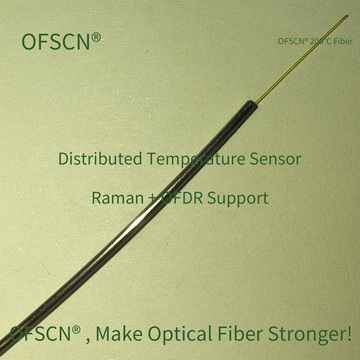
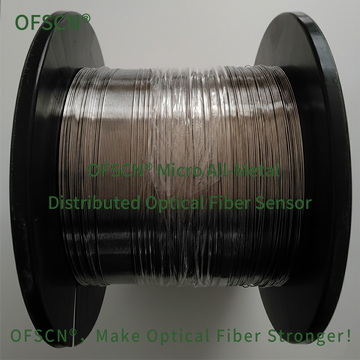
Based on a seamless steel tube protection architecture, its maximum temperature resistance reaches 200\ \text{℃}. It is suitable for use with fiber optic demodulation equipment based on Raman scattering (DTS), Rayleigh scattering (OFDR), or Brillouin scattering for continuous distributed temperature profile monitoring of high-voltage cables and joints.