Why do some connectors cost a few yuan, while others cost tens of yuan? How to judge the quality of ceramics?
The price of fiber optic connectors ranges from a few yuan to tens or even hundreds of yuan. The core technical differences and cost bottlenecks mainly lie in the processing precision of the Ceramic Ferrule, the end-face geometric inspection standards, and environmental adaptability (such as temperature and pressure resistance).
From the perspective of optical physics and precision engineering, these differences and methods for judging quality can be analyzed as follows:
I. Physical Alignment Mechanism of Ceramic Ferrules and Reasons for Price Differences
The essential function of a fiber optic connector is to achieve a detachable connection between two optical fibers. In single-mode optical fibers, light transmission is confined within a core with a diameter of only about 9\ \mu\text{m} . To achieve ultra-low loss connection, the cores of the two optical fibers must achieve nanometer-level Physical Contact and geometric alignment in three-dimensional space.
1. Concentricity and Tolerance Precision (Geometric Hierarchy)
To secure the optical fiber with an outer diameter of 125\ \mu\text{m} within the central micro-hole of the ceramic ferrule, the concentricity of the micro-hole is crucial.
- Low-end connectors (a few yuan): Typically use multi-mode grade ferrules or wide-tolerance single-mode ferrules. Concentricity deviation may range from 1.0\ \mu\text{m} to 3.0\ \mu\text{m} or even more. This leads to significant eccentricity when the optical fibers are connected, resulting in high and extremely unstable insertion loss (IL).
- High-end connectors (tens of yuan): Employ premium or master grade single-mode ceramic ferrules, with concentricity deviation strictly controlled within \le 0.5\ \mu\text{m} or even \le 0.3\ \mu\text{m} . This sub-micron processing precision is extremely demanding, leading to an exponential increase in the defect rate and thus significantly higher costs.
2. Precision Grinding and 3D Interferometer Inspection
After the optical fiber is assembled into a high-quality connector, the end face needs to undergo multiple stages of fine polishing and grinding (e.g., coarse grinding, medium grinding, ultra-fine polishing). It must also be inspected individually for end-face geometry using a 3D Interferometer. Inexpensive connectors often skip the expensive full inspection process with an interferometer, making it difficult to guarantee long-term reliability.
3. Environmental Adaptability and Component Materials
- Standard communication connectors: Outer casing components are typically made of ordinary plastic, cured with room-temperature adhesive, with an operating temperature usually between -20\ ^\circ\text{C} and +50\ ^\circ\text{C} or -40\ ^\circ\text{C} to +75\ ^\circ\text{C} .
- Industrial/High-temperature connectors: Require all-metal components, special formulations of high-temperature inorganic adhesives, and ceramic materials with special thermal expansion coefficients. Under extreme temperature differences from -200\ ^\circ\text{C} to +300\ ^\circ\text{C} , the connector components must not undergo non-linear thermal deformation, which would cause core misalignment. Therefore, these special connectors are much more expensive.
II. How to Judge the Quality of Ceramic Ferrules? (Core Technical Indicators)
In laboratories and field engineering, the quality of ceramic ferrules and connectors is typically evaluated qualitatively and quantitatively based on the following four physical indicators:
1. Concentricity
Concentricity refers to the deviation between the center of the outer circle and the center of the inner hole of the ceramic ferrule.
- Master Grade / Premium Single-Mode: \le 0.3\ \mu\text{m} to \le 0.5\ \mu\text{m} (used for laboratory-grade standard fibers or high-demand industrial sensors).
- Standard Single-Mode (SM): \le 1.0\ \mu\text{m} .
- Multi-Mode (MM): \le 1.4\ \mu\text{m} to 3.0\ \mu\text{m} . Due to the larger core diameter of multi-mode fibers (e.g., 50\ \mu\text{m} or 62.5\ \mu\text{m} ), they are less sensitive to minor eccentricity.
2. Inner Diameter Tolerance
The cladding diameter of standard single-mode optical fibers is 125\ \mu\text{m} .
- High-quality ferrules: Inner diameter is controlled within 125.5\ \mu\text{m} \pm 0.5\ \mu\text{m} , with minimal gap when the fiber is inserted, preventing it from wobbling.
- Low-quality ferrules: The inner diameter is too large or not round, causing the optical fiber to be biased to one side during curing, leading to deterioration of actual concentricity.
3. 3D Geometry Parameters of the End Face
These three key parameters are measured using an interferometer:
- Radius of Curvature: The end face of the ferrule is usually ground into a spherical shape to ensure physical contact. The standard range for PC/UPC connectors is 10\ \text{mm} \sim 25\ \text{mm} .
- Apex Offset: The physical deviation of the apex of the sphere from the center of the optical fiber. High-quality ferrules require \le 50\ \mu\text{m} (better ones \le 30\ \mu\text{m} ). If the offset is too large, the fiber cores will not be in contact when the two ends are connected.
- Fiber Height/Undercut: The depth or protrusion of the fiber end face relative to the ceramic end face. It should be strictly controlled within \pm 50\ \text{nm} . Excessive undercut will create an air gap between fibers, causing reflection; excessive protrusion will crush the fiber end face during insertion and removal.
4. Surface Quality
Observed under a 400x fiber microscope, the ceramic end face and fiber end face of high-quality ferrules should be free of any pits, chips, scratches, or dirt (conforming to IEC 61300-3-35 international standard).
III. Official Technical Specifications and Product Examples
To ensure high-standard transmission performance in harsh environments, OFSCN® provides fiber patch cords and connector products based on high-precision ceramic ferrules and precision components:
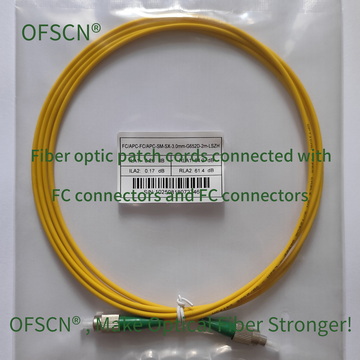
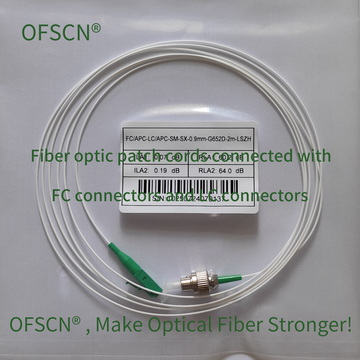
- High-quality connection in standard environments:
OFSCN® Standard Fiber Patch Cord uses standard precision ceramic ferrules and high-specification G.652D fiber, ensuring extremely low physical insertion loss and excellent repeatability of insertion and removal.
- Precision connection for special high-temperature environments:
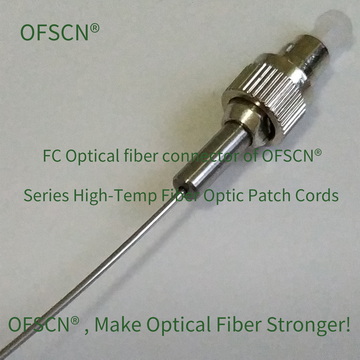
Designed for harsh environments, OFSCN® 120℃ Fiber Optic Connector, OFSCN® 200℃ Fiber Optic Connector, and OFSCN® 300℃ Fiber Optic Connector use high-temperature resistant metal components combined with precision Zirconium Dioxide ( \text{ZrO}_2 ) ceramic ferrules. They maintain sub-micron mechanical alignment within an extremely wide temperature range, preventing optical signal attenuation due to thermal stress variations.
- Precision alignment adapters:
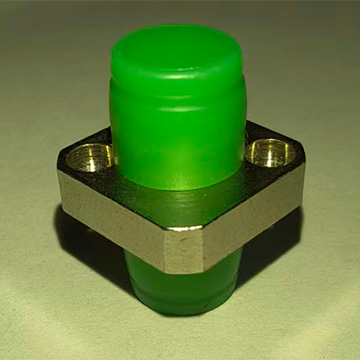
When two connectors are mated, high-precision sleeves are required for guidance. The OFSCN® High Temperature Resistant Fiber Optic Adapter is equipped with a high-temperature resistant, high-elasticity ceramic sleeve inside, which ensures excellent coaxiality of the high-precision ceramic ferrules during mating.