What is that white thin tube called? Is it hollow? Where does the light come out from?
In the fields of fiber optic communication and fiber optic sensing, the small, slightly protruding white tube you see at the center of a fiber optic connector serves a critical and precise physical alignment and transmission function. Here is a professional academic answer to your question:
1. What is that white tube called?
This white tube’s official academic name is Ceramic Ferrule, also commonly referred to as a Ceramic Pin in engineering.
- Material: It is typically made from high-precision, high-hardness, and extremely thermally stable Zirconium Dioxide (ZrO_2) ceramic material.
- Function: Its primary role is to provide extremely high-precision physical alignment. When two fiber optic connectors are mated (or inserted into a flange/adapter), the ceramic ferrule ensures that the central axes of the two optical fibers are perfectly aligned, thereby minimizing coupling loss and reflection loss of the optical signal.
2. Is it hollow?
Yes and no (depending on its production and assembly state):
- Before assembly (semi-finished state): It is hollow. A very small axial through-hole (micro-hole) is machined along the central axis of the ceramic ferrule. For standard single-mode fiber connectors, the diameter of this micro-hole is typically between 125\ \mu\text{m} and 127\ \mu\text{m}, just slightly larger than the standard fiber’s outer glass diameter (125\ \mu\text{m}).
- In the finished connector (in use): It is solid. During the connector fabrication process, the bare optical fiber glass, after stripping its coating, is inserted into this micro-hole and cured with a specialized high-temperature epoxy adhesive. Subsequently, technicians perform extremely precise polishing and grinding on the end face at the front of the ferrule. Therefore, in a finished connector you receive, the micro-hole is completely filled with the glass fiber and adhesive, and is no longer hollow.
3. Where does the light come out from?
Light is emitted from the geometric center of the polished end face of the ceramic ferrule – specifically, from the Fiber Core embedded within it.
Taking the most commonly used standard single-mode fiber connector as an example, its physical structure is distributed as follows:
- Ceramic Ferrule Outer Diameter: Typically 2.5\text{mm} (e.g., FC, SC, ST connectors) or 1.25\text{mm} (e.g., LC connectors).
- Fiber Glass Body (Cladding): Embedded in the center of the ferrule, with a diameter of 125\ \mu\text{m}.
- Fiber Core: Located at the very heart of the glass body, with a diameter typically only around 9\ \mu\text{m}.
The optical signal is strictly confined within the extremely thin 9\ \mu\text{m} core and propagates forward via total internal reflection, finally emitting from this tiny central area on the ferrule’s end face. Because the light emission area is extremely small (about one-tenth the diameter of a human hair), when using a safe visible light source (like a red light pen) for testing, you will see a tiny bright spot in the very center of the ferrule.
Related Technologies and Products
In OFSCN®'s high-performance fiber optic patch cords and sensor products, high-quality, high-precision Zirconium Dioxide ceramic ferrules are used to ensure long-term precise alignment under various normal temperatures, high temperatures, and harsh industrial environments.
For example, the following related connector and patch cord products:
- OFSCN® 120℃ Fiber Optic Connector: High-precision fiber optic connectors supporting regular and up to 120℃ environments, covering various interfaces such as FC/PC, FC/APC, ST, SC, LC, etc.
- OFSCN® 200℃ Fiber Optic Connector: Precision fiber optic connectors capable of withstanding 200℃ high temperatures.
- OFSCN® 300℃ Fiber Optic Connector: Special fiber optic connectors that can withstand extreme temperatures of 300℃, utilizing temperature-resistant ceramic ferrules and special metal encapsulation.
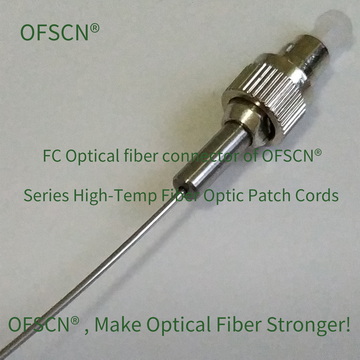
These high-precision ceramic ferrules, combined with special temperature-resistant fibers, form high-quality fiber optic patch cords such as OFSCN® 300℃ Fiber Optic Patch Cord, ensuring that optical signals or Fiber Bragg Grating (FBG) sensing signals can achieve high-precision, low-loss connection and transmission through the ceramic ferrule end face even in harsh operating conditions.