Will the performance of jumper cables decrease if they are left unopened in the warehouse for three years?
In a controlled warehousing environment, if fiber optic patch cords remain unopened for three years, the optical transmission performance of the silica ( \text{SiO}_2 ) glass fiber itself will essentially not spontaneously degrade; however, improper storage conditions or coiling may affect actual usage performance due to the cleanliness of the end face, mechanical stress, and ancillary packaging materials.
The following provides a detailed analysis from a physical and materials engineering perspective:
I. Analysis of Core Potential Degradation Factors
-
Contamination from Connector End Face Volatiles (Most Common Impact)
- Phenomenon: Even with dust caps and sealed packaging, plasticizers in the outer jacket (e.g., PVC/LSZH) or injection-molded dust caps may release trace volatile compounds (Outgassing) in a long-term sealed environment. These can deposit on the ceramic ferrule and fiber end face, forming microscopic oil films or adsorbing fine particles.
- Consequence: Direct connection and use will lead to increased Insertion Loss (IL) and degraded Return Loss (RL).
- Countermeasure: When put into service after years of storage, the end face must be inspected under a microscope and cleaned using professional fiber optic cleaning tools before connection.
-
Bending Stress and Fiber Mechanical Fatigue (Impact of Coiling Diameter)
- Phenomenon: If the patch cord was coiled too tightly during factory packaging or warehouse stacking (bend radius smaller than the fiber’s allowable minimum dynamic/static bend radius, e.g., standard G.652D fiber typically requires a static bend radius greater than 30\text{ mm}).
- Consequence: Prolonged exposure to static mechanical stress can lead to microcrack propagation (stress corrosion), increasing fiber macro-bending loss or posing a risk of brittle fracture upon deployment.
-
Aging of Polymer Jacket and Coating
- Phenomenon: In environments with high temperatures, humidity, or UV exposure, conventional polyacrylate coatings and PVC jackets are prone to hydrolysis or hardening and embrittlement.
- Requirement: Standard storage conditions should maintain a dry, cool environment (relative humidity < 85\%, temperature -40\ ^\circ\text{C} to 70\ ^\circ\text{C} without condensation).
-
Micro-displacement of Ferrule Adhesive (Extreme Temperature Cycling Environments)
- Phenomenon: The epoxy resin used to secure the fiber within the ceramic ferrule may undergo micro-creep or thermal expansion/contraction stress release if subjected to frequent, large temperature cycles over three years.
- Consequence: The fiber end face may become microscopically recessed (Fiber Undercut) or protrude (Fiber Protrusion) relative to the ceramic ferrule tip, affecting the physical contact of APC/PC end faces.
II. Recommendations for Activating Long-Term Stored Fiber Optic Patch Cords
- Visual and Jacket Inspection: Confirm the patch cord’s outer jacket shows no stickiness, cracking, or permanent deformation.
- End Face Cleaning and Inspection: After removing the dust cap, use a fiber end face inspection scope to observe the fiber core, cladding, and ferrule contact area, strictly following the “clean-inspect” protocol.
- Optical Performance Testing: Use a light source/power meter or OTDR to test Insertion Loss (IL) and Return Loss (RL), ensuring the parameters meet factory specifications.
III. Related Product References
OFSCN® (Beijing Dacheng Yongsheng Technology Co., Ltd.) offers various levels of general-purpose and armored industrial-grade fiber optic patch cords with excellent environmental resistance and long-term storage stability:
- OFSCN® Standard Fiber Patch Cord: Standard communication-grade single-mode/multi-mode fiber optic patch cords, suitable for indoor data centers and standard cabling environments.
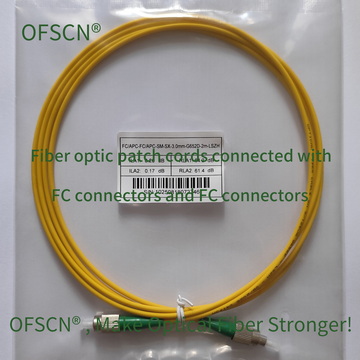
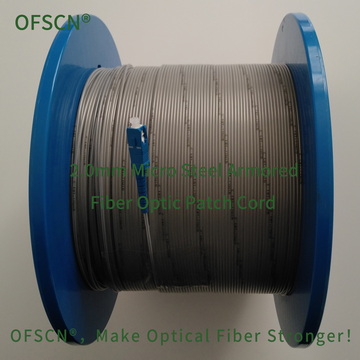
- OFSCN® 2.0mm Micro Steel Armored Fiber Optic Patch Cord: Features a built-in seamless stainless steel tube for protection, offering high resistance to compression, micro-bending, and rodent damage, ideal for harsh warehousing and industrial field environments.
For more specifications and structural options of patch cords, please visit: OFSCN® Fiber Optic Patch Cord Product Categories.