If jumper cables are left unopened in a warehouse for three years, will their performance degrade?
Under compliant general warehousing conditions (normal temperature, dry, dark, no external pressure) and with the original factory packaging unopened, a fiber optic patch cord stored for three years will typically not experience degradation in intrinsic transmission loss in its core quartz glass fiber.
However, during actual warehousing, as patch cords are composite assemblies made of polymer jackets, coatings, ceramic ferrules, epoxy adhesives, and plastic dust caps, performance degradation or abnormal indicators may still occur if warehousing conditions are poorly controlled or if they are subjected to static stress for extended periods. The potential degradation mechanisms are primarily concentrated at the following physical and material levels:
I. Material and Physical Mechanisms Potentially Leading to Performance Degradation After Three Years of Warehousing
-
Outgassing & Oil Migration from Dust Caps
- Common plastic dust caps are often made from injection-molded low-molecular-weight polymers. In a long-term sealed environment, plasticizers, mold release agents, or residual monomers within the dust cap material are prone to outgassing under fluctuating temperature and humidity. These volatiles can condense on the polished end-face (PC/APC) of the ceramic ferrule, forming an invisible oily micro-layer.
- Impact: This phenomenon can cause air gaps or Fresnel reflection mismatches during fiber optic connections, directly leading to increased insertion loss (IL) and significantly worsened return loss (RL). If not cleaned before use, direct insertion after unsealing can cause permanent contamination.
-
Stress Relaxation and Geometric Micro-bending from Long-Term Coiling
- If the patch cord was coiled with too small a radius (smaller than the allowable fiber threshold, e.g., less than 30\text{ mm}) during factory packaging or warehousing, the outer PVC or LSZH polymer jacket may undergo physical creep and stress relaxation under sustained strain, forming a permanent “bend memory.”
- Impact: Uneven stress release in the polymer material can transmit radial micro-compression to the internal fiber, inducing micro-bending loss and causing abnormal increases in optical power attenuation.
-
Hydrolysis/Aging of Polymer Jacket and Coating
- Conventional PVC jackets, flame retardants, and the fiber’s native UV-cured polyacrylate coatings are sensitive to moisture. If the warehouse’s relative humidity remains high for extended periods (> 75\%\ \text{RH}), moisture can gradually penetrate the jacketing, leading to hydrolysis and delamination of the coating or hardening and embrittlement of the jacket.
- Impact: While not directly damaging the fiber core, this weakens the mechanical buffering and protective capability for the core and increases additional lateral stress on the fiber under thermal variations.
-
Fatigue of Connector Epoxy Adhesive and Mechanical Spring
- Inside the patch cord connector, the fiber is secured within the ceramic ferrule bore using epoxy resin. After years of thermal expansion/contraction and slight moisture ingress, inferior adhesives may develop microscopic cracks or minor displacements (Fiber Piston effect), causing the end-face to sink or protrude.
- The metal spring maintaining physical contact at the end-face inside the connector is under constant compression. If the environment contains corrosive gases or high humidity, the spring’s elastic modulus may slightly degrade, reducing the axial pressure at the mating interface.
II. Ideal Warehousing Environment Specifications for Fiber Optic Patch Cords
To ensure long-term storage without performance degradation, standard warehousing should meet the following environmental boundary conditions:
- Ambient Temperature: Recommended to be maintained between 15\ ^\circ\text{C} and 25\ ^\circ\text{C} (extreme allowable storage range is -20\ ^\circ\text{C} to +50\ ^\circ\text{C}).
- Relative Humidity: Recommended to be controlled between 20\%\ \text{RH} and 60\%\ \text{RH}, completely avoiding any condensation.
- Coiling and Stress Control: Maintain natural, loose coiling. The coiling radius must not be less than the minimum allowable working bend radius of the fiber (for standard single-mode fibers, a coiling diameter \ge 80\text{ mm} is recommended). Heavy objects must not be stacked on top, causing compression.
- Physical Sealing and Protection: Keep the original factory sealed bag intact, include an active silica gel desiccant, and keep away from strong UV light, ozone sources, and volatile chemical solvents.
III. Engineering Specifications Before Shipment and Use
Fiber optic patch cords that have been stored unopened for three years must undergo the following testing procedures before being put back into service:
- End-face Microscopic Inspection: Use a 200\times or 400\times fiber microscope to inspect the end-face of the ceramic ferrule.
- Professional Dry/Wet Cleaning: Even if the dust cap is intact, the end-face must be cleaned using a lint-free cleaning pen (or lint-free wipes with high-purity isopropyl alcohol, IPA) to thoroughly remove any potential adhered volatile oil films.
- Optical Loss Re-measurement: Verify the insertion loss of the patch cord using a light source and optical power meter (the insertion loss for a single connection of a standard single-mode patch cord should typically be \le 0.3\text{ dB}).
IV. Related OFSCN® Products and High-Durability Packaging
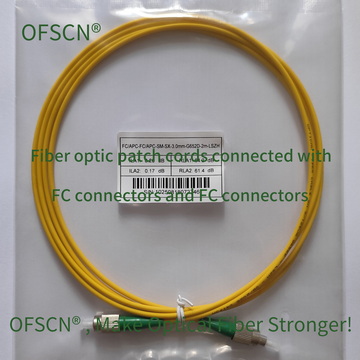
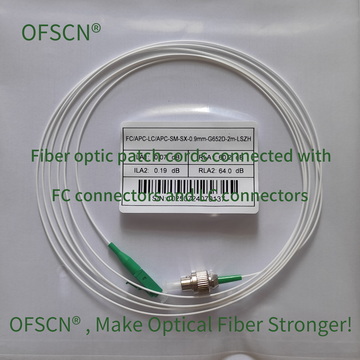
For applications requiring high environmental stability and resistance to mechanical pressure over long periods, Beijing Dacheng Yongsheng Technology Co., Ltd. offers patch cords with standard PVC jackets as well as those with metal seamless armored structures for superior long-term weatherability:
1. Standard Jacket Patch Cords
Suitable for standard data center environments:
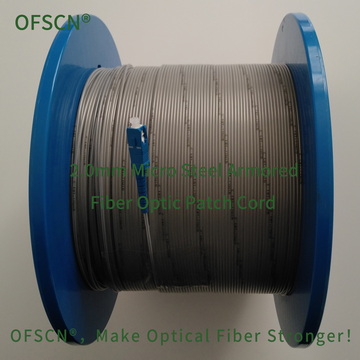
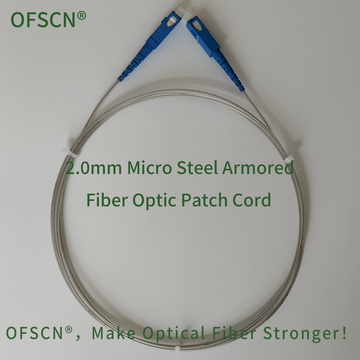
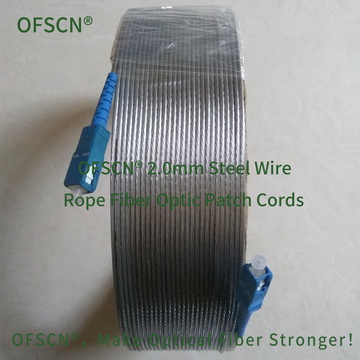
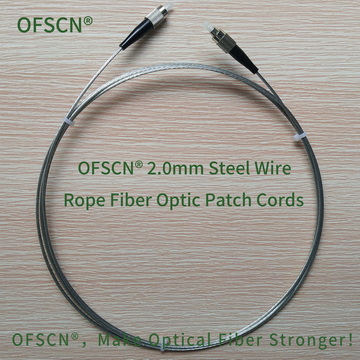
2. Micro-Armored and Steel Wire Rope Fully Metal High-Protection Patch Cords
For environments that are humid, experience wide temperature fluctuations, are prone to crushing, or require long-term maintenance-free operation, the metal protective sheath can completely isolate against polymer aging stress and mechanical damage: