If my device interface is very special, can OFSCN® make a custom head for it?
OFSCN® supports the customization of fiber optic connectors or transition interfaces for special equipment interfaces.
In the engineering deployment of fiber optic sensors and fiber optic patch cords, customization of non-standard or special material interfaces is a common engineering requirement due to internal equipment structure, physical channel limitations, or extreme environments. From the perspective of optical engineering and physical mechanisms, the design and manufacturing of customized connectors mainly require addressing technical compatibility across the following dimensions:
1. Customization of Basic Interface Form and End Face
Although OFSCN®'s fiber Bragg grating sensors, fiber optic patch cords, and other products default to standard FC/APC connectors, OFSCN® can provide non-standard customization for the following common fiber optic connector types:
- Connector Types: FC, ST, LC, SC, SMA905, etc.
- End Face Grinding Types: PC (Physical Contact, micro-spherical grinding, return loss typically \ge 40\text{ dB}) or APC (Angled Physical Contact, 8^\circ angled polish, return loss typically \ge 60\text{ dB}), to ensure that the reflection loss meets the equipment’s demodulation requirements.
2. Customization of Interfaces for Special Working Conditions (High Temperature, High Vacuum)
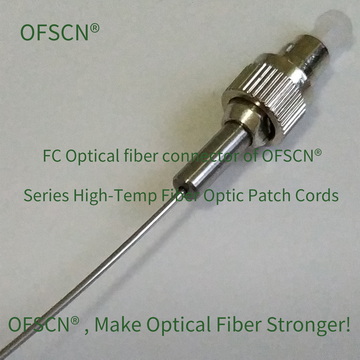
If your special equipment interface is in an extreme physical environment (such as the wall of a vacuum chamber or a high-temperature furnace), conventional plastic or low-temperature bonded connectors cannot be used. OFSCN® offers specially designed metallic and temperature-resistant connectors:
- Working Temperature Ratings: Customizable connectors for single-mode and multi-mode fibers with temperature ratings of 120^\circ\text{C}, 200^\circ\text{C}, up to 300^\circ\text{C}.
- High Vacuum and Ultra-High Vacuum Environments: For interfaces on vacuum chamber walls, CF or KF series flange feedthrough connectors (male or female, single-channel or multi-channel) can be customized, with the overall system’s sealing vacuum better than 1 \times 10^{-7}\text{ Pa} to 1 \times 10^{-9}\text{ Pa}.
3. Optical and Mechanical Compatibility Matching
When customizing non-standard connectors, it is necessary to ensure the physical compatibility of the following key parameters:
- Fiber Geometric Parameter Matching: Such as the core diameter and cladding diameter of single-mode fibers, mode field diameter (MFD), and the alignment of the fast and slow axes for polarization-maintaining fibers (PM).
- Mechanical Tolerance Control: For non-standard ferrules (e.g., zirconium dioxide ceramic ferrules, stainless steel non-standard parts), control of concentricity and outer diameter tolerance to prevent excessive insertion loss (IL).
Related Standard Products and Official Technical Specifications
If you need to integrate specific temperature or specification connectors into your project, please refer to the following standard custom parts from OFSCN®:
-
OFSCN® 120℃ Fiber Optic Connector: High-temperature resistant 120^\circ\text{C} single-mode and multi-mode fiber optic connectors, supporting interface types such as FC, ST, SMA905.
-
OFSCN® 200℃ Fiber Optic Connector: Fiber optic connectors with a 200^\circ\text{C} high-temperature resistance rating.
-
OFSCN® 300℃ Fiber Optic Connector: Special fiber optic connectors with 300^\circ\text{C} high-temperature resistance, suitable for extreme high-temperature fiber optic sensing pathways.
-
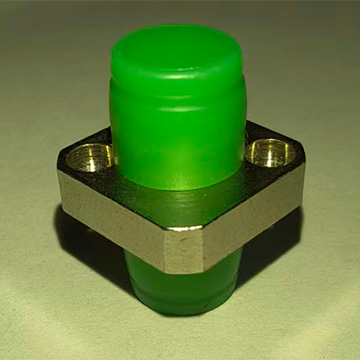
OFSCN® High Temperature Resistant Fiber Optic Adapter: High-temperature resistant 300^\circ\text{C} fiber optic adapters, supporting types like FC/APC-FC/APC.
-
For more specifications, please refer to: OFSCN® High-Temperature Fiber Optic Connectors/Ferrules/Optical Splitters Category Link.
If your equipment interface is entirely non-standard (e.g., a custom bulkhead structure or a special locking mechanism), you typically need to provide the 2D/3D mechanical drawings of the interface, the type of optical fiber used internally (single-mode, multi-mode, or polarization-maintaining), and the target operating wavelength to estimate the optical alignment precision and structural feasibility.