Can I ask for a special ratio like 20/80?
Yes, you can absolutely request special and non-uniform splitting ratios like 20/80. In practical engineering and customized applications, besides common uniform splitting (e.g., 50/50), non-uniform splitting ratios (such as 10/90, 20/80, 5/95, 1/99, 30/70, etc.) can all be customized according to specific design requirements.
This customized proportion has a clear technical background in physical principles, manufacturing processes, and system network design:
1. Technical Implementation Principle: FBT Fused Biconical Taper Process
In the manufacturing of passive optical components, asymmetric (non-uniform) splitting ratios are primarily achieved through FBT Fused Biconical Taper technology:
- FBT Fused Biconical Taper Splitter: Two (or more) optical fibers have their coatings removed and are placed in close proximity. They are then heated and fused at high temperatures while being stretched in opposite directions. During the stretching process, the fiber core becomes thinner, causing the optical signal in one fiber to couple to the other fiber via evanescent waves. By real-time monitoring of the optical power ratio at the two output ports during stretching, the stretching is stopped and the device is solidified and packaged once the target ratio (e.g., 20:80) is reached. This process can achieve precise asymmetric distribution at almost any ratio.
- PLC Planar Lightwave Circuit Splitter: This is typically fabricated on a quartz substrate using semiconductor lithography to create symmetric micron-level branching waveguides (e.g., multiple Y-shaped branches). It is highly suitable for producing multi-way splitters with equal splitting (e.g., 1x4, 1x8, 1x16, 1x32 equal splitting). Achieving asymmetric splitting like 20/80 requires extremely complex mask designs and processes, making it very costly and thus rarely used.
2. Application Value in Fiber Bragg Grating (FBG) Sensing Networks
In Fiber Bragg Grating (FBG) sensor networks, distributed fiber sensing systems, or bus-type network topologies, non-uniform splitting ratios play a crucial role:
- Balancing Link Optical Power: In bus-type or cascaded branching structures, if a 50/50 equal split is used at each stage, the optical signal will attenuate exponentially with increasing stages, resulting in negligible optical power received by sensors at the backend.
- Optimizing Signal-to-Noise Ratio (SNR): By reasonably combining asymmetric splitting ratios on the link (e.g., splitting a smaller proportion at near-end nodes, such as 10/90 or 20/80; splitting a higher proportion at far-end nodes, such as 50/50), the optical intensity of the reflected signals from each FBG sensor returning to the demodulator can be kept roughly consistent. This prevents saturation of the photodetector due to excessively strong reflected signals from near-end sensors while ensuring a sufficiently strong signal from far-end sensors, thereby enhancing the measurement accuracy and stability of the entire system.
Related Products
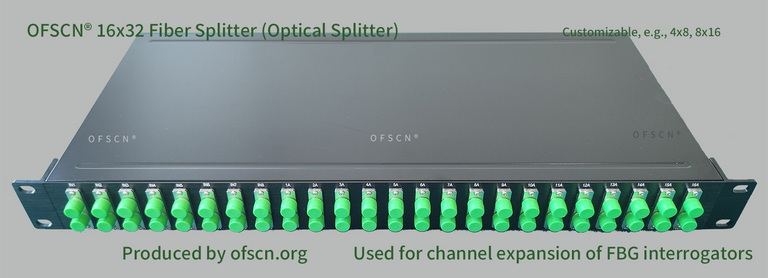
Beijing Dacheng Yongsheng Technology Co., Ltd. offers OFSCN® Optical Fiber Splitter products. In large-scale fiber Bragg grating sensing projects, these splitters are not only used to construct various asymmetric optical network structures but are also routinely supplied with fiber Bragg grating demodulators. By rigorously designing the system’s reflection wavelengths, a single physical channel of the demodulator can be logically expanded into multiple channels, significantly improving channel utilization and reducing the average cost per channel.