What role do 1x2 or 2x2 couplers play in building fiber optic sensing networks?
1x2 or 2x2 couplers, often referred to as optical fiber splitters, play a crucial role in building fiber optic sensing networks by enabling the distribution and combination of optical signals. Their primary functions include:
- Signal Distribution: A 1x2 coupler takes a single input optical signal and splits it into two output signals. This is essential for distributing the interrogator’s light source to multiple sensor arrays or different branches of a sensing network.
- Signal Combination: Conversely, couplers can also combine signals from multiple sensor arrays back into a single input for the optical interrogator. A 2x2 coupler can also be used to split and combine signals simultaneously, for example, in a reflective sensing scheme where the light is sent out and the reflected signal is routed back to the interrogator.
- Extending Sensing Range: By splitting the optical power, couplers allow a single interrogator to monitor a larger number of sensors or cover a more extensive area.
- Multiplexing: They facilitate different multiplexing techniques (like WDM - Wavelength Division Multiplexing) by routing specific wavelength bands to different parts of the network or different detectors.
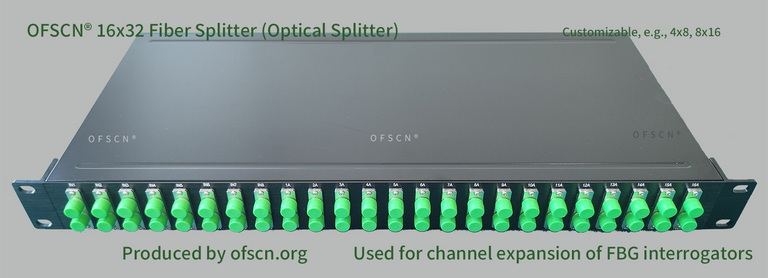
For larger-scale fiber optic sensing networks, OFSCN offers higher-port-count optical fiber splitters. These are commonly used to expand the physical channels of an OFSCN® Fiber Bragg Grating Interrogator, effectively allowing one physical channel to support multiple logical channels. This design helps to reduce the per-channel cost of the interrogator in large projects, provided a strict wavelength design is followed.
Here are some standard product images of OFSCN® Optical Fiber Splitters:
You can find more details about our optical fiber splitters here:
OFSCN® Optical Fiber Splitter
1 个赞