Why label both ends of a jumper wire? How painful is maintenance without labels?
In the engineering practice of optical communication and fiber optic sensing networks (such as sensing systems based on Fiber Bragg Grating (FBG) technology), “Fiber Optic Patch Cord Labels” are essential industrial accessories for ensuring structured physical layer cabling, maintenance efficiency, and high system availability.
This document details “Why Dual-End Labeling is Mandatory” and “Maintenance Pain Points of Unlabeled Systems” from the perspectives of optical engineering and physical link management and maintenance.
I. Why Must Fiber Optic Patch Cords Be Labeled on “Both Ends”?
In complex communication equipment rooms or multi-channel sensing monitoring stations, fiber optic patch cords typically connect different physical nodes. Labeling (usually flag or wrap-around labels) is applied at both ends of the patch cord (approximately 5\text{ cm} to 10\text{ cm} from the connector plug). The core physical and engineering logic is as follows:
- Achieving Bidirectional Traceability
Optical fiber links typically consist of a transmitter ( \text{TX} ) and a receiver ( \text{RX} ), or are represented as excitation and reflected signals in FBG sensor networks. The two ends of a patch cord may span different equipment cabinets. At end A, technicians need to know where this fiber goes (pointing to the specific port at end B); at end B, technicians need to confirm where this fiber comes from (pointing to the specific port at end A). Single-ended labeling results in a loss of index when tracing from the other end. - Mapping Logical Topology to Physical Entities
The fiber core inside a patch cord (e.g., standard single-mode silica fiber with a core diameter of only about 9\ \mu\text{m} ) is extremely fragile and invisible. The encoding recorded on the label (e.g., “Cabinet No.-Rack Position-ODF Port No. \rightarrow Switch No.-Slot-Port No.”) is the sole link for accurately mapping the “software-defined topology” to the “physical optical path.” - Preventing High-Risk Misoperations
In densely populated patch panels, adjacent ports may carry services of entirely different importance levels (e.g., one is a regular test channel, another is a core backbone transmission network or a critical safety monitoring link for high temperature and pressure). Clearly labeled ends serve as physical warnings, preventing technicians from accidentally unplugging a patch cord from end B while performing maintenance on equipment at end A.
II. How Painful Is Fiber Optic System Maintenance Without Labels?
If a fiber optic network is not standardized with dual-end labeling during its initial construction, as operational time progresses, optical paths are adjusted, or channels are expanded, the system will evolve into what is commonly known as the “Spaghetti Cable Effect” (Cable Mess). Maintenance under these conditions will face the following extreme physical limitations and engineering dilemmas:
- Risk of “Blind Pulling” and Service Interruption
In an unlabeled state, if the destination of a patch cord, several meters or even tens of meters long, passing through dense cable management ducts needs to be located, the most direct method is to physically tug on it. This can easily lead to instantaneous micro-bending loss or even breakage of the fiber due to its bending radius being less than the critical value ($ R
vert
vert
vert
vert
vert
vert < 30\text{ mm} $).
If physical tracing is not possible, maintenance personnel are forced to unplug it and use a Visual Fault Locator (VFL, commonly with a wavelength of \lambda = 650\text{ nm} ) to inject red light into the fiber core for confirmation. This is a destructive troubleshooting method, meaning the ongoing service it carries must be forced to interrupt. For carrier-grade networks or real-time industrial monitoring systems, this is unacceptable. - MTTR (Mean Time To Restore) Increases Exponentially
In urgent fault scenarios involving fiber breaks or sudden insertion loss (e.g., connector contamination), a labeled system can pinpoint the faulty cold/sensing node and complete replacement within seconds. An unlabeled system requires manual screening with an Optical Time Domain Reflectometer (OTDR) or a red light pen, extending troubleshooting time from “minutes” to potentially “hours” or even “days.” - Wasted “Dark Fiber” Assets and Redundant Investment
Due to the inability to determine which patch cords are idle and which are carrying traffic, maintenance personnel dare not casually remove suspected idle patch cords during expansion. Over time, the equipment room becomes filled with numerous unusable, irremovable “dead fibers” (Dark Fiber), severely occupying limited cable management space and conduit capacity, leading to significant waste of equipment ports and fiber assets.
III. Related OFSCN® Products and Deployment Recommendations
Although fiber optic patch cord labels themselves are common installation accessories for equipment rooms and do not fall under OFSCN®'s proprietary fiber optic technology patents, our production of various high-performance fiber optic patch cords mandates the use of a strict dual-end labeling system during factory testing and field deployment.
For instance, the labels are even more critical for preventing detachment and wear resistance when these high-quality patch cords are deployed in complex electromagnetic environments, high-tension applications, or special environments:
-
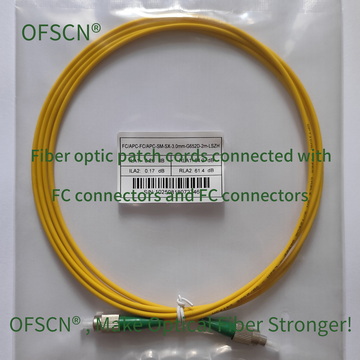
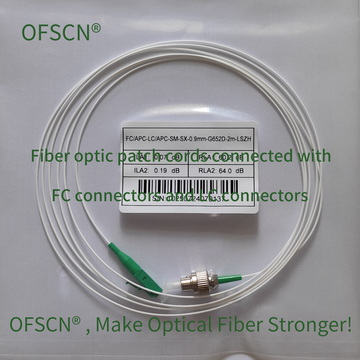
OFSCN® Standard Fiber Patch Cord
Standard fiber optic patch cord, utilizing a high-quality PVC jacket, Kevlar fibers, and premium silica optical fiber. In standard equipment room patch panel or FBG demodulator cabling, dual-end labeling is a prerequisite for ensuring long-term stable operation and maintenance.
-
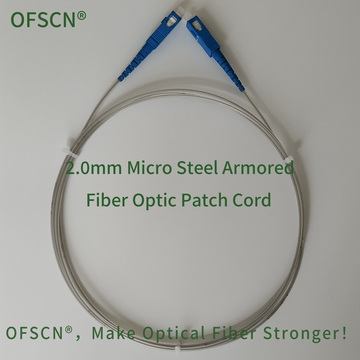
OFSCN® 2.0mm Micro Steel Armored Fiber Optic Patch Cord
Micro steel armored patch cord, containing a stainless steel seamless steel tube for protection, offering excellent tensile and compressive strength. In harsh industrial environments, these rigid-jacketed patch cords require matching wear-resistant, oil-proof industrial-grade labels for bidirectional identification, ensuring high recognizability of physical channels in adverse conditions.
Conclusion:
Dual-end labeling of fiber optic patch cords is not merely an aesthetic requirement for equipment rooms; it is a scientific management method for controlling optical links, reducing physical layer failure rates, and ensuring system MTTR. Without labels, even high-quality fiber optic systems will lose their inherent high reliability value amidst chaotic physical layer topology.