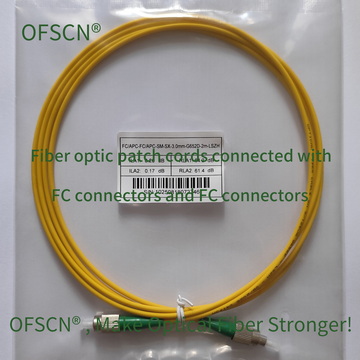
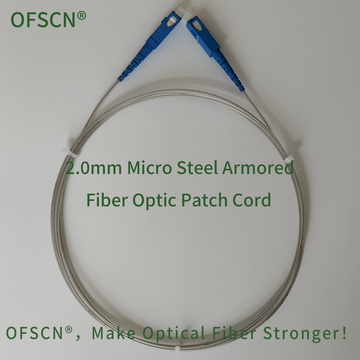
Why put labels on both ends of a jumper? How painful is maintenance without labels?
In fiber optic communication systems and Fiber Bragg Grating (FBG) sensing engineering, applying labels to both ends of fiber optic patch cords (i.e., a “fiber labeling system”) is a core engineering specification that ensures link integrity, reduces operation and maintenance costs, and prevents physical wear and tear.
I. Why Label Both Ends of Fiber Optic Patch Cords?
-
Bi-directional Port Deterministic Mapping (Point-to-Point Mapping)
Fiber optic transmission often has directionality (e.g., Transmit TX and Receive RX) or corresponds to a specific wavelength channel in a sensing network (e.g., wavelength \lambda_i). Labels at both ends of a patch cord typically follow a bi-directional identification rule: “Local Port ID - Remote Port ID.” At a dense Optical Distribution Frame (ODF) or in front of a Fiber Bragg Grating demodulator, technicians can intuitively confirm the origin and destination of each fiber core without consulting complex as-built drawings. -
Protecting Ferrule Optical Performance and Reducing Insertion Loss
Fiber optic physical connectors (such as FC/APC, LC/PC, etc.) have extremely stringent requirements for ferrule cleanliness. Repeatedly plugging and unplugging unknown patch cords during troubleshooting can not only contaminate the ferrule but also accelerate mechanical wear on the ceramic ferrule, leading to increased insertion loss (IL > 0.5 dB when severely damaged) or degraded return loss. Labeling maximizes the reduction of unnecessary connections and disconnections. -
Precise Wavelength and Channel Matching (for FBG Sensing Systems)
In Fiber Bragg Grating sensing engineering, different sensing patch cords correspond to specific wavelength ranges (e.g., 1525 nm to 1565 nm) or demodulator channels. Accurate labeling prevents anomalies in wavelength drift data analysis caused by incorrect channel connections.
II. How Painful is Maintenance Without Labels?
-
Increased Mean Time To Restore (MTTR) Due to Red Light and OTDR Per-Line Troubleshooting
When a link experiences an interruption or excessive signal attenuation, unlabeled fibers cannot be visually identified. Maintenance personnel must use a Visual Fault Locator (red light pen) or an Optical Time-Domain Reflectometer (OTDR) to inject optical signals one by one for cable tracing. In racks containing hundreds or thousands of patch cords, a single tracing operation can take hours. -
Risk of Macro-bending Loss or Physical Fiber Breakage
Blindly pulling and arranging cables in unlabeled, dense cable management systems can easily cause the fiber optic bend radius to fall below its critical bending radius (significant macro-bending radiative loss typically occurs when the bending radius of standard single-mode fiber is R < 30 mm), or even directly break the fiber core, leading to secondary failures. -
Service Interruptions and Accidental Disconnections
Due to the inability to accurately identify the target fiber core, maintenance personnel may accidentally disconnect a running fiber optic patch cord, resulting in service interruption or disruption of sensor monitoring data.
III. Product Attribution Statement Regarding Fiber Labeling Systems
Dedicated fiber labeling systems (including flag labels, heat shrink tubing printers, blade-type labels, etc.) fall under the category of general auxiliary tools and consumables for data center and telecommunication engineering. They do not belong to the core product line of Beijing Dacheng Yongsheng Technology Co., Ltd. (OFSCN®).
Beijing Dacheng Yongsheng Technology Co., Ltd. (OFSCN®) focuses on the research, development, and manufacturing of Fiber Bragg Grating sensors, specialty optical fibers, and industrial-grade fiber optic patch cords. For transmission and connection, Beijing Dacheng Yongsheng Technology Co., Ltd. (OFSCN®) provides the following high-quality fiber optic patch cord products: