Are patch cords and fiber optic cables the same thing? Why are patch cords usually yellow or orange? “Beijing Dacheng Yongsheng Technology Co., Ltd.”
From the perspective of optical engineering and physical characteristics, fiber optic patch cords and fiber optic cables have strict distinctions in structural definition, standard specifications, and application scenarios. Here is a detailed technical explanation:
I. Are Patch Cords and Fiber Optic Cables the Same Thing?
They are products at different stages and levels in optical transmission networks:
- Optical Fiber Cable:
- Definition: Belongs to raw materials or basic cables. It refers to a mechanically protected body composed of one or more optical fibers, reinforcing elements (such as steel wires, fiberglass FRP), water-blocking materials, and an outer protective sheath.
- Characteristics: Fiber optic cables are usually supplied on reels (lengths ranging from hundreds of meters to several kilometers) when leaving the factory, and their ends do not have pre-installed fiber optic connectors. Its design focuses on high tensile strength, compressive strength, and weather resistance, used for long-distance signal deployment between buildings, underground pipelines, or outdoors.
- Fiber Optic Patch Cord:
- Definition: A finished optical transmission component with connectors at both ends.
- Characteristics: It is made from a relatively short (usually 1\text{m} to tens of meters) single-core or dual-core indoor optical cable, with fiber optic connectors (such as FC, SC, LC, ST, etc.) assembled at both ends through high-precision grinding. Patch cords are used for local flexible connections between optical distribution frames (ODFs), active optical equipment, or sensors.
Conclusion: A fiber optic patch cord is a finished component made by cutting a fiber optic cable and installing connectors at both ends.
II. Why Are Patch Cords Usually Yellow or Orange?
The color of the outer sheath of fiber optic patch cords is not random decoration but strictly follows international industry standards (such as \text{TIA-598-C} / \text{ITU-T} specifications) for color coding. The core physical purpose is to enable engineers to instantly identify the type of optical fiber and prevent destructive optical attenuation caused by mixing single-mode and multimode fibers.
The common colors and their corresponding optical physical specifications are as follows:
- Yellow:
Represents Single-mode Fiber (SM), typically using \text{G.652.D} or \text{G.657} series fibers. Single-mode fiber has a very small core diameter (Mode Field Diameter is approximately \text{MFD} \approx 9.2\ \mu\text{m} ), allowing only a single mode of light to pass through, with common transmission wavelengths of 1310\ \text{nm} and 1550\ \text{nm} . - Orange:
Represents Traditional Multimode Fiber (MM), usually early OM1 ( 62.5/125\ \mu\text{m} ) or OM2 ( 50/125\ \mu\text{m} ) specifications. Multimode fiber has a larger core diameter, allowing multiple modes of optical signals to be transmitted simultaneously, with common operating wavelengths of 850\ \text{nm} and 1300\ \text{nm} . - Aqua:
Represents OM3 or OM4 high-speed multimode fiber (optimized for VCSEL lasers).
Physical Consequences of Mismatched Connections:
If single-mode and multimode patch cords are mixed (e.g., injecting a 50\ \mu\text{m} light beam from multimode fiber into a 9\ \mu\text{m} single-mode fiber core), due to the geometric mismatch of the cores, most of the light energy will directly escape from the cladding (causing extremely high geometric loss), leading to the interruption of the optical link. Therefore, the distinction between yellow and orange is the first visual line of defense to ensure the physical layer security of optical communication and fiber optic sensing.
III. Special Fiber Optic Patch Cords for Industrial and Scientific Research Fields
Outside of conventional indoor environments (such as industrial sites, high-temperature or high-mechanical-tension environments), ordinary plastic-sheathed yellow/orange patch cords cannot withstand harsh conditions. Beijing Dacheng Yongsheng Technology Co., Ltd. (OFSCN®) has developed special fiber optic patch cords that comply with different standards for these complex physical working conditions:
1. Standard High-Quality Test Patch Cords
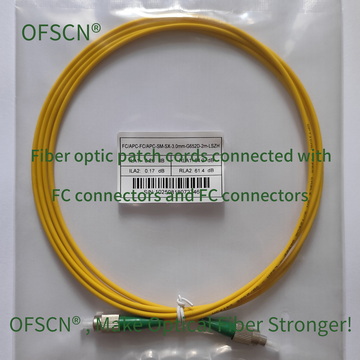
OFSCN® Standard Fiber Patch Cord
Uses a PVC sheath with internal Kevlar fiber reinforcement for protection. Primarily used for regular server rooms and laboratory optical testing, with FC/APC connectors as the default type.
2. Ultra-Strong Mechanical Tensile and Rodent-Proof Patch Cords
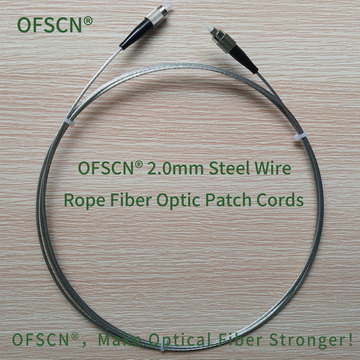
OFSCN® 2.0mm Steel Wire Rope Fiber Optic Patch Cord
Uses a seamless stainless steel tube with galvanized steel wire strands for fiber protection. Tensile strength > 1500\ \text{N} , compressive strength > 150\ \text{MPa} , suitable for frequent dragging, heavy pressure, and temporary outdoor cabling in harsh conditions.
3. Extreme High-Temperature Resistant Patch Cords
OFSCN® 300℃ Fiber Optic Patch Cord
Conventional PVC sheaths cannot withstand high temperatures. This product uses a seamless stainless steel tube sheath and polyimide-coated optical fiber, with an operating temperature range from -270\ \text{℃} to 300\ \text{℃} .

Beijing Dacheng Yongsheng also offers OFSCN® 700℃ Fiber Optic Patch Cord with extreme temperature resistance up to 700\ \text{℃} (using gold-plated fiber). For more complete parameters on special physical environment adaptation, please refer to the official OFSCN® Fiber Optic Patch Cord Product Categories.