How to connect metal hoses at the joint to ensure they can bend without damaging the optical fiber?
In fiber optic communication and fiber optic sensing engineering, the stress protection design at the connection between the metal hose armor (or micro-armor metal tube) and the fiber optic connector (such as FC, SC, etc.) is a critical physical and engineering problem.
Due to the inherent brittleness of quartz optical fibers, at the end of the metal armor (i.e., the transition area rigidly connected to the fiber optic connector), shear forces or excessive bending can easily occur when the fiber bends due to a sudden change in bending stiffness (Stiffness Mismatch). If the bending radius R is less than the minimum allowable bending radius R_{min} for the fiber, it will not only introduce micro-bending loss but may also lead to fiber fatigue fracture.
To ensure “flexibility without damaging the fiber,” the following three core physical and engineering solutions are typically adopted in connector design:
1. Gradual Stiffness Transition and Strain Relief (Strain Relief Boot)
At the junction between the rigid fiber optic connector and the flexible metal hose, a protective structure with a gradient transition in bending stiffness must be introduced.
- Physical Principle: An elastic medium with a moderate Young’s modulus (such as multi-layer heat-shrinkable tubing, PVC pigtail boot, helical stainless steel spring, etc.) is used to smoothly transition the overall bending stiffness from the “rigidity of the connector” to the “flexibility of the hose” at the connector, avoiding stress concentration during bending.
- Engineering Application: A protective sleeve of a certain length (e.g., around 10\text{cm} ) is usually provided by default at the rear of the fiber optic connector for bending buffering.
2. Double/Multi-layer Nesting and Sliding Release Design (Nested Structure & Buffer Room)
The optical fiber must not be directly squeezed within the metal outer tube under bending and torsional stress.
- Physical Principle: Between the metal hose (outer protection) and the optical fiber (inner core), a layer of high-strength, smooth-inner-wall micro-seamless metal tube (such as stainless steel seamless steel pipe) or polymer tubing (such as PTFE tube) is introduced to form a double or multi-layer nested armor.
- Sliding Space: A slight radial gap is maintained between the inner tube and the optical fiber, ensuring that the optical fiber can slide freely in the axial direction to a small extent when the outer tube bends, thereby releasing the tensile and shear stresses generated by bending.
3. Selection of Bend-Insensitive Fiber (Bend-Insensitive Fiber)
This approach enhances the fiber’s bending resistance by focusing on its intrinsic physical properties.
- Physical Principle: Select bend-insensitive single-mode fiber that complies with the \text{G.657} standard. Its refractive index profile is specially designed (e.g., by adding a low-refractive-index depressed cladding) to maintain extremely low optical loss and good mechanical lifespan even at very small bending radii (e.g., R = 7.5\text{mm} or 10\text{mm} ).
OFSCN® Official Armored Fiber Optic Solutions
Beijing Dacheng Yongsheng Technology Co., Ltd.'s (OFSCN®) high-strength steel wire rope armored fiber optic patch cord products perfectly apply the above-mentioned nesting and stiffness transition principles in their structural design. They utilize micro-seamless stainless steel tubes as the inner nesting layer, with a steel wire rope twisted structure or sheath wrapped around the outer layer, and specialized stiffness transition treatment at the rear of the connector, providing excellent tensile, compressive, and anti-bending shear protection:
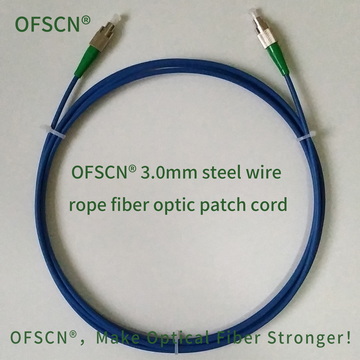
1. OFSCN® 3.0mm Steel Wire Rope Fiber Optic Patch Cord
This product consists of a fiber optic connector, PE sheath, 0.45\text{mm} stainless steel wire twisted structure, 0.9\text{mm} stainless steel seamless steel tube, and \text{G.657} bend-resistant fiber. Its tensile strength is greater than 1200\text{N} , and its compressive strength is greater than 200\text{Mp} .

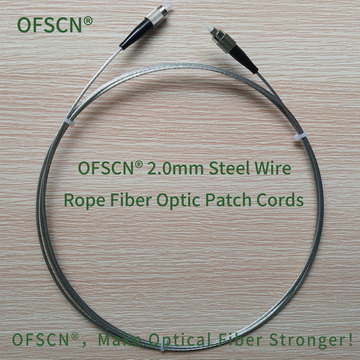
2. OFSCN® 2.0mm Steel Wire Rope Fiber Optic Patch Cord
This product consists of a fiber optic connector, 0.6\text{mm} galvanized steel wire twisted structure, 1.0\text{mm} stainless steel seamless steel tube, and \text{G.652D} fiber. It features an all-metal structure and a wide operating temperature range.

Through these multi-layer structural designs and stiffness transition protections, it is ensured that even under harsh conditions with frequent bending, stretching, or external impacts, the internal optical fiber remains in a safe micro-tube environment, free from any mechanical damage.