What is the essential difference in principle between it and a single-mode splitter?
The essential differences between multimode splitters and single-mode splitters lie in their physical principles and waveguide optics. These distinctions not only dictate their design and manufacturing complexity but also directly influence their performance in various optical systems.
Here is a comparison of the core technologies and principles of the two:
1. Fundamental Differences in the Number of Transmitted Spatial Modes
- Single-mode Splitter: Its working fiber (such as standard G.652D or G.657 single-mode fiber) has a very small core diameter, typically around 9 \ \mu\text{m}. At the working wavelength, only a single fundamental mode (LP_{01} mode) is allowed to propagate in the fiber.
- Multimode Splitter: Its working fiber (such as multimode fiber with a core diameter of 50\ \mu\text{m} or 62.5\ \mu\text{m}) supports the simultaneous transmission of hundreds or thousands of higher-order spatial transverse modes (LP_{lm} modes).
2. Differences in Optical Power Coupling and Distribution Mechanisms
- Evanescent Wave Coupling in Single-mode Splitters:
The core physical mechanism of single-mode splitters, whether Fusion Biconical Taper (FBT) or Planar Lightwave Circuit (PLC), is singular and well-defined. When the core regions of two single-mode fibers are brought close together, the evanescent field of the fundamental mode (LP_{01}) overlaps. Optical energy can then undergo stable electromagnetic field coupling between the two waveguides. Since there is only one mode, this energy exchange is completely controllable, highly uniform, and extremely stable at specific wavelengths and taper lengths, unaffected by slight perturbations from external physical conditions. - Dependence on Modal Power Distribution in Multimode Splitters:
Optical energy in multimode fiber is distributed across hundreds or thousands of different spatial modes. When fusion tapering or waveguide coupling is performed, different order modes have different evanescent field penetration depths. Higher-order modes tend to leak out more easily and couple earlier, while lower-order modes tend to remain within their original core.
This means that maintaining an absolutely uniform splitting ratio in multimode splitters is extremely difficult. Simple tapering would result in inconsistent modal power spectra distributed to each output channel, leading to high Modal-dependent Loss (MDL). To address this, multimode splitters typically require the incorporation of special ‘mode scrambling’ or ‘geometric light mixing’ structures during manufacturing to ensure thorough mixing of all spatial modes before splitting.
3. Sensitivity to Injection Conditions and Environmental Perturbations
- Single-mode Splitters: Insensitive to the injection state of the light source. Whether it’s a semiconductor laser, a superluminescent light-emitting diode (SLED), or a fiber laser, as long as the wavelength falls within the operating window, the splitting ratio remains constant, and losses due to environmental bending are consistently broadband.
- Multimode Splitters: Extremely sensitive to light source injection conditions (Launch Condition). If the light source uses an Overfilled Launch (OFL) mode, energy will fill higher-order modes; if it uses center single-mode injection, energy will concentrate in lower-order modes. A change in injection conditions will lead to significant deviations in the final splitting ratio at each branch. Furthermore, any slight bending or vibration of the fiber will induce strong Mode Coupling, causing severe Modal Noise at the output.
OFSCN® Related Products and Applications
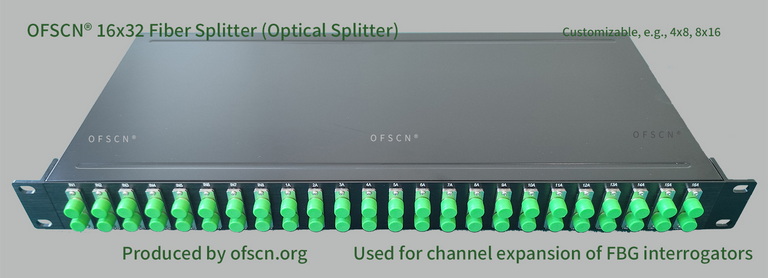
In Beijing Dacheng Yongsheng Technology Co., Ltd.'s (OFSCN®) fiber optic sensing systems, splitters are widely used in large-scale projects, particularly to complement single-mode Fiber Bragg Grating (FBG) interrogator systems.
Product Name: OFSCN® Optical Fiber Splitter | Official Link
Key Parameters
- Standard Configurations: Including 16x32 splitters, 8x16 splitters, 4x8 splitters, and 32x64 splitters.
- Core Applications: Used in conjunction with OFSCN® FBG interrogators in large-scale fiber optic sensing projects. By designing each sensor with a strict wavelength, one physical channel of the interrogator is logically expanded into two or three, significantly reducing the average cost per channel in multi-channel systems.
- Customization Capability: Supports standard temperature and high-temperature custom products with maximum operating temperatures up to 250^{\circ}\text{C}.