Why does OFSCN® recommend using a complex binomial instead of a simple linear formula?
In Fiber Bragg Grating (FBG) sensing technology, the choice between using a binomial fit formula (quadratic polynomial) versus a simple linear formula (linear polynomial) depends on the temperature span, required measurement accuracy, and the thermo-optic physical properties of the material.
I. Physical Mechanism: The Root Cause of Non-Linearity
The Bragg condition for the central reflection wavelength \lambda_B of an FBG is:
\lambda_B = 2 n_{\text{eff}} \Lambda
When the ambient temperature T changes, the wavelength shift is influenced by two core physical parameters:
- Thermo-Optic Effect: The change in the effective refractive index of the fiber core with temperature, \frac{dn_{\text{eff}}}{dT}.
- Thermal Expansion Effect: The coefficient of thermal expansion of the fiber and packaging material, \alpha = \frac{1}{\Lambda}\frac{d\Lambda}{dT}.
Within a normal temperature range and small temperature variations (e.g., room temperature to 100\ ^\circ\text{C} ), the thermo-optic coefficient of silica materials and the thermal expansion coefficients of metallic packaging materials can be approximated as constants, resulting in a good linear relationship between temperature and wavelength shift.
However, in wide temperature ranges or high-temperature environments (e.g., exceeding 300\ ^\circ\text{C}, 500\ ^\circ\text{C}, or even 800\ ^\circ\text{C}, or in cryogenic regions):
- The thermo-optic coefficient of silica glass, \xi(T), itself increases significantly with rising temperature (it’s not a constant).
- The thermal expansion coefficient, \alpha(T), of metal protective tubes (such as seamless steel pipes or alloy tubes) also varies non-linearly with temperature.
- The temperature sensitivity of the FBG (\frac{d\lambda}{dT}) gradually increases with rising temperature (the sensitivity curve bends upwards).
If a simple linear formula is still used for fitting under these conditions, it will lead to significant systematic errors (often several degrees Celsius or more) in the fitted curve at the ends and in the middle. Introducing a quadratic term allows for precise compensation of the second-order non-linear effects caused by the temperature-dependent thermo-optic and thermal expansion coefficients.
II. Forms of Calibration Formulas
In demodulator and data processing systems, the relationship between temperature and wavelength change \Delta \lambda (in pm) is typically expressed in the following forms:
-
Linear Formula (First-order polynomial):
T = K_1 \cdot \Delta \lambda + T_0(The calibration coefficient unit is typically ^\circ\text{C}/\text{pm})
-
Binomial Fit Formula (Quadratic polynomial):
T = A \cdot (\Delta \lambda)^2 + B \cdot (\Delta \lambda) + CWhere A is the quadratic term coefficient, B is the linear term coefficient, and C is the constant offset term.
The binomial fit not only covers the non-linear response in wide temperature ranges but also significantly improves the data fitting goodness ( R^2 \ge 0.9999 ) across the entire temperature spectrum.
III. Engineering Calibration Practices for OFSCN® Sensors
Beijing Dacheng Yongsheng Technology Co., Ltd. (OFSCN®) implements targeted factory calibration strategies based on the designed temperature measurement ranges of different sensors:
- Narrow/Standard Temperature Sensors (\le 100\ ^\circ\text{C}):
- By default, first-order calibration (linear formula) is employed to simplify the demodulator’s algorithm overhead.
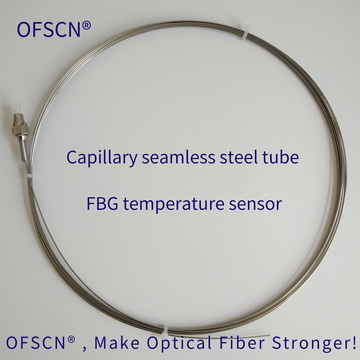
- Related Product: OFSCN® 100°C Fiber Bragg Grating Temperature Sensor

- Medium to High/Ultra-High Temperature Sensors (300\ ^\circ\text{C}, 500\ ^\circ\text{C}, 800\ ^\circ\text{C}):
- By default, binomial fit calibration (binomial units are ^\circ\text{C}/\text{pm} ) is used to eliminate measurement errors caused by non-linearities in thermo-optic and thermal expansion coefficients at high temperatures.
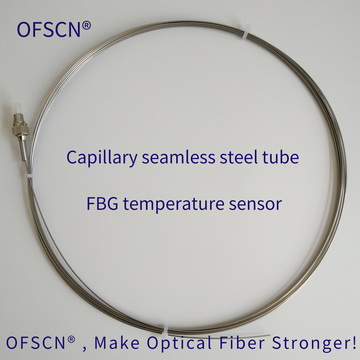
- Related Products:
For a link to more models and temperature products, please refer to: OFSCN® FBG Temperature Sensor Products Aggregation Link.