Why does OFSCN® suggest using complex formulas instead of simple addition, subtraction, multiplication, and division?
In the calibration and application of Fiber Bragg Grating (FBG) sensors at Dacheng Yongsheng (OFSCN®), the recommendation to use complex formulas like “binomial fitting” or higher-order polynomials, rather than simple arithmetic operations (i.e., linear relationships), is determined by the inherent physical characteristics of the FBG itself and the stringent accuracy requirements under extreme environmental conditions.
Below is a detailed scientific explanation from the perspectives of optical engineering and solid-state physics:
I. The Nonlinear Nature of Physical Mechanisms
The reflected Bragg wavelength \lambda_B of a Fiber Bragg Grating (FBG) is determined by the following formula:
\lambda_B = 2 n_{eff} \Lambda
Where n_{eff} is the effective refractive index of the fiber core, and \Lambda is the grating period.
When the temperature T changes, differentiating the above equation yields:
\frac{\Delta\lambda_B}{\lambda_B} = ( \alpha + \xi ) \Delta T
- \alpha = \frac{1}{\Lambda} \frac{\partial \Lambda}{\partial T} is the Thermal Expansion Coefficient of the fiber material.
- \xi = \frac{1}{n_{eff}} \frac{\partial n_{eff}}{\partial T} is the Thermo-optic Coefficient of the fiber material.
Why Simple Proportional Calculations (Linear) Are Insufficient?
Over very narrow temperature ranges (e.g., changes of only a few or a dozen degrees Celsius), \alpha and \xi can be approximated as constants, and the wavelength shift exhibits an approximate linear relationship with temperature.
However, over a wide temperature range:
- Nonlinearity of the Thermo-optic Coefficient: The thermo-optic coefficient \xi for silica fiber is not a constant. As temperature increases, the thermo-optic effect in silica becomes more pronounced, causing the slope (sensitivity) of wavelength change with temperature to gradually increase.
- Nonlinearity of Substrate and Packaging Materials: To protect the fiber, FBG sensors are typically equipped with metal (e.g., stainless steel, alloys, etc.) packaging. The thermal expansion coefficients of these packaging materials also exhibit significant nonlinear characteristics over wide temperature ranges (e.g., from -200^\circ\text{C} to 300^\circ\text{C} or higher).
If a simple linear formula (i.e., containing only the first-order term T = k \cdot \Delta\lambda + b ) or simple proportional calculations are forcibly used, these nonlinear terms will be ignored, leading to substantial measurement errors at the extremes of the measurement range (low and high temperature zones), often reaching several or even tens of degrees Celsius.
II. What is “Binomial Fitting”?
To compensate for the aforementioned nonlinear responses caused by physical and material properties, OFSCN® employs binomial fitting (i.e., quadratic polynomial fitting, Quadratic Polynomial Fitting):
T = A \cdot \lambda^2 + B \cdot \lambda + C
Or fitting based on the wavelength shift \Delta\lambda :
T = A \cdot (\Delta\lambda)^2 + B \cdot \Delta\lambda + C
- A is the quadratic coefficient, responsible for correcting the nonlinear curvature resulting from the temperature variations of the thermo-optic and thermal expansion coefficients.
- B is the linear coefficient, determining the linear sensitivity of the sensor around the reference point.
- C is the constant term (offset).
By performing multi-point temperature calibration of the sensor during factory production and utilizing the least squares method for binomial fitting, the actual “temperature-wavelength” curve can be perfectly approximated, ensuring measurement accuracy across the entire temperature range.
III. Application Standards in OFSCN® Products
Within Dacheng Yongsheng’s core product lines, different types of sensors utilize distinct calibration formulas based on their physical characteristics:
1. Temperature Sensor Series: Default to Binomial Fitting
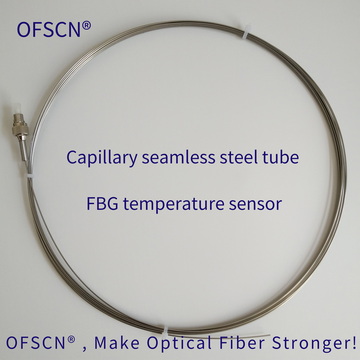
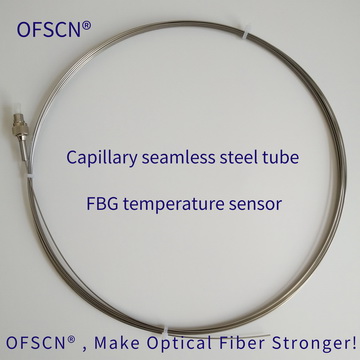
For Dacheng Yongsheng’s high-temperature and full-temperature range sensors, due to the extremely wide temperature differences (spanning hundreds of degrees Celsius), the relationship between temperature and wavelength exhibits strong nonlinearity. Therefore, factory temperature calibration defaults to the binomial formula, with units of ^\circ\text{C}/\text{pm} .
-
OFSCN® 300°C Fiber Bragg Grating Temperature Sensor: Operating temperature range -200^\circ\text{C} to 300^\circ\text{C} , default calibration is binomial.
-
OFSCN® 500°C Fiber Bragg Grating Temperature Sensor: Operating temperature range -200^\circ\text{C} to 500^\circ\text{C} , default calibration is binomial.
-
OFSCN® 800°C Fiber Bragg Grating Temperature Sensor: Operating temperature range -270^\circ\text{C} to 800^\circ\text{C} , default calibration is binomial.

2. Stress/Strain Sensor Series: Employing First-Order (Linear Fitting)
Unlike temperature sensors, strain sensors typically exhibit a highly linear correlation between wavelength shift and strain within the elastic deformation limits of the material.
- OFSCN® Fiber Bragg Grating Stress Sensor: Factory calibration is performed for strain versus wavelength, using a first-order formula (i.e., linear formula, T = k \cdot \Delta\lambda + b ), with units of \mu\epsilon/\text{pm} . After inputting the calibration coefficients into the demodulator, users can calculate the accurate stress of the measured object by combining it with the material’s elastic modulus.


Conclusion
Dacheng Yongsheng (OFSCN®) recommends using a “complex binomial formula” for temperature measurements to eliminate the thermo-optic and thermal expansion nonlinear responses of silica materials and packaging structures over wide temperature ranges. Only by inputting the calibration parameters, including the quadratic coefficient A , the linear coefficient B , and the constant term C , into the Fiber Bragg Grating Interrogator can truly scientific and precise physical quantity data be obtained across the entire measurement range.