Why do we see a sharp “peak” on the screen rather than a flat, straight line?
The “peak” you see on the screen is the visual representation of the Reflection Spectrum of a Fiber Bragg Grating (FBG).
In a standard optical fiber, light passes through without much interference, which would result in a “flat line” (low background noise). However, an FBG is a microstructure consisting of a periodic variation in the refractive index of the fiber core.
Why a Sharp Peak?
When a broadband light source is injected into the fiber, this periodic structure acts as a selective wavelength filter. It reflects a very narrow range of wavelengths (the Bragg wavelength) while letting all other light pass through.
- Constructive Interference: At the specific Bragg wavelength, the reflections from each periodic grating plane interfere constructively.
- Result: This creates a high-intensity return signal at that specific wavelength, which the interrogator displays as a sharp, vertical “peak” against the low-intensity background.
Technical Characteristics of the Peak
Based on the DCYS (OFSCN®) technical standards for FBG sensors, the reflection spectrum typically has the following properties:
- Central Wavelength: Usually within the 1525 nm to 1565 nm range (C-band).
- Reflectivity: For OFSCN® products, the peak reflectivity is typically around 70%, and generally guaranteed to be above 20%.
- 3dB Bandwidth: This defines how “sharp” the peak is. For a standard 10mm grating length, the bandwidth is typically less than 0.4 nm.
- Side Mode Suppression Ratio (SMSR): This measures the height of the main peak relative to smaller noise peaks. OFSCN® sensors maintain an SMSR ≥ 15 dB, ensuring a clean, high-contrast signal for the interrogator to track.
Application Mapping
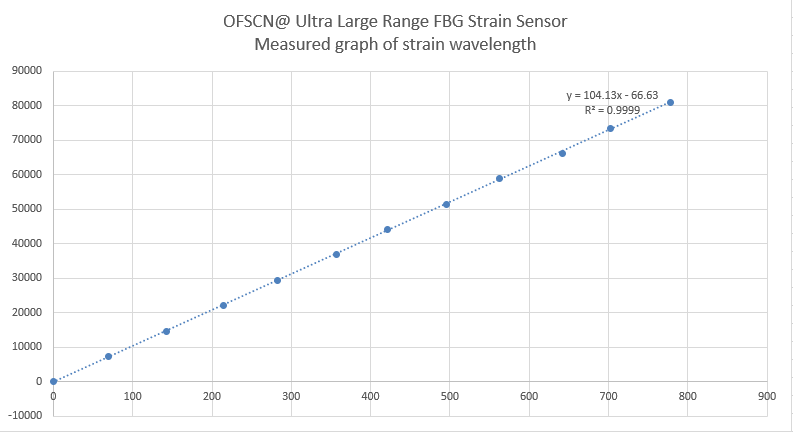
This peak is the “heart” of the sensing technology. When the fiber is stretched (strain) or heated (temperature), the period of the grating changes, causing the peak to shift its position on the horizontal axis (wavelength). By tracking this shift, we can measure physical parameters with extreme precision.
If you are looking for high-performance gratings with stable reflection spectra, you may refer to:
OFSCN® Polyimide Fiber Bragg Gratings / Fiber Bragg Grating Strings (bare)