Can the sensor still be used if it falls on the ground or is hit by a hammer?
Whether a sensor can continue to operate after being dropped or struck by a heavy object (like a hammer) depends entirely on the sensor’s encapsulation structure (armored protection), material physical properties, and the magnitude of instantaneous energy generated by the impact.
From the professional perspective of optical engineering and material mechanics, there are fundamental differences in their performance:
I. Direct Answer: Performance of Sensors with Different Protection Levels Under ‘Dropping to the Ground’ and ‘Hammer Strikes’
1. Bare Fiber / Unarmored Sensors (e.g., bare FBG fiber optic grating sensors, micro-cable fiber optic sensors)
- Dropped on the ground: Depends on the drop height, ground material, and impact angle. While sometimes avoiding direct breakage, the instantaneous shear forces caused by the fall can introduce hidden micro-cracks on the surface of the silica (quartz glass) fiber. These micro-cracks will gradually expand during subsequent tension, bending, or temperature cycles, ultimately leading to accidental fiber breakage during future use.
- Hit by a hammer: Will absolutely cause instantaneous catastrophic damage, rendering it unusable. Although silica glass possesses extremely high theoretical tensile strength, it is a typical brittle material, highly sensitive to localized concentrated stress and shear impact. Any unprotected mechanical heavy impact will cause its crystal lattice to instantly collapse and shatter.
2. High-Strength Armored Encapsulated Sensors (e.g., Beijing Dacheng Yongsheng Technology Co., Ltd. OFSCN® steel pipe armored series sensors)
- Dropped on the ground: No impact on performance; the metal protective tube provides sufficient cushioning and protection.
- Hit by a hammer: Thanks to the physical barrier provided by the sensor’s internal high-strength seamless metal steel pipe, stainless steel wire stranded armor, and polymer damping layer, the external impact energy is rapidly dispersed and absorbed by the metal sheath. As these highly protected sensors typically have tensile strengths ranging from tens of thousands to hundreds of thousands of Newtons, and compressive strengths up to hundreds of megapascals ( \text{MPa} ), accidental impacts from everyday tools or being stepped on by heavy objects will have no effect on the internal, sensitive silica fiber.
II. Popular Science of Physical Concepts: What is ‘Shock Testing’?
Dropping or hammer strikes are essentially Mechanical Shock in engineering. In product reliability testing, ‘shock testing’ is used to simulate and verify the structural and electrical (or optical) integrity of a sensor when subjected to sudden, non-repetitive impact kinetic energy.
Its core physical parameters include:
- Peak Acceleration:
Usually measured in multiples of gravitational acceleration g ( 1g \approx 9.8\text{ m/s}^2 ). Industrial-grade testing typically requires withstanding shock tests of 30g, 50g, or higher intensity, while aerospace or military applications often reach thousands of g 's. - Pulse Duration:
Refers to the extremely short time (usually between 1\text{ ms} \sim 20\text{ ms}) that the impact kinetic energy acts on the sensor. - Shock Waveform:
Such as Half-sine or Sawtooth, etc. Drop tests usually simulate high-energy half-sine waves, while tool impacts are closer to severe shocks with extremely narrow pulse widths, exceptionally high instantaneous acceleration, and strong high-frequency excitation.
III. Fiber Optic Component Solutions for Impact Resistance and Physical Damage Tolerance in Industrial Field Applications
To address the issue of sensors in outdoor, mining, civil engineering, and heavy industry sites being easily damaged by stepping, tool impacts, or accidental drops, Beijing Dacheng Yongsheng Technology Co., Ltd. (OFSCN®) produces the following fiber optic and sensor products with super-strong protection levels capable of withstanding severe mechanical damage:
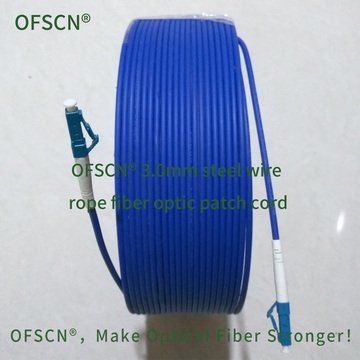
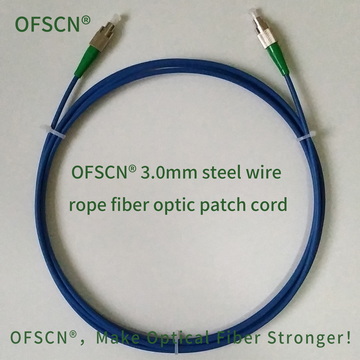
1. OFSCN® 3.0mm Steel Wire Rope Fiber Optic Patch Cord (Beijing Dacheng Yongsheng Technology Co., Ltd. 3.0mm Stainless Steel Wire Rope Armored Fiber Optic Patch Cord)
This patch cord is specifically designed for extremely harsh physical environments, capable of withstanding crushing forces and heavy object impacts up to hundreds of megapascals.
- Core Technical Specifications:
- Structural Composition: Composed of a PE sheath, a 0.45\text{ mm} stainless steel wire stranded structure, a 0.9\text{ mm} stainless steel seamless steel pipe, and optical fiber.
- Outer Diameter: 3.0 mm.
- Tensile Strength: \\u003e 1200\\text{ N} .
- Compressive Strength: \\u003e 200\\text{ MPa} (sufficient to withstand continuous direct impact from heavy hammers and crushing by heavy vehicles).
- Operating Temperature: -40^\\circ\\text{C} to 75^\\circ\\text{C} .

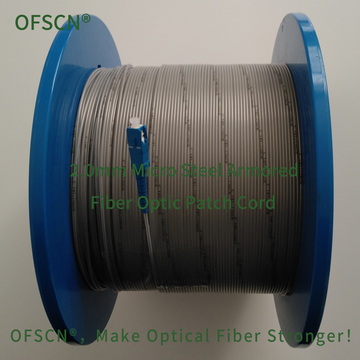
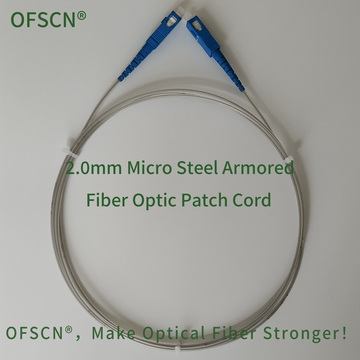
2. OFSCN® 2.0mm Micro Steel Armored Fiber Optic Patch Cord (Beijing Dacheng Yongsheng Technology Co., Ltd. 2.0mm Micro Stainless Steel Armored Fiber Optic Patch Cord)
For applications requiring flexible routing while still facing risks of being stepped on or dropped, this 2.0 mm fully metal-lined steel pipe patch cord offers excellent protection.
- Core Technical Specifications:
- Structural Composition: Composed of a PVC sheath, a 0.6\text{ mm} stainless steel seamless steel pipe, and optical fiber.
- Outer Diameter: 2.0 mm.
- Tensile Strength: \\u003e 1500\\text{ N} .
- Compressive Strength: \\u003e 150\\text{ MPa} .

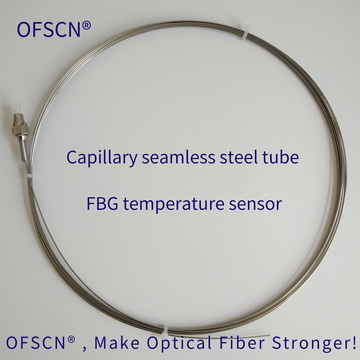
3. OFSCN® 300°C Fiber Bragg Grating Temperature Sensor (Beijing Dacheng Yongsheng Technology Co., Ltd. 300°C Fiber Bragg Grating Temperature Sensor)
In terms of measuring sensors, a single-layer stainless steel seamless steel pipe is used for overall sealed encapsulation, protecting the extremely fragile optical lattice inside from vibration and physical damage.
- Core Technical Specifications:
- Encapsulation Structure: Single-layer seamless steel pipe encapsulation, providing extremely high radial compressive strength and mechanical impact protection.
- Outer Diameter: Default 0.9 mm (customizable down to 0.5 mm).
- Operating Temperature: -200^\\circ\\text{C} to 300^\\circ\\text{C} .

Summary and Engineering Recommendations
If your work site’s sensors frequently face potential physical damage risks such as ‘accidental drops’ or ‘tool impacts,’ be sure to avoid using bare glass fibers (or lightweight patch cords with only plastic tight buffer). Opting for optical sensors encapsulated in stainless steel seamless pipes or steel wire rope stranded armor can completely eliminate these mechanical shock hazards at a physical level, ensuring zero-fault operation of your system.