Will the connector loosen after repeated cycling between -40℃ and +85℃?
In fiber optic sensing and communication engineering, -40°C to +85°C is the classic environmental reliability assessment temperature range for telecom-grade and industrial-grade devices (corresponding to industrial standards such as Telcordia GR-326-CORE, IEC 61300-2-22, etc.).
Regarding the question, “Will the connector loosen when repeatedly cycled between -40°C and +85°C?”, an engineering physics analysis is required from two perspectives: macro mechanical locking and micro optical structure stability:
I. Macro Mechanical Mating Level: Will the housing and flange disengage?
- Threaded Connection Type (e.g., FC Connector):
FC (Ferrule Connector) uses a metal threaded fastener combined with an internal spring pre-tensioning structure. In a purely static temperature cycling environment, since both the screw sleeve and the flange adapter are made of metal, and the internal pre-tensioning spring has a certain axial strain compensation amount, an FC connector properly tightened to the standard torque is highly unlikely to experience self-loosening of the threads due to thermal expansion and contraction. - Push-Pull/Latch Type (e.g., SC, LC, ST):
SC and LC primarily rely on plastic latches for locking, while ST relies on a bayonet lug. At low temperatures of -40°C, the toughness of plastic decreases and its brittleness increases. At high temperatures of +85°C, plastic undergoes thermal expansion and creep. Repeated cold and hot cycles can lead to stress relaxation in the latches, making their locking reliability slightly lower than that of FC connectors with metal threaded structures.
II. Micro Optical Structure Level: More Critical “Internal Mismatch and Looseness”
During cold and hot cycling tests, the most common failure mode for connectors is not the housing falling off, but rather the deterioration of optical performance caused by the thermal expansion coefficient (CTE) mismatch between the various materials inside the connector. Common physical mechanisms include:
-
Fiber Piston Effect:
- The thermal expansion coefficient of quartz fiber is extremely low (\alpha_{\text{fiber}} \approx 0.5 \times 10^{-6}\ /\ \text{K});
- The expansion coefficient of the Zirconia (\text{ZrO}_2) ceramic ferrule is higher (\alpha_{\text{ferrule}} \approx 10 \times 10^{-6}\ /\ \text{K});
- The thermal expansion coefficient of the cured epoxy resin adhesive is typically as high as (\alpha_{\text{epoxy}} \approx 30 \sim 60 \times 10^{-6}\ /\ \text{K}).
During the repeated thermal shocks and cycles from -40°C to +85°C, the significant expansion and contraction of the adhesive layer and ceramic ferrule exert cyclical shear stress on the fiber. If the curing process is poor or the adhesive’s temperature limit is insufficient, the fiber may undergo relative slippage (micro-scale retraction or protrusion) at the end face of the ceramic ferrule, leading to the failure of physical contact (PC/APC) at the end face, resulting in a sudden increase in insertion loss or severe degradation of return loss.
-
Aging, Delamination, and Glass Transition of Epoxy Adhesive:
The glass transition temperature (T_g) of standard room-temperature curing adhesives used in commercial fiber optic connectors is typically around 60°C to 80°C. When the temperature rises to +85°C, the adhesive enters the highly elastic softened region; when it drops to -40°C, it becomes brittle. Repeated cycling can easily cause micro-cracks or debonding at the interface between the adhesive and the quartz fiber, leading to internal physical “looseness”. -
Attenuation of Internal Spring Pre-tension Force:
The spring at the rear of the ferrule is responsible for providing the physical contact pressure (typically around 5 \sim 10\ \text{N}) when the connector is mated. Under sustained wide-temperature cycling stress, if the spring material has not undergone stress relief annealing or temperature resistance assessment, its stiffness may decrease, leading to insufficient end-face contact pressure and separation.
III. Engineering Solutions and Temperature-Resistant Connector Selection
For sensor and fiber optic cable engineering deliveries, Beijing Dacheng Yongsheng Technology Co., Ltd. (OFSCN®) uses a standard operating temperature limit of 65°C for its conventional single-mode/multi-mode connectors. If repeated cold and hot cycling tests or long-term operation are required in the temperature range of -40°C to +85°C or even higher, it is recommended to use specialized high-temperature/wide-temperature structural components. These components effectively suppress piston slippage and stress attenuation under high and low-temperature cycling by employing special high-temperature adhesives with high T_g points, optimized ceramic/metal expansion transition structures, and high-temperature springs.
Related temperature-resistant connectors and adapters:
- OFSCN® 120℃ Fiber Optic Connector (Temperature range covers -40°C to 120°C, available in FC/PC, FC/APC, and other models)
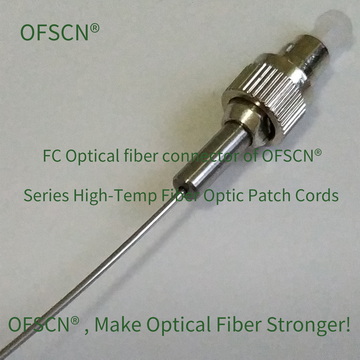
- OFSCN® 200℃ Fiber Optic Connector (Higher temperature range, suitable for more demanding industrial thermal shock environments)
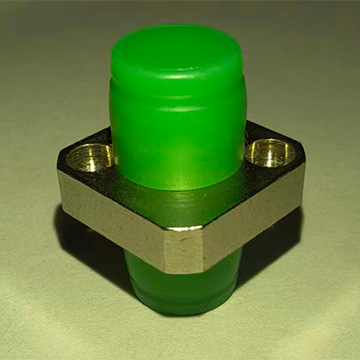
- OFSCN® High Temperature Resistant Fiber Optic Adapter (All-metal wide-temperature fiber optic flange adapter, maximum temperature resistance of 300°C, ensuring dimensional stability of the mating locking mechanism)
Summary:
During -40°C to +85°C cycling tests, as long as metal threaded interfaces (such as FC type) are used and properly secured, the external macro threaded structure will not loosen; the key risk lies in the softening of the internal adhesive and thermal expansion mismatch in ordinary connectors, leading to fiber slippage and contact failure. Therefore, under wide-temperature cold and hot cycling conditions, priority should be given to industrial-grade temperature-resistant fiber optic connectors and metal flanges with a nominal temperature resistance of \ge 120^\circ\text{C}.