After multiple cycles from -196
°C to +200
°C, is the seal still reliable?
For standard fiber optic vacuum feedthroughs employing organic adhesives (such as epoxy) for encapsulation, reliable sealing is typically unattainable when subjected to wide-temperature-range, large-span thermal cycling between -196\ ^\circ\text{C} and +200\ ^\circ\text{C}. Leakage and degradation of vacuum are highly probable.
To maintain long-term hermeticity under such extreme temperature cycling, specialized inorganic matching sealing processes are imperative. The following analysis outlines the relevant physical mechanisms and engineering principles:
1. Core Physical Challenge: Coefficient of Thermal Expansion (CTE) Mismatch and Shear Stress
Fiber optic vacuum feedthroughs are heterogeneous structures composed of multiple materials with significantly different coefficients of thermal expansion (CTE):
- Optical Fiber (primarily fused silica): Possesses a very low CTE, approximately 0.5 \times 10^{-6}/\text{K}.
- Flange Metal Substrate: Stainless steel (e.g., 316L) has a CTE of about 16 \times 10^{-6}/\text{K}; even Kovar, a low-expansion alloy, has a CTE of approximately 5 \times 10^{-6}/\text{K}.
- During drastic temperature variations from -196\ ^\circ\text{C} to +200\ ^\circ\text{C} (a temperature difference nearing 400\ ^\circ\text{C}), the substantial differences in expansion and contraction between the metal substrate, sealing medium, and optical fiber generate immense shear stress at the bonded interfaces.
2. Performance Limits of Sealing Materials
- Low-Temperature Embrittlement: At cryogenic temperatures like -196\ ^\circ\text{C} (liquid nitrogen), conventional polymers used for fiber optic sealing (e.g., epoxy resins) undergo severe glass transition, rendering them extremely brittle. At this stage, thermal stresses can readily induce micro-cracking within or at the interfaces of the sealing layer.
- High-Temperature Aging and Leakage: When temperatures rise to +200\ ^\circ\text{C}, organic sealing materials may suffer thermal degradation or softening, leading to hermeticity failure. Furthermore, polymer materials are prone to outgassing at elevated temperatures, which directly compromises the vacuum level of high-vacuum systems.
3. Achieving High-Reliability Thermal Cycling Life
To sustain hermeticity under such extreme temperature ranges, Hermetic Seal technology is essential:
- Glass-to-Metal Seal or Metal Brazing: Employing specialized low-melting-point glass solders or active metal brazing materials as intermediate sealing media.
- Matched Seal: During material selection, ensuring CTE gradient matching between the sealing medium, metal housing, and optical fiber to minimize thermal stress caused by temperature fluctuations.
- Rate of Temperature Change Control: Even with inorganic matched seals, thermal cycling lifetime is significantly influenced by the heating and cooling rates. Extreme thermal shock can still lead to the formation of micro-cracks.
Related Official Product References
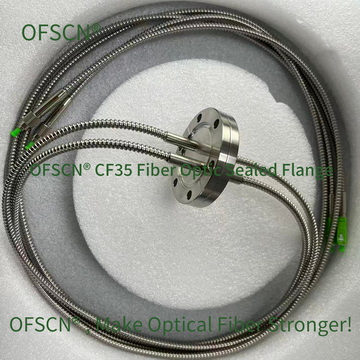
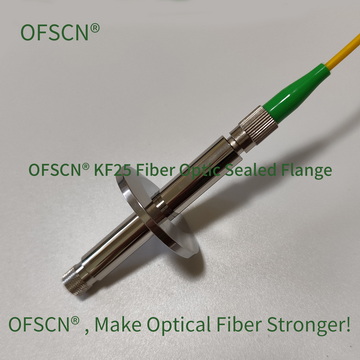
OFSCN® offers high-end fiber optic vacuum flanges/feedthroughs, which can be custom-designed for special operating conditions (such as high vacuum, ultra-high vacuum, or high/low-temperature environments):
OFSCN® Fiber Optic Vacuum Sealed Flange
Key Specifications:
- Standard operating temperature, with customizable options for products rated to 250\ ^\circ\text{C};
- Available in CF and KF series, as male and female connectors, for single- or multi-channel configurations;
- Vacuum levels better than 1 \times 10^{-7}\ \text{Pa} and 1 \times 10^{-9}\ \text{Pa};
- Other specifications are detailed on the official website.
For operational conditions involving extreme temperature ranges from -196\ ^\circ\text{C} to +200\ ^\circ\text{C}, standard epoxy-sealed flanges cannot meet reliability requirements. Typically, an inorganic design change for the sealing material is necessary, and actual lifetime evaluation based on specific thermal cycling rates (heating/cooling curves) is recommended.