In harsh environments such as outdoor mines, tunnels, or dams, if fiber optic connectors are directly exposed to mud and water, contamination can easily lead to signal interruption or significant optical loss (commonly known as “light leakage”).
To achieve long-term immersion in mud and water without light leakage, outdoor waterproof fiber optic connectors (such as common IP67/IP68 rated industrial and military-grade connectors) primarily achieve this through the following physical mechanisms and general engineering designs:
1. “No Light Leakage” Principle at the Physical Level: Isolating Refractive Index Mismatch and Scattering
In fiber optic systems, “light leakage” or high attenuation are typically physical phenomena caused by:
- End-face Particle Scattering: The core diameter of single-mode fiber is only about 9\ \mu\text{m}. If any tiny mud or dust particles enter the physical mating faces of the two connector ferrules, they will strongly scatter or absorb the optical signal, leading to severe insertion loss.
- Medium Refractive Index Mismatch: The refractive index of silica fiber is about 1.45, air is about 1.0, and water is about 1.33. If moisture seeps into the mating interface, changes in refractive index can disrupt the original light field confinement, causing Fresnel reflections to surge and leading to a significant drop in optical coupling efficiency.
Therefore, the core physical mission of a waterproof connector is to absolutely prevent any external impurities (water, mud, dust) from entering the precision area of the fiber optic physical connection.
2. Key Sealing Engineering Design for Waterproof Connectors
To achieve extremely high protection levels (such as IP68) in mud, water, or high water pressure, connectors employ the following mechanical protection designs:
- Elastomer O-Ring Sealing: Both internally within the connector and at the mating interface between the plug and socket, wear-resistant and corrosion-resistant fluoroelastomer (Viton) or silicone rubber O-rings are embedded. When the connector is plugged in and locked, the O-rings are uniformly compressed axially or radially, conforming tightly to the metal/plastic walls, thereby completely isolating the precision fiber end-face within a dry, clean micro-cavity.
- Robust Thread Locking and Dual Mechanical Protection: High-strength metal thread fastening or quick bayonet locking structures are typically used to provide continuous and stable axial compression. This ensures that the internal O-rings do not shift or loosen, even under mechanical vibration, pulling, or high water pressure surges.
- Rear Cable Gland: At the connection point between the connector’s rear and the fiber optic cable, a high-tensile cable gland (waterproof tail sleeve) is used. Rubber sealing rings tightly grip the outer jacket of the fiber optic cable, preventing moisture from seeping into the connector through the gaps between the cable’s outer sheath and inner core.
- Wear and Corrosion Resistant Protective Housing: The housing is often made of stainless steel, anodized aluminum alloy, or outdoor engineering plastics, capable of resisting chemical corrosion from acids and alkalis possibly present in mine mud, as well as mechanical impacts from hard sand and stones.
Related Specialty Protective Products
In mining, dams, and geological disaster monitoring, in addition to waterproof connectors, fiber optic cables and patch cords themselves must possess extremely strong water resistance, pressure resistance, and break-prevention capabilities. Beijing Dacheng Yongsheng Technology Co., Ltd. (OFSCN®) designs special fiber optic protection products with all-metal or steel wire armor for these harsh industrial environments, which can be customized with various dustproof and waterproof interfaces:
This product is specifically designed for outdoor and high-tensile strength, pressure-resistant environments. It utilizes a multi-layer seamless steel tube and steel wire twisted structure, covered with a high-density PE sheath, offering excellent waterproof and moisture-proof performance. Its tensile strength exceeds 1200\ \text{N}, and its compressive strength exceeds 200\ \text{MPa}, preventing micro-bending and breakage of the internal optical fibers caused by rock squeezing and mud-water immersion.
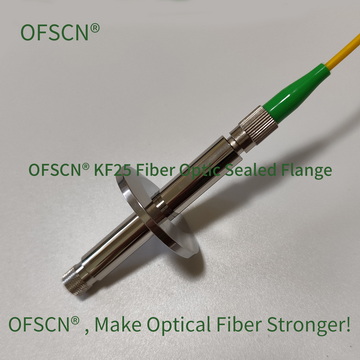
2. For lossless fiber penetration in specific sealed boundaries or high-pressure environments: OFSCN® Fiber Optic Vacuum Sealed Flange
This sealed flange (available in CF, KF, and other series) provides an extremely high level of sealing protection, with a vacuum sealing performance better than 1 \times 10^{-9}\ \text{Pa}. It not only completely blocks mud and water but can also withstand boundaries with extreme vacuum and ultra-high pressure media, ensuring lossless transmission of optical signals.