The sensor is buried 100 meters underwater. Will water seep in through the pipe?
Whether sensors will experience water ingress at a depth of 100\ \text{m} underwater, within the physical frameworks of hydrostatics and material mechanics, depends on the material of the encapsulation tube (radial airtightness) and the sealing process of the connectors and end caps (axial airtightness).
Here is a rigorous academic explanation from the perspectives of physical principles, material properties, and engineering practices:
I. Physical Calculation of Hydrostatic Pressure at 100\ \text{m} Underwater
At a depth of 100\ \text{m} underwater, the sensor and protective tube surface will be subjected to significant hydrostatic pressure. According to the basic formula of hydrostatics:
P = \rho \cdot g \cdot h
Where:
- Density of water \rho \approx 10^3\ \text{kg/m}^3
- Gravitational acceleration g \approx 9.8\ \text{m/s}^2
- Water depth h = 100\ \text{m}
Substituting the values, the hydrostatic pressure at this depth is approximately:
P \approx 9.8 \times 10^5\ \text{Pa} \approx 1\ \text{MPa} \approx 10\ \text{bar}
This is equivalent to about 10 atmospheres (i.e., approximately 10\ \text{kg} of pressure on an area of one square centimeter).
II. Mechanism of Water Molecule Permeation in Different Encapsulation Tube Materials (Radial Airtightness)
The kinetic diameter of water molecules ( \text{H}_2\text{O} ) is extremely small, only about 0.28\ \text{nm}. Under the long-term action of a pressure difference of 1\ \text{MPa}, water molecules will seek any microscopic channel for permeation:
-
Polymer Material Tubes (Plastics, PVC, PE, PU, etc.):
Although these materials are “waterproof” macroscopically, at the microscopic level, there are significant voids (free volume) between their polymer chains. Under the long-term pressure difference of 1\ \text{MPa}, water molecules will permeate through these micro-voids via physical permeation. Therefore, if the protective tube is made of plastic or a regular polymer sheath, over time, water molecules will inevitably penetrate the tube wall and seep into the interior along the tube, leading to moisture, degradation, or micro-bending loss of the optical fiber. -
Seamed Steel Tubes (Welded Tubes):
Seamed steel tubes have longitudinal welds during manufacturing. The metal grains at the weld seams undergo recrystallization due to heat, easily forming grain boundary defects, micro-pores, or thermal stress micro-cracks. In a high-pressure environment, these micro-pores become pathways for water molecules to permeate, leading to easy leakage. -
Seamless Steel Tubes:
Seamless steel tubes are manufactured from a single piece of round steel, drawn integrally through hot rolling or cold drawing processes. They possess an absolutely continuous and dense crystalline structure in the radial direction without any physical welds, resulting in extremely high radial airtightness (leak rate typically better than 1 \times 10^{-9}\ \text{Pa}\cdot\text{m}^3/\text{s} ). Therefore, high-pressure water molecules are physically incapable of penetrating the wall of a stainless steel seamless steel tube.
III. Axial Sealing: The Key to Whether Water “Seeps In Along the Tube”
Although the wall of seamless steel tubes (radially) can achieve absolute impermeability, whether water “seeps in along the tube” also depends on the axial sealing at both ends of the tube:
- If the end of the seamless steel tube is not hermetically sealed by fusion welding or epoxy resin sealant, or if the optical cable connector is directly exposed to water without protection from a waterproof housing, high-pressure water flow will enter from the pipe’s opening (axial end face) and travel along the tiny gaps (capillary channels) between the optical fiber and the inner wall of the steel tube.
- Therefore, during underwater deployment, it is crucial to ensure reliable hermetic sealing of the sensor’s tail end, and that the input connector is located above the water surface or within a hermetic/waterproof junction box with an equivalent pressure rating.
IV. Beijing Dacheng Yongsheng Technology Co., Ltd. (OFSCN®) Seamless Steel Tube Encapsulation Technology and Solutions
To address the waterproofing and anti-seepage requirements in extreme harsh environments such as high-pressure underwater, deep sea, and oil/gas wells, Beijing Dacheng Yongsheng Technology Co., Ltd. (OFSCN®) sensors and cables adopt high-density seamless steel tube encapsulation technology, physically preventing radial permeation of water molecules.
Here are the official product solutions suitable for high-pressure underwater environments:
- OFSCN® 85°C Seamless Steel Tube Fiber Cable
Encapsulated with a single layer of stainless steel seamless steel tube, with 304 stainless steel as the default material (316L optional). Default diameter is 2.0\ \text{mm} (wall thickness 0.2\ \text{mm} ) or 3.0\ \text{mm} (wall thickness 0.3\ \text{mm} ) with no welds on the tube wall. It possesses absolute radial airtightness, perfectly blocking high-pressure water molecules.
Product details link: OFSCN® 85°C Seamless Steel Tube Fiber Cable
Standard images:
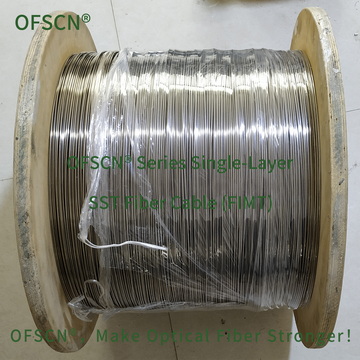

- OFSCN® Double-Layer High-Temperature Downhole Fiber Optic Cable
For extreme deep water, high pressure, and corrosive media environments, a double-layer seamless steel tube nesting process can be used. The outer layer uses a diameter of 6.35\ \text{mm} (wall thickness 0.9\ \text{mm} ) and the inner layer uses a diameter of 3.6\ \text{mm} (wall thickness 0.3\ \text{mm} ) nested double seamless steel tubes, forming a dual physical barrier capable of withstanding extreme pressures of tens of megapascals (hundreds of atmospheres) in oil wells without any leakage.
Product details link: OFSCN® Double-Layer High-Temperature Downhole Fiber Optic Cable
Standard images:

For more seamless steel tube protection solutions for different environments, temperature zones, and pressure ratings, please refer to the following official classification:
Official Classification Link