How can 1310nm communication signals and 1550nm sensing signals be transmitted over a single fiber?
To transmit both 1310nm communication signals and 1550nm sensing signals over a single fiber, you can employ a technology known as Wavelength Division Multiplexing (WDM).
Principle:
WDM allows multiple optical signals at different wavelengths to be simultaneously transmitted over a single optical fiber. In your scenario:
- A WDM multiplexer combines the 1310nm communication signal and the 1550nm sensing signal into one fiber at the transmitting end.
- At the receiving end, a WDM demultiplexer separates these two distinct wavelength signals back into their respective paths, allowing the 1310nm signal to go to the communication receiver and the 1550nm signal to go to the FBG interrogator.
This method efficiently utilizes the fiber’s bandwidth, enabling co-existence of communication and sensing applications on the same physical medium without interference.
OFSCN’s Fiber Bragg Grating (FBG) sensing solutions primarily operate within the 1550nm wavelength window (typically 1525 nm to 1565 nm), which is well-suited for integration into such WDM systems.
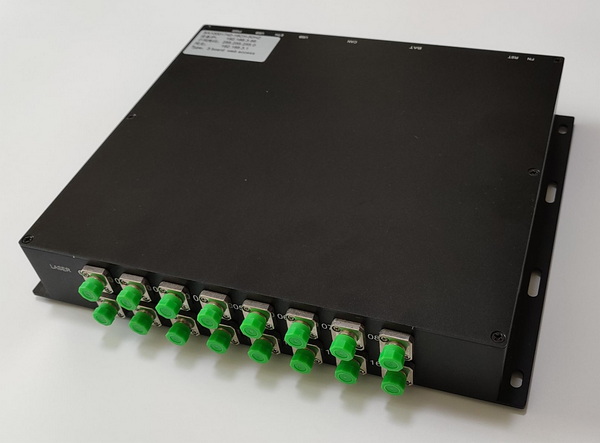
For the sensing signals, you would use an FBG interrogator, such as the OFSCN® Fiber Bragg Grating Interrogator, to monitor the wavelength shifts from your FBG sensors.
Here is an image of a typical FBG interrogator: