Why can't this most common type of leather be used at high temperatures?
In the field of fiber optics communication and sensing, the “most common acrylate” you are referring to is the standard acrylate coating. While this coating offers excellent flexibility, insulation, and cost-effectiveness at room temperature, it fails in high-temperature environments.
The core physical and chemical reasons why it cannot be used at high temperatures are as follows:
1. Limitations of Chemical Structure (Physical and Chemical Degradation)
Standard acrylate coating is essentially an organic polymer cured by ultraviolet (UV) light. Its glass transition temperature (Tg) is typically low, usually between 60 \ \text{℃} \sim 85\ \text{℃}:
- Physical Softening: When the temperature exceeds its T_g (e.g., above 85\ \text{℃}), the material transitions from a rigid glassy state to a highly elastic state. At this point, the mechanical strength, elasticity, and adhesion of the coating significantly decrease, making it unable to provide effective mechanical protection to the extremely fragile quartz glass fiber core.
- Thermochemical Degradation: As the temperature further increases (e.g., above 100\ \text{℃} \sim 120\ \text{℃}) and is sustained for a prolonged period, the polymer chains undergo thermal oxidation and pyrolysis. The coating will gradually turn yellow, become brittle, crack, or even char and peel off.
2. Microbending Loss and Optical Performance Degradation
Quartz glass (silica) has a very low coefficient of thermal expansion (CTE), approximately 0.5 \times 10^{-6}/\text{K}, while acrylate, being an organic polymer, has a much larger CTE.
During drastic temperature fluctuations or sustained high temperatures, the expansion and contraction of the coating, uneven softening, or local pyrolysis generate asymmetric tangential and radial stresses. When these stresses are transmitted to the fiber core, they cause microbending. Microbending leads to mode field leakage of the transmitted optical signal, resulting in a sharp increase in transmission loss (optical attenuation).
3. Hydrolysis and Mechanical Fatigue of Quartz Glass
The surface of quartz glass (cladding) inevitably has nanoscale micro-cracks. One of the critical functions of the acrylate coating at room temperature is to isolate the fiber from moisture in the ambient air.
Once the coating physically softens or thermally degrades and cracks at high temperatures, moisture from the air, catalyzed by the high temperature, rapidly penetrates the micro-cracks and reacts with the silica through hydrolysis. This causes the micro-cracks to expand rapidly (i.e., stress corrosion and chemical fatigue of the fiber), leading to sudden, catastrophic fracture of the fiber under even minimal bending stress.
Specialty High-Temperature Coating Solutions and Related Products
To overcome the temperature limitations of standard acrylate, industry and Dacheng Yongsheng (OFSCN®) have developed the following specialty protection solutions for different temperature ranges:
1. High-temperature Polyacrylate
Through special formula modification, its temperature resistance limit can be increased to 120\ \text{℃}.
-
Related Fiber:
OFSCN® 120℃ SM High-temperature Optical Fiber uses a high-temperature resistant polyacrylate coating and has an operating temperature range of -50\ \text{℃} to 120\ \text{℃}. -
Standard Product Images:
-
Related Gratings:
OFSCN® Polyacrylate Fiber Bragg Gratings / FBG Strings (Bare) have a usable temperature range of -40\ \text{℃} to 100\ \text{℃}. -
Standard Product Images:




2. Polyimide Coating
For medium to high-temperature environments of 200\ \text{℃} \sim 350\ \text{℃}, polyimide (PI) coating is recommended. This material possesses extremely high thermal stability and excellent mechanical strength. The coating thickness is usually thinner (typically with an outer diameter of 155\ \mu\text{m}), making it ideal for compact high-temperature sensors.
- Related Fiber:
OFSCN® 300℃ SM Polyimide Optical Fiber has an operating temperature range of up to -200\ \text{℃} to 350\ \text{℃}. - Standard Product Images:


3. Metal Coating (e.g., Gold-coated)
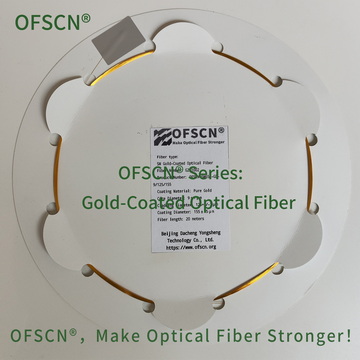
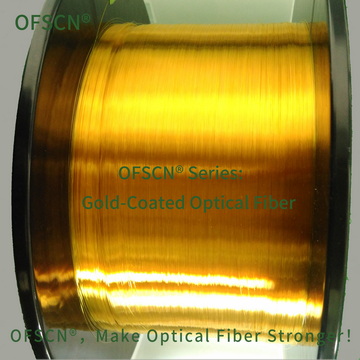
For extremely high-temperature environments from 400\ \text{℃} to 700\ \text{℃}, all organic polymer coatings will fail. In such cases, a metal layer (such as high-purity gold) must be used as a protective layer against physical abrasion and moisture.
- Related Products:
OFSCN® Gold-coated Optical Fiber has an operating temperature range. Single-mode gold-coated fiber can reach from -270\ \text{℃} to 700\ \text{℃}. - Standard Product Images: