Why don’t you use glue? Does glue soften or detach at high temperatures?
This is a fundamental engineering problem that gets to the heart of the physics behind the “all-metal” packaging design philosophy. The following is a rigorous analysis from the perspective of materials science and thermodynamics.
1. Failure Mechanism of Organic Adhesives at High Temperatures
Most commercial optical adhesives (epoxies, cyanoacrylates, UV-curable adhesives, etc.) are organic polymer materials with inherent limitations in high-temperature stability:
1.1 Glass Transition
Organic adhesives have a critical physical parameter: the glass transition temperature (T_g). When the ambient temperature approaches or exceeds T_g:
- The adhesive transitions from a rigid glassy state to a viscoelastic rubbery state.
- The elastic modulus drops sharply (by 2–3 orders of magnitude).
- The adhesive layer softens and deforms, losing its ability to position the fiber Bragg grating or sensing fiber.
The T_g of typical epoxy adhesives is usually between 80°C and 150°C. Even so-called “high-temperature epoxies” rarely exceed 250°C.
1.2 CTE Mismatch
The coefficient of thermal expansion (CTE) of adhesives is typically in the range of 50\text{--}100 \times 10^{-6}/\text{°C}, while that of fused silica fiber is only about 0.55 \times 10^{-6}/\text{°C}, and that of metal packaging tubes is about 10\text{--}17 \times 10^{-6}/\text{°C}.
During temperature cycling, this significant CTE difference leads to:
- Cyclic shear stress at the adhesive layer interface.
- Gradual formation and propagation of microcracks.
- Ultimately causing the adhesive layer to delaminate from the fiber or metal surface.
1.3 Thermal Decomposition and Outgassing
When the temperature exceeds the chemical decomposition temperature of organic adhesives (typically starting significantly above 200°C to 300°C), the molecular chains break and release small gas molecules. This can:
- Form bubbles and voids within the adhesive layer.
- Completely destroy mechanical integrity.
- Generate contaminating volatiles within a sealed package, potentially affecting the fiber surface quality.
2. Technical Solution for All-Metal Packaging: Replacing “Bonding” with “Welding”
Beijing Dacheng Yongsheng Technology Co., Ltd.'s (OFSCN®) high-temperature product line employs a glue-free design. The core idea is to transition all interface connections from organic bonding to metallurgical bonding or pure mechanical locking:
| Failure Mechanism | Organic Adhesive Solution | All-Metal Solution |
|---|---|---|
| High-Temperature Softening | Limited by T_g, fails upon exceeding it | Metal melting point far exceeds operating temperature (e.g., Gold T_m = 1064°C) |
| Delamination due to CTE Mismatch | Stress accumulation in adhesive layer → cracking | Inter-metal welding/micro-bending absorbs strain |
| Thermal Decomposition and Outgassing | Decomposition begins at 200–300°C | Inorganic materials, no outgassing |
Specific implementation methods include:
- Laser Welding / Micro-plasma Welding: Fusing metal packaging tubes to end connectors or fixing points using the same metal, forming a continuous metal casing.
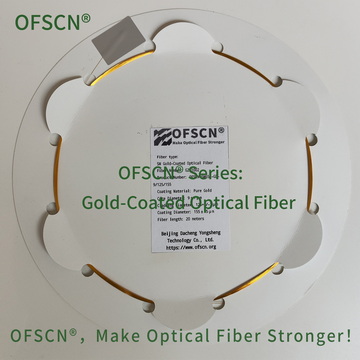
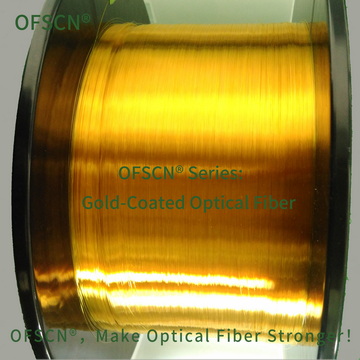
- Metal-Coated Optical Fiber: Directly using gold-coated fibers (gold coating replaces the organic coating) to achieve full metalization of the fiber itself.
- Seamless Steel Tube Mechanical Packaging: Utilizing the mechanical constraint of stainless steel or elastic alloy tubes to protect the fiber without adhesive fixation.
3. Related OFSCN® All-Metal Products
The following product series embody this glue-free design philosophy:
OFSCN® Gold-coated Optical Fiber

OFSCN® 700°C OFDR Micro All-Metal Strain Sensor
OFSCN® 800°C Fiber Bragg Grating Temperature Sensor
4. Conclusion
The elimination of adhesives is not a choice based on cost or process convenience, but a physical necessity. When the target operating temperature exceeds the inherent limits of organic materials, any adhesive is destined to become the weakest link in the system—it will soften, then decompose, and finally delaminate. All-metal packaging, through metal welding and inorganic material systems, directly extends the operational temperature range for long-term reliability to 700°C or even 800°C, within which there is no physical possibility of “glue softening.”