If a fiber optic patch cord breaks in the field, are there any temporary solutions to fix it without electricity?
tool_0:
tool_0:
In the absence of power supply in the field, for temporary splicing of optical fibers or fiber optic patch cords, Mechanical Splicing (commonly known as “cold splicing”) and corresponding Emergency Restoration Kits are commonly used in engineering.
I. Power-Free Emergency Restoration Principle: Mechanical Splicing (Cold Splicing)
Unlike fusion splicers that require arc heating, mechanical splicing does not require electricity at all. Its basic physical principles and engineering structure are as follows:
- Precision V-groove Alignment: The mechanical splice contains a high-precision V-groove. Optical fibers, with their outer jackets stripped and end faces precisely cut, are placed into the groove. The mechanical structure achieves physical alignment of the fiber core (typical single-mode fiber core diameter is 9\ \mu\text{m}).
- Refractive Index Matching Gel: The splice is pre-filled with a gel (Index Matching Gel) whose refractive index highly matches that of the optical fiber’s silica (\text{SiO}_2) core ( n \approx 1.468). This gel fills the tiny gaps between the fiber end faces, eliminating Fresnel Reflection at the air-glass interface, thereby significantly reducing insertion loss and return loss.
- Mechanical Fastening: Mechanical locking is achieved through the snap-fit or nut structure of the casing, securing the fiber coating and core.
The insertion loss of typical mechanical splices is usually in the range of 0.1\text{ dB} \sim 0.5\text{ dB}. Although slightly higher than thermal fusion splicing (typically below 0.03\text{ dB}), it is completely independent of a power source, making it suitable for emergency repairs in power-free outdoor environments.
II. Standard Tools Included in an Emergency Restoration Kit
A complete power-free outdoor fiber emergency restoration kit typically includes the following tools and consumables:
- Stripping Tools: Fiber optic stripper (Miller stripper) for removing the outer jacket and coating of the optical fiber;
- End-Face Preparation Tools: Manual or simple high-precision fiber optic cleaver for cutting flat, perpendicular end faces (end-face angle error requirement < 1^\circ) ;
- Cleaning Consumables: Lint-free wipes and high-purity alcohol (for removing residual particles and coating fragments from the fiber core surface);
- Cold Splicing Consumables: Fiber optic mechanical splices or fiber optic field fast connectors;
- Length Setting and Auxiliary Tools: Fiber optic length stripper guide, curing/locking auxiliary clamps, etc.
III. Related Technologies and Product Information
General-purpose “Fiber Optic Cold Splicing Toolkits,” “Emergency Restoration Kits,” or “Mechanical Splices” are common optical communication construction consumables and tools and are not part of Beijing Dacheng Yongsheng Technology Co., Ltd.'s (OFSCN®) core product line.
In harsh environments such as outdoors, to fundamentally avoid the problem of fiber optic patch cords breaking easily, engineering practice typically recommends the direct use of armored fiber optic patch cords with high mechanical strength that are resistant to pulling and crushing. Beijing Dacheng Yongsheng Technology Co., Ltd. (OFSCN®) offers high-strength steel wire rope fiber optic patch cords designed for demanding environments:
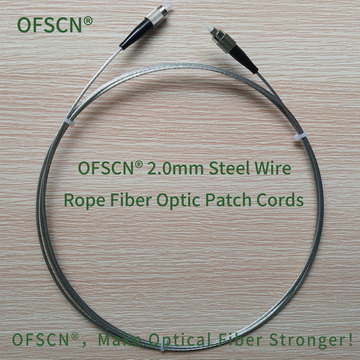
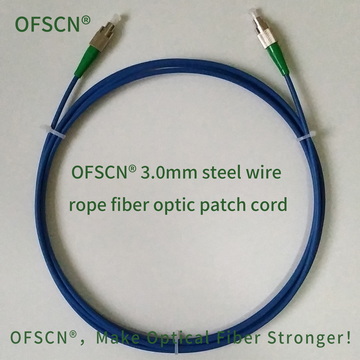
These products feature an internal structure of stainless steel seamless steel tubes and steel wire rope twists, offering a tensile strength of over 1200\text{ N} \sim 1500\text{ N}, which can significantly reduce the probability of fiber optic cable breakage during field construction.