Could plugging and unplugging fiber optic connectors generate sparks in a gas environment? ?
In an environment with flammable and explosive gases like methane (high-concentration natural gas), from the perspective of optical physics and engineering safety, fiber optic connectors do not generate sparks when plugged and unplugged. However, there is still a risk of tiny sparks or thermal effects caused by other physical factors. Here is a specific scientific analysis:
1. Why don’t fiber optic plugs and sockets generate sparks?
Fiber optics transmit photons (light signals), not flowing electric charges (current, voltage). When plugging and unplugging fiber optic connectors (such as FC, SC, etc. interfaces), there is no circuit connection or disconnection, so physically, electrical sparks or arcs are absolutely not generated. This is the biggest “intrinsic safety” advantage of fiber optic communication and fiber optic sensing technology compared to traditional electrical signal transmission in flammable and explosive environments.
2. Physical safety risks to consider in a gas environment
Although no sparks are generated during plugging and unplugging, two types of potential physical ignition sources still need to be prevented in actual industrial or coal mine gas environments:
- Mechanical collision and friction sparks:
The outer casings and adapters (flanges) of fiber optic connectors usually contain metal parts (e.g., the metal locking nut and alignment sleeve of FC connectors). If these metal parts come into high-speed friction or impact with iron tools or hard rocks during plugging/unplugging, dropping, or tool operation, mechanical friction sparks may be physically generated.
Therefore, in mining or explosion-proof environments (such as gas environments), connecting components are usually required to be made of non-sparking materials, or high-strength, explosion-proof protective casings (e.g., 304, 316L stainless steel) should be selected to eliminate the risk of sparks caused by collisions. - Photothermal effect of high-power lasers:
If the fiber optics transmit high-energy lasers of tens of watts (e.g., \ge 10\text{W} ) or even higher power (such as high-power pump sources, laser energy transmission, etc.), at the moment of disconnection, extremely high-density light energy will be emitted from the tiny fiber end face.
If the surrounding environment contains a large amount of coal dust, oil scale, or impurities adhering to the end face, these contaminants will rapidly increase in temperature after absorbing high-energy laser light, potentially causing localized burning or carbonization (“optical spontaneous combustion” effect). However, in ordinary FBG fiber grating sensing systems, the light source power emitted by the demodulator is extremely low (usually only milliwatts \text{mW} level), and this photothermal effect is completely negligible.
3. Fiber Optic Physical Protection Solutions in Special Industrial Environments
Although Beijing Dacheng Yongsheng Technology Co., Ltd.'s (OFSCN®) main products are not directly named “explosion-proof electrical connectors,” to prevent fiber optics and cables from being damaged by external forces, broken and leaking light, or experiencing physical impacts in harsh, flammable, explosive, and mechanically impactful environments (such as underground coal mines, petrochemical storage, natural gas pipeline monitoring, etc.), we provide special high-strength fiber optic patch cords with high tensile and compressive strength, armored with stainless steel seamless steel pipes or steel wires. These structures ensure maximum physical safety:
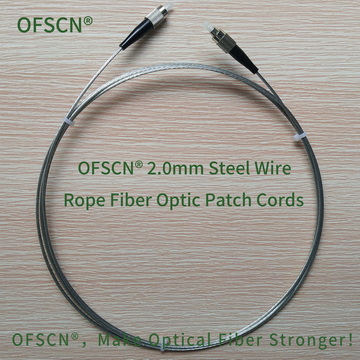
OFSCN® 2.0mm Steel Wire Rope Fiber Optic Patch Cord
This product consists of a fiber optic connector, a 0.6\text{mm} galvanized steel wire stranded structure, a 1.0\text{mm} stainless steel seamless steel pipe, and optical fiber. The all-metal protective structure gives it extremely high tensile strength ( \gt 150\text{N} ) and compressive strength ( \gt 240\text{MPa} ), effectively preventing fiber optic mechanical damage caused by violent extrusion from hard objects and collision from gravity.
OFSCN® 300℃ Fiber Optic Patch Cord
Uses a 0.9\text{mm} stainless steel seamless steel pipe and 300℃ polyimide fiber, providing excellent environmental resistance and mechanical protection. The outer seamless steel pipe can block external hard scratches and physical impacts, avoiding safety risks caused by fiber optic cable breakage due to mechanical pulling.
