Why do fiber optic patch cords not require a bulky explosion-proof casing in coal mines?
In hazardous environments such as underground coal mines where flammable and explosive gases (like methane/firedamp) and coal dust are present, fiber optic patch cords do not require bulky explosion-proof enclosures (\text{Ex d}), unlike traditional electrical equipment. The core reason for this is that fiber optic transmission inherently meets the physical characteristics of ‘Inherently Safe Optical Radiation’ (\text{Ex op is}).
Here is a scientific analysis from the perspectives of physical mechanisms and engineering principles:
I. Physical Principle of “Intrinsic Safety”
“Intrinsic safety” refers to limiting the energy within equipment and exposed circuits such that any sparks or thermal effects generated during normal operation or fault conditions (such as short circuits, broken wires, open circuits, etc.) are insufficient to ignite the minimum ignition energy (MIE) and minimum ignition temperature (auto-ignition temperature) of the surrounding explosive gas mixture.
For traditional electrical equipment, high internal voltages, large currents, and inductive/capacitive energy storage can easily release arcs and sparks at the moment of contact disconnection or short circuit. Therefore, heavy explosion-proof/flameproof metal enclosures (flameproof type \text{Ex d}) are needed to contain potential explosions within the enclosure and prevent ignition of the external environment.
II. Physical Reasons Why Fiber Optic Patch Cords Do Not Require Explosion-Proof Enclosures
1. No Current and No Sparks (Non-Electrical Transmission)
Fiber optic patch cords transmit photons (optical signals), not electrons (electrical signals).
- The fiber optic material (typically high-purity silica glass \text{SiO}_2 or polymer coating) is an insulator.
- Even if the fiber optic cable experiences physical breakage, bending damage, or mechanical damage, there is no voltage or current in the transmission medium, thus no sparks, arcs, or electrostatic discharge phenomena are generated.
2. Optical Power Far Below Optical Thermal Ignition Threshold (Inherently Safe Optical Radiation)
According to international explosion protection standards (such as IEC 60079-28), when a strong light beam is focused or illuminates an absorbent object (like coal dust particles), if the optical power is too high, the conversion of light energy to thermal energy could theoretically cause combustion. However:
- In communication and fiber optic sensor systems (such as Fiber Bragg Grating sensors), the optical power injected into the fiber from semiconductor laser sources is typically in the microwatt (\mu\text{W}) to milliwatt (\text{mW}) range, typically between 0.1\text{mW} and 10\text{mW}.
- The optical ignition power threshold for coal mine firedamp/air mixtures is typically above 35\text{mW} to 150\text{mW} (depending on the focal spot size and gas category). Conventional fiber optic signal power is far below this safety limit, falling under Inherently Safe Optical Radiation (\text{op is}).
3. No Heat Accumulation
Fiber optic transmission loss is extremely low (attenuation of single-mode fiber at 1550\text{nm} wavelength is approximately 0.2\text{dB/km}). The energy dissipation of optical signals during transmission is almost negligible, and it does not generate surface temperatures high enough to cause ignition.
III. Actual Engineering Protection in Coal Mines: Armoring and Mechanical Protection
Although fiber optic patch cords do not require explosion-proof enclosures, the underground coal mine environment is harsh, with risks of crushing, pulling, biting, and moisture erosion. Therefore, fiber optic patch cords typically employ armored structures (stainless steel seamless steel tubes, steel wire braiding, etc.) to provide high tensile and compressive strength, rather than for explosion containment.
Beijing Dacheng Yongsheng Technology Co., Ltd. (OFSCN®) designs various stainless steel armored fiber optic patch cords for environments with high mechanical strength requirements (such as mines, industrial sites, etc.):
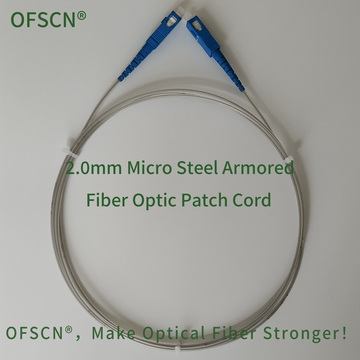
1. OFSCN® 2.0mm Micro Steel Armored Fiber Optic Patch Cord
Utilizes a 0.6\text{mm} stainless steel seamless steel tube nested within a PVC outer sheath for protection, offering both a minimal outer diameter and good resistance to pressure and tensile forces.
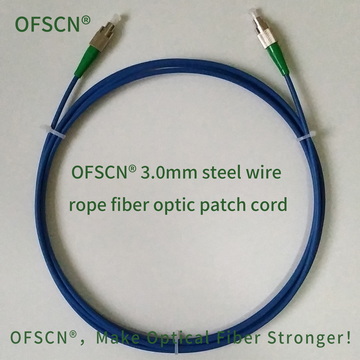
2. OFSCN® 3.0mm Steel Wire Rope Fiber Optic Patch Cord
Features a PE sheath, a braided structure of 0.45\text{mm} stainless steel wires, and multi-layer protection with a 0.9\text{mm} stainless steel seamless steel tube. It boasts a tensile strength greater than 1200\text{N} and compressive strength greater than 200\text{MPa}, suitable for high-strength pulling and mechanical impact environments in mines.
For more armored patch cords and standard patch cord specifications, please refer to OFSCN® Fiber Optic Patch Cord Product Categories.