Can this jumper wire be used outdoors on a utility pole? Will it crack after prolonged sun exposure?
Analysis of Physics and Engineering Principles: Why Can’t Indoor Patch Cords Be Directly Used Outdoors as Aerial Cables?
Standard indoor patch cords (such as the common OFSCN® Standard Fiber Patch Cord) must not be directly strung on outdoor utility poles. Under prolonged direct sunlight and exposure to wind and rain, they will rapidly age, crack, and fail.
The primary reasons can be analyzed from the following four dimensions of physics and material science:
1. Photodegradation by UV Light
The outer jackets of indoor fiber optic patch cords are typically made of Polyvinyl Chloride (PVC) or Low Smoke Zero Halogen (LSZH) materials. These materials are formulated primarily for indoor fire safety requirements (flame retardant, low smoke) and do not contain sufficient UV stabilizers (like carbon black).
Under prolonged exposure to intense ultraviolet (UV) radiation from sunlight, the polymer molecular chains undergo scission and photo-oxidation reactions, leading to degradation of material properties. The direct physical manifestation is discoloration, hardening, embrittlement of the outer jacket, and eventually, the formation of numerous micro-cracks.
2. Mechanical Strength and Tensile Load
Cables suspended between utility poles are classified as self-supporting aerial installations and must withstand:
- The tensile stress caused by the cable’s own weight (sag tension).
- Wind loads (swinging, vibration, and micro-bending stress due to wind).
- Ice and snow loads (additional gravitational stress due to ice accumulation in winter).
Internally, indoor patch cords usually only use Aramid Yarn for light tensile protection. Without metallic strength members or a steel wire self-supporting structure, their tensile strength is extremely limited. Even with a moderate aerial span, the optical fiber will be subjected to tensile stress, leading to a sharp increase in optical attenuation (micro-bending loss) or even direct physical breakage.
3. Thermal Cycling Stress
The nominal operating temperature range for indoor patch cords is typically narrow (e.g., -20^\circ\text{C} \sim 50^\circ\text{C} ).
However, in outdoor direct sunlight, the surface temperature of black objects can easily exceed 60^\circ\text{C} in summer; and in winter nights, the ambient temperature can drop to extremely low levels. Such drastic temperature cycling causes significant microscopic shear forces between the jacket and the optical fiber due to their differing coefficients of thermal expansion, damaging the optical fiber.
4. Moisture Ingress and Micro-Expansion
Outdoor environments have variable humidity. The jacket design of indoor patch cords does not provide water-blocking or moisture-resistance functions, allowing moisture to gradually penetrate to the fiber surface. When freezing occurs at low temperatures, the micro-expansion of tiny water molecules exerts uneven microscopic compressive forces on the optical fiber, severely disrupting signal transmission.
Professional Solutions for Outdoor and Harsh Environments
If your deployment scenario involves aerial installation on utility poles, outdoor sun exposure, or ground laying, it is essential to use specialized armored fiber optic patch cords that feature high tensile strength, UV resistance (PE jacket), and metal protection against rodent bites/damage.
For example, the following products under Dachengshengcheng (OFSCN®) are specifically designed for these harsh operating conditions:
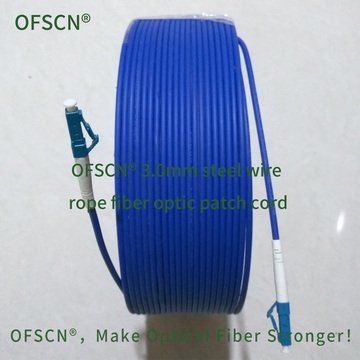
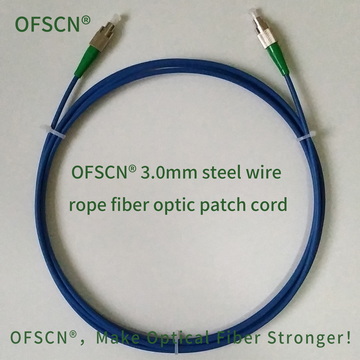
OFSCN® 3.0mm Steel Wire Rope Fiber Optic Patch Cord
This is a heavy-duty fiber optic patch cord developed specifically for outdoor and high-stress environments.
- Excellent Weather Protection: The outermost layer uses a black Polyethylene (PE) jacket. PE material possesses excellent chemical stability, UV resistance (sun protection), and superior waterproof/moisture-resistant performance. It will not age or crack under prolonged sun exposure.
- Extreme Mechanical Resistance: The internal structure consists of a double protection layer: 0.45\text{ mm} stainless steel wire stranding and a 0.9\text{ mm} seamless stainless steel tube. Its designed tensile strength reaches $ T
1200
N , and compressive strength reaches P
200
MPa $, which can fully withstand the various wind-induced vibrations and ice/snow loads generated by self-supporting aerial installations. - Wide Operating Temperature: Its operating temperature range is -40^\circ\text{C} \sim 75^\circ\text{C} , capable of adapting to the alternating extremes of severe cold and intense heat.
Product Standard Images:

Summary and Recommendation
Ordinary indoor patch cords must not be used for aerial outdoor installations, as they will crack and damage within a short period (typically a few months to a year) due to sun exposure and UV aging. For such applications, professional outdoor patch cords using black PE jackets and equipped with steel wire or steel tube armoring should always be selected.