Will the outer skin of jumper wires crack if exposed to the sun for a long time?
Prolonged exposure to direct sunlight will indeed cause standard fiber optic patch cord jackets to crack.
This is a typical phenomenon of UV Aging and Photo-oxidation Degradation in polymer materials. The following provides an in-depth analysis of the physical and material science mechanisms, along with corresponding engineering solutions.
I. Physical and Material Mechanisms of UV Aging
The plastic sheaths commonly used in fiber optic patch cords (such as Polyvinyl Chloride - PVC, Polyurethane - PU, etc.) undergo complex physicochemical degradation when exposed to sunlight outdoors for extended periods:
- Photon Energy and Chemical Bond Cleavage:
Ultraviolet (UV) radiation in sunlight (primarily in the wavelength range of \lambda \approx 290\ \text{nm} \sim 400\ \text{nm} ) possesses high single-photon energy E = h\nu . When polymer materials absorb UV photons in this spectral band, the photon energy is sufficient to excite and break covalent bonds (such as \text{C-C} or \text{C-Cl} bonds) within the polymer molecular chains. - Photo-oxidation Degradation:
In the presence of oxygen in the air, the free radicals formed from broken polymer chains rapidly react with oxygen to generate peroxy radicals, initiating a chain degradation reaction. This leads to a decrease in the average molecular weight of the material and the destruction of the polymer network structure. - Embrittlement and Macroscopic Cracking:
As degradation progresses, additives such as plasticizers within the sheath material accelerate their loss or migration. Microscopically, the material exhibits abnormal cross-linking or chain scission, while macroscopically, it loses elasticity, increases in hardness, and becomes discolored and brittle. When subjected to stress from thermal expansion and contraction due to daily temperature fluctuations, wind loads, or minor physical movements, micro-cracks rapidly propagate, ultimately leading to severe jacket cracking and peeling. - Damage to the Optical Fiber:
Once the outer jacket cracks, moisture and salt mist can directly penetrate internally, corroding the aramid (Kevlar) strength member and exposing the tight-buffered fiber to direct environmental mechanical stress and bending stress. This can result in micro-bending losses in the fiber, or even complete fiber breakage.
II. Solutions for Industrial and Outdoor Engineering Applications
In actual industrial deployments and outdoor communication/sensing monitoring, different fiber optic patch cord structures need to be selected based on UV irradiation intensity and environmental severity:
1. Standard Indoor Type (Not Recommended for Direct Outdoor Sunlight)
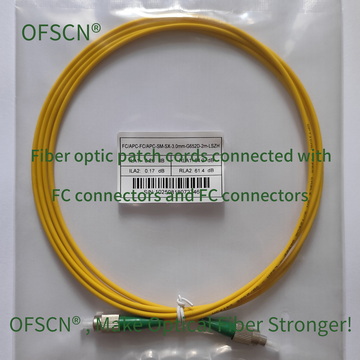
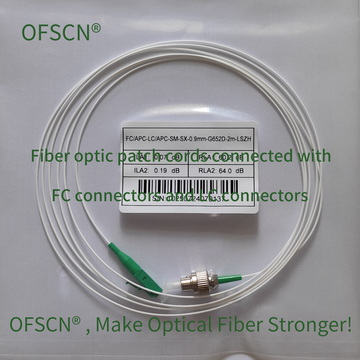
Conventional standard fiber optic patch cords (e.g., with PVC jackets) are primarily used in data centers and indoor environments. They lack UV-resistant additives and typically show discoloration, hardening, and cracking within months when exposed to direct sunlight outdoors.
- Representative Product:** OFSCN® Standard Fiber Patch Cord
- Standard Image:
2. Enhanced Weather-Resistant Structure (Suitable for Moderate Outdoor Exposure)
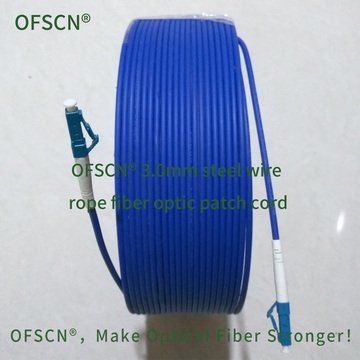
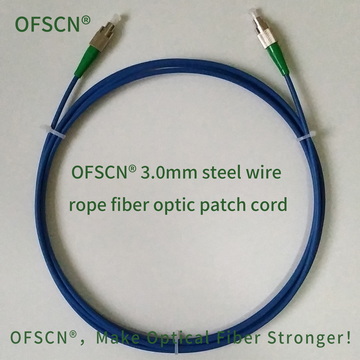
Utilizing more weather-resistant Polyethylene (PE) material for the sheath, along with internal steel wire protection. PE materials offer significantly better UV resistance than conventional PVC and are suitable for use in direct sunlight outdoors with some level of protection or moderate intensity.
- Representative Product:** OFSCN® 3.0mm Steel Wire Rope Fiber Optic Patch Cord
- Standard Image:

3. All-Metal Inorganic Protection Structure (Ultimate UV Aging Resistance Solution)
If patch cords must be permanently exposed to intense direct sunlight (e.g., in deserts, Gobi, dams, or outdoor pipelines in high-temperature industrial areas), the most fundamental solution is to eliminate the outermost organic polymer sheath.
Patch cords provided by Dacheng Yongsheng (OFSCN®) featuring all-metal and special stainless steel armored seamless steel pipe structures have a metal outer layer (such as stainless steel or galvanized steel wire stranding). They are impervious to any high-energy UV radiation, offering inherent resistance to UV, aging, and rodent damage. Their lifespan is equivalent to that of the metal material itself.
-
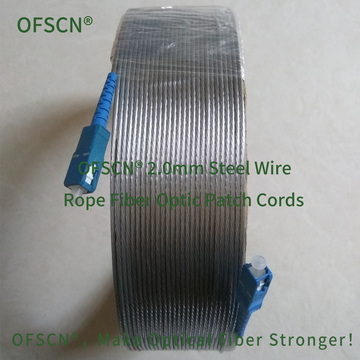
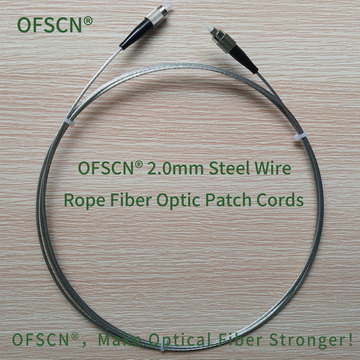
All-Metal Tensile Strength Patch Cord:** OFSCN® 2.0mm Steel Wire Rope Fiber Optic Patch Cord (Features a purely metallic outer layer design combining galvanized steel wire stranding and stainless steel seamless steel pipe)
-
Special Stainless Steel Seamless Steel Pipe Patch Cord:** OFSCN® 300℃ Fiber Optic Patch Cord (Utilizes a 0.9\ \text{mm} stainless steel seamless steel pipe with a temperature-resistant polyimide fiber. It has no organic outer jacket and can operate stably for extended periods under extreme outdoor cosmic radiation and strong UV at temperatures ranging from -270^\circ\text{C} \sim 300^\circ\text{C} )