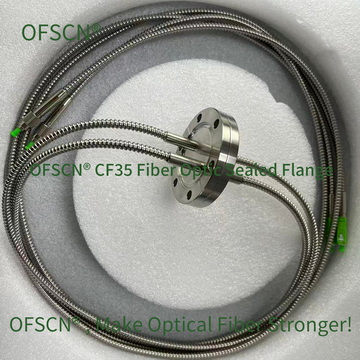
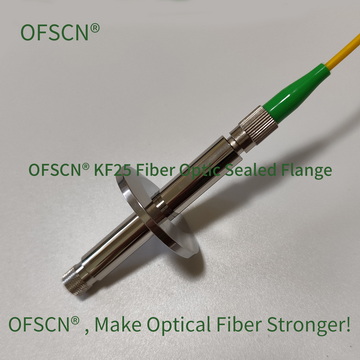
Do the flanges come with connectors on both ends, or do users need to weld them themselves?
“Integrated Jumper” Vacuum Sealed Flanges Have Built-in Connectors, Eliminating the Need for Fiber Splicing by Users.
I. What is an “Integrated Jumper” Vacuum Flange?
In vacuum fiber optic feedthrough technology, there are two main common connection structures:
- Adapter-style: The center of the flange is a dual-port adapter (e.g., FC-FC adapter). Users need to prepare two separate fiber optic patch cords and plug them into the flange on the outside and inside of the vacuum chamber, respectively.
- Integrated Jumper-style / Patch Cord Feedthrough: The optical fiber passes continuously through the flange body and achieves vacuum sealing. When the flange leaves the factory, optical fiber jumpers of specific lengths are already extended from both sides (usually with protective sheaths externally, such as seamless stainless steel tubes, armored sheaths, or polymer hoses), and the ends of the jumpers are pre-fabricated with high-precision fiber optic connectors (e.g., FC/APC, FC/PC, SMA905, etc.).
II. Do Users Need to Splice? How to Use It?
For “Integrated Jumper” vacuum flanges, users do not need to use a fiber optic splicer for splicing. The usage process is plug-and-play:
- Install the Flange: Fix the flange (e.g., KF25, CF35, etc.) onto the corresponding flange port of the vacuum chamber using clamps, copper gaskets, or bolts to ensure a mechanical seal.
- Connect Internally: Directly insert the internal fiber optic connector of the flange into the fiber optic sensor (e.g., Fiber Bragg Grating temperature/strain sensor) or other optical components inside the chamber.
- Connect Externally: Directly insert the external fiber optic connector of the flange into the external test instrument (e.g., Fiber Bragg Grating demodulator, light source, or spectrometer).
Because this design eliminates the flange contact points of intermediate adapters, the optical fiber is continuous inside the flange. Therefore, it offers extremely low insertion loss and very high vacuum reliability, making it ideal for scientific research and industrial testing scenarios that require high vacuum, high sensitivity, or high tensile strength.
III. Recommended Official Products
DCYSE offers professional OFSCN® Fiber Optic Vacuum Sealed Flange, which provides excellent vacuum sealing and optical transmission performance.
Key Technical Specifications:
- Operating Temperature: Room temperature operation; customizable high-temperature products up to 250\ ^{\circ}\text{C}.
- Interface and Channels: Divided into CF and KF series. Available as female (adapter-style) and male (integrated jumper-style / direct fiber output style); supports customization of single-head (single channel) and multi-head (multi-channel).
- High Vacuum: Vacuum better than 1 \times 10^{-5}\ \text{Pa} and 1 \times 10^{-7}\ \text{Pa}.
- Fiber Type: Supports various fiber configurations such as single-mode (SM), multi-mode (MM), and polarization-maintaining (PM). The default connector type is FC/APC, with customization support for other connector types (e.g., ST, LC, SC, SMA905, PC or APC).