In liquid nitrogen (-196°C) or even liquid helium (-269°C), will optical fibers shatter like ice?
In cryogenic environments like liquid nitrogen (-196\ ^\circ\text{C}) or even liquid helium (-269\ ^\circ\text{C}), quartz optical fibers themselves do not spontaneously freeze and shatter like ordinary “ice cubes.” However, on standard, non-specially designed fibers, issues such as coating hardening and peeling, micro-bend induced loss surge, and even brittle fracture under external force can occur.
I. Physical Mechanisms: Fiber Behavior at Ultra-Low Temperatures
Optical fibers consist of two main components: the central high-purity silicon dioxide ( \text{SiO}_2 ) glass body (core and cladding) and the outer polymer coating.
-
Stability of Quartz Glass Constitutive Properties
- Macrospically, quartz glass has an amorphous silicate network structure, lacking the “Ductile-to-Brittle Transition” seen in polycrystalline metals due to limited lattice slip.
- At ambient temperatures, quartz glass is inherently a linear elastic brittle material. When the temperature drops to the liquid nitrogen (77\ \text{K}) or even liquid helium (4.2\ \text{K}) range, atomic vibrations in quartz glass weaken. Its theoretical tensile strength, Young’s modulus, and even fracture toughness may slightly increase. Therefore, the pure quartz glass body will not spontaneously fracture in a static low-temperature state.
-
Core Reasons for Failure of Ordinary Fibers in Cryogenic Conditions
- Coating Embrittlement: Standard communication optical fibers use UV-cured dual-layer polyacrylate as the coating, generally designed for a temperature range of -40\ ^\circ\text{C} to +85\ ^\circ\text{C}. When the ambient temperature drops below -50\ ^\circ\text{C} or into the -196\ ^\circ\text{C} range, the polyacrylate undergoes complete vitrification and exhibits severe cold embrittlement, losing its elasticity and cushioning capabilities.
- Severe Mismatch in Coefficient of Thermal Expansion (CTE): The CTE of quartz glass is extremely low (approximately 0.5 \times 10^{-6}\ /\text{K} ), while that of polyacrylate materials is as high as 10^{-4}\ /\text{K} . When the temperature drops rapidly, the coating undergoes significant axial and radial thermal contraction, inducing immense shear stress and micro-bend stress at the fiber core interface.
- Micro-bend Loss and Mechanical Cracking: The contraction stress not only disrupts the total internal reflection condition within the fiber, leading to a surge in transmission loss (optical signal “freezing” and interruption); simultaneously, the hardened and cracked coating, when subjected to minor disturbances or vibrations, will concentrate stress onto existing micro-cracks on the bare fiber surface, causing the quartz bare fiber to fracture instantly.
II. What is “Cryogenic-Resistant” Optical Fiber?
To maintain normal optical transmission and structural integrity in cryogenic environments like liquid nitrogen (-196\ ^\circ\text{C}) and liquid helium (-269\ ^\circ\text{C}, near absolute zero), “cryogenic-resistant” optical fibers primarily employ special coating materials and interface control techniques:
- Polyimide (PI) Coated Optical Fibers
- Polyimide polymers possess a highly stable rigid chain structure with aromatic heterocyclic rings, allowing for an operational temperature range spanning from -200\ ^\circ\text{C} or even -270\ ^\circ\text{C} up to +350\ ^\circ\text{C}.
- The PI coating is very thin (typically for single-mode fiber with a cladding diameter of 125\ \mu\text{m}, the outer diameter after coating is only 155\ \mu\text{m}) and adheres strongly to the silica surface. In liquid nitrogen or liquid helium, PI materials do not undergo severe phase transitions or fracturing, and the additional micro-bend loss caused by thermal contraction is minimal, effectively maintaining the fiber’s optical waveguide performance and mechanical protection.
- Metal Coated Optical Fibers (e.g., Gold-Coated Fibers)
- A metal layer (such as gold coating, with a temperature range of -270\ ^\circ\text{C} to +700\ ^\circ\text{C}) is deposited onto the quartz fiber surface via magnetron sputtering or chemical deposition.
- Metal coatings do not suffer from aging or cold brittle cracking issues associated with polymers. They maintain a stable protective layer in cryogenic environments near absolute zero and offer high mechanical resistance.
III. Official Specifications for Related Specialty Optical Fiber Products
Within the OFSCN® (Beijing Dacheng Yongsheng Technology Co., Ltd.) series of specialty fibers, standard products for cryogenic and wide-temperature environments are available:
1. OFSCN® 300℃ SM Polyimide Optical Fiber
- Coating Material: Polyimide (PI)
- Operating Temperature Range: -200\ ^\circ\text{C} to 350\ ^\circ\text{C}, or -270\ ^\circ\text{C} to 350\ ^\circ\text{C} (covering liquid nitrogen and liquid helium conditions)
- Geometric Parameters: Core diameter 9\ \mu\text{m}, Cladding diameter 125\ \mu\text{m}, Coating diameter 155\ \mu\text{m}
- Preform Standard: Produced based on standard G.652D optical preform, with options for G.657 A2 / B3 bend-resistant characteristics, and customizable pure silica core


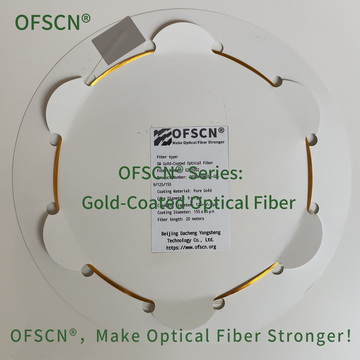
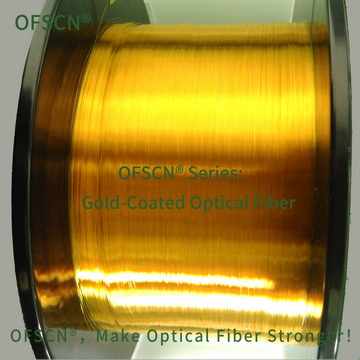
2. OFSCN® Gold-coated Optical Fiber
- Coating Material: High-purity Gold (Au)
- Operating Temperature Range: Single-mode gold-coated fiber -270\ ^\circ\text{C} to 700\ ^\circ\text{C}, Multi-mode gold-coated fiber -270\ ^\circ\text{C} to 650\ ^\circ\text{C}
- Geometric Parameters: Single-mode core diameter 9\ \mu\text{m} (Multi-mode optional 50\ \mu\text{m} / 62.5\ \mu\text{m} ), Cladding diameter 125\ \mu\text{m}, Coating diameter 155\ \mu\text{m}

3. OFSCN® 300℃ Fiber Optic Patch Cord
For direct splicing and testing in cryogenic environments, stainless steel seamless pipe armored polyimide fiber patch cords are typically used:
- Structural Components: Fiber connector (FC, ST; PC/APC), 0.9\ \text{mm} stainless steel seamless pipe, and 300\ ^\circ\text{C} polyimide optical fiber
- Operating Temperature Range: -270\ ^\circ\text{C} to 300\ ^\circ\text{C}

