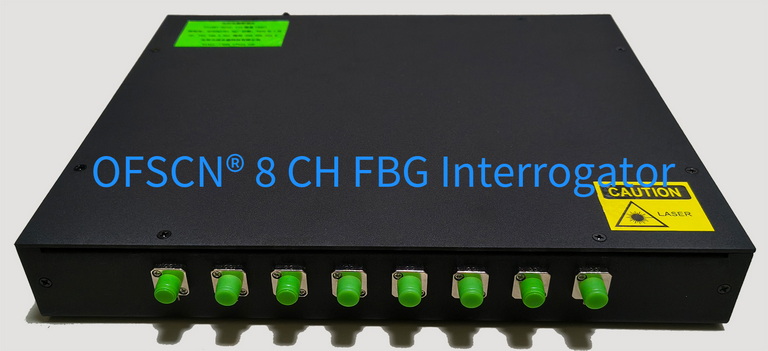
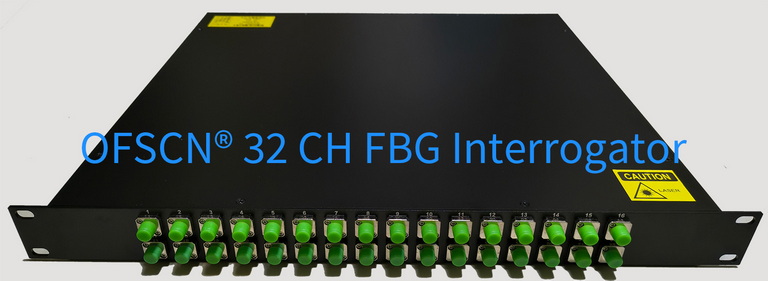
After replacing the sensor, can the software automatically find the new wavelength position?
Yes, the interrogator software can automatically find new wavelength positions. This is precisely the core function of the “Automatic Peak Searching” feature in a fiber Bragg grating demodulator system.
I. Working Principle of Automatic Peak Searching
The operation of Fiber Bragg Grating (FBG) sensors is based on narrow-band reflection characteristics, where the reflection center wavelength satisfies the Bragg condition:
\lambda_B = 2 n_{\text{eff}} \Lambda
When a new sensor is connected, the system automatically identifies the new wavelength through the following process:
- Full Spectrum Scan: The interrogator’s internal light source and spectral detection module perform continuous periodic scans within the working wavelength range (e.g., 1525\text{ nm} \sim 1565\text{ nm} or 1528\text{ nm} \sim 1568\text{ nm}).
- Peak Extraction Algorithm: The demodulator software uses built-in algorithms (such as the centroid method, Gaussian fitting, or threshold extremum method) to perform real-time mathematical calculations on the acquired reflection spectrum.
- Automatic Capture and Lock: As long as the reflected signal strength from the newly connected sensor exceeds the set signal threshold, the software automatically identifies the center position of the reflection peak and displays the current wavelength in real-time (in units of \text{nm} or \text{pm}).
II. Engineering Considerations When Replacing Sensors
Although the software can automatically capture wavelengths, several points need attention during actual operation:
- Wavelength Range Matching: The center wavelength of the newly connected sensor must fall within the spectral working range of the interrogator.
- Signal Strength and Peak Search Threshold: If the fiber fusion loss is too high, the connector is dirty, or the bending radius is too small, causing optical power attenuation, the reflected peak amplitude may be too low to trigger peak searching. In such cases, clean the connector (e.g., standard FC/APC connector) or fine-tune the peak search threshold in the software.
- Physical Quantity Calibration Formula Update:
- The software automatically obtains the raw wavelength physical quantity (\text{nm} / \text{pm}).
- To calculate precise engineering physical quantities (such as temperature ℃, strain \mu\varepsilon, stress \text{MPa}), the coefficients from the new sensor’s factory calibration sheet (e.g., linear/quadratic coefficients for temperature, or strain calibration coefficients) need to be entered into the software channel configuration.