Why do the optical properties of light change inside the fiber when it is subjected to mechanical pressure or squeezing?
The change in optical properties within a fiber under mechanical pressure or squeezing is primarily due to a physical phenomenon called Stress-Birefringence.
1. The Physical Mechanism: Photoelastic Effect
When an optical fiber (typically made of silica) is subjected to mechanical pressure or transverse squeezing, the isotropic nature of the glass is broken. This is known as the Photoelastic Effect.
In an undisturbed fiber, light travels at the same speed regardless of its polarization. However, when you squeeze the fiber:
- Refractive Index Change: The mechanical stress alters the density and electronic structure of the glass along the axis of the pressure.
- Anisotropy: This creates two distinct principal axes (fast and slow axes) with different refractive indices.
- Phase Shift: Light components polarized parallel to the pressure travel at a different velocity than those polarized perpendicular to it.
2. Impact on Fiber Bragg Gratings (FBG)
For FBG sensors, this effect is highly significant. If a standard FBG is subjected to non-uniform transverse pressure:
- Peak Splitting: The single reflection peak may split into two separate peaks. This happens because the FBG now “sees” two different optical paths due to the induced birefringence.
- Signal Distortion: This can lead to measurement errors if the sensing system is not designed to handle polarized light shifts.
3. DCYS (OFSCN) Technical Solutions
At Beijing Dacheng Yongsheng Technology Co., Ltd. (OFSCN®), we account for these optical property changes in our sensor designs. To mitigate or utilize these effects, we offer specialized products:
- Polarization-Maintaining (PM) FBG Sensors: These are designed with intentional internal stress (using PANDA or Bow-tie structures) to maintain a stable polarization state, making them less susceptible to external random squeezing.
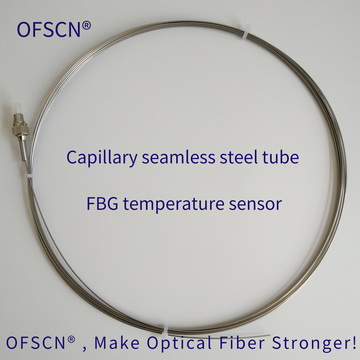
- Specialized Packaging: Our OFSCN® Capillary Seamless Steel Tube Series provides robust mechanical protection. The seamless steel tube shields the fiber from direct transverse squeezing, ensuring that the optical properties remain stable even in harsh industrial environments.
Related Products:
OFSCN® 800°C Fiber Bragg Grating Temperature Sensor (Seamless Steel Tube)
OFSCN® Alloy Tube Packaged Fiber Bragg Grating strain sensor
Product Image (Example of Protective Packaging):




For more detailed technical parameters on how our sensors handle mechanical stress, you may explore our knowledge base or visit the product links above.