Does the vibration direction of light affect sensing? Why do certain fibers need to maintain polarization (PM fibers)?
In the field of fiber optics and Fiber Bragg Grating (FBG) sensing, the vibration direction of light—known as Polarization—plays a critical role in both signal stability and sensor performance.
1. Does the vibration direction of light affect sensing?
Yes, it does. In a standard single-mode fiber, light consists of two orthogonal polarization modes. Under ideal conditions, these modes travel at the same speed. However, in real-world applications, external factors such as physical stress, bending, or temperature changes cause Birefringence.
Birefringence causes the two polarization modes to travel at different speeds, leading to:
- Signal Fluctuations: Polarization-Induced Fading (PIF) can cause the intensity of the signal to drop, making it difficult for an interrogator to accurately detect the FBG wavelength.
- Measurement Errors: If the polarization state shifts during a measurement, it can introduce “noise” or slight shifts in the reflected Bragg wavelength, which might be misinterpreted as a change in temperature or strain.
2. Why do certain fibers need to maintain polarization (PM Fibers)?
Polarization-Maintaining (PM) Fibers are specially designed to fix the polarization state of light as it travels. They usually feature internal “stress rods” (like PANDA or Bow-tie structures) that create intentional, high birefringence.
The key reasons for using PM fibers in FBG sensing include:
- Eliminating Signal Fading: By forcing light to travel along a specific axis, the sensor avoids random polarization shifts, ensuring a stable and consistent signal for the interrogator.
- High-Precision Sensing: In applications like Fiber Optic Gyroscopes (FOG) or high-accuracy stress sensing, PM-FBGs are used because they can separate the response of the two polarization axes. This allows for the simultaneous measurement of multiple parameters (e.g., transverse strain and temperature).
- Interferometric Stability: Many advanced sensing systems rely on the interference of light waves. If the polarization states do not match, the interference pattern disappears. PM fibers ensure these states remain aligned.
DCYS (OFSCN) Related Technology
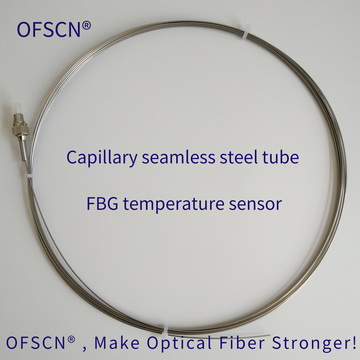
At OFSCN®, we utilize high-quality fibers and advanced packaging techniques to manage these optical properties. For most standard industrial monitoring, our seamless steel tube packaging protects the fiber from external micro-bending that could cause unwanted polarization shifts.
For users requiring high stability in harsh environments, you can explore our specialized sensor structures:
OFSCN® 800°C Fiber Bragg Grating Temperature Sensor(Seamless Steel Tube Packaged )
Standard Image for Reference:

If you have a specific application requiring PM-FBG sensors or if you are dealing with signal stability issues in a high-vibration environment, please feel free to provide more technical details.