Can the sensor be screwed into the machine’s screw hole like a screw?
What is “Bolted Installation”? Can a sensor be screwed into a machine’s threaded hole like a screw?
Answer: Absolutely. This installation method is very common for industrial sensors (including Fiber Bragg Grating sensors, or FBG sensors) and is known as “Bolted / Threaded Installation”.
Below, we delve into the technical characteristics and physical implementation process of this installation method from the perspective of physics and general engineering principles:
I. Physical and Mechanical Principles of Bolted Installation
Depending on the physical quantity being measured, the design and working principle of bolted sensors vary significantly. They can be broadly classified into two categories: temperature measurement and strain/stress measurement:
1. Bolted Temperature Sensor (Physical Process of Heat Conduction)
For temperature sensors (such as RTDs, thermocouples, or FBG temperature sensors), by encapsulating them within a metal bolt body with standard external threads (e.g., M6, M8, M10, or G1/4 specifications), they can be directly screwed into the threaded holes of machine casings or pipelines like ordinary screws.
-
Thermal Conduction Coupling: The temperature-sensitive element of the sensor (e.g., FBG sensing point) is typically located at the tip of the bolt. When the bolt is tightened, the sensor tip makes close contact with the bottom of the measured hole or the medium. Through the excellent thermal conductivity of the metal, thermal equilibrium is rapidly achieved. The heat transfer process follows Fourier’s Law of Heat Conduction:
Q = \frac{k \cdot A \cdot (T_{\text{target}} - T_{\text{sensor}})}{d}Where Q is the heat flux, k is the thermal conductivity of the material, A is the contact area, and d is the heat transfer distance.
-
Sealing and Pressure Resistance: In liquid pipelines (e.g., oil or water lines), bolted installation can provide high-pressure sealing while measuring temperature, by using sealing gaskets (copper washers, combination washers) or winding raw tape.
2. Bolted Strain/Stress Sensor (Mechanical Deformation Transfer)
Strain measurement is fundamentally different from temperature measurement. Strain (\\varepsilon) measurement requires that the deformation of the object being measured be non-destructively transferred to the sensor’s interior.
-
Single-Point Bolt Cannot Measure Strain Directly: If the sensor is only screwed into one hole like a regular screw, when the machine stretches or compresses, the sensor cannot perceive deformation due to the lack of displacement difference in a single-point constraint.
-
Dual-End Bolt Anchoring: In practical engineering, bolted strain sensors typically adopt a “dual-end anchoring” structure. The sensor body is a tube (e.g., stainless steel or elastic alloy tube) with bolts or external threads at both ends. Two corresponding holes are drilled and tapped on the machine surface, and the sensor’s ends are screwed in and tightened. When the base material between the two holes deforms slightly by \\Delta L, this deformation is transferred to the sensor:
\varepsilon = \frac{\\Delta L}{L}This enables precise measurement of structural deformation and mechanical stress.
-
Smart Bolts: FBG or other sensing elements are directly embedded into the core of high-strength bolts. When the bolt is tightened or subjected to operational load, its axial direction experiences tension, causing the internal fiber to stretch. The change in reflected wavelength can directly calculate the bolt’s preload and stress state.
II. OFSCN® (Dacheng Yongsheng) Related Technical Solutions and Product Matching
To achieve stable, long-term threaded fastening installation on machines or structural components, OFSCN® provides dedicated sensor mounting fixtures and adapter products, avoiding the issues of aging adhesives or inconvenient on-site welding:
1. OFSCN® FBG Installation Fixture
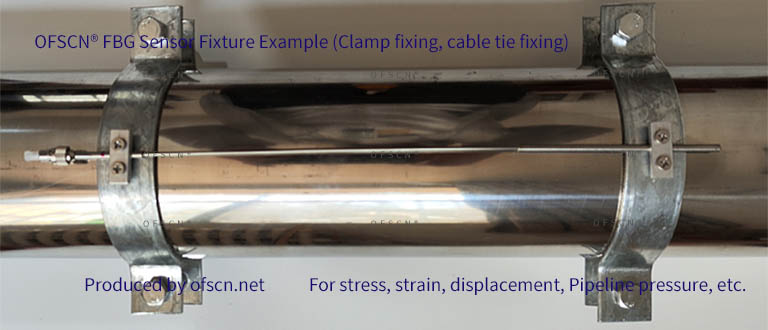
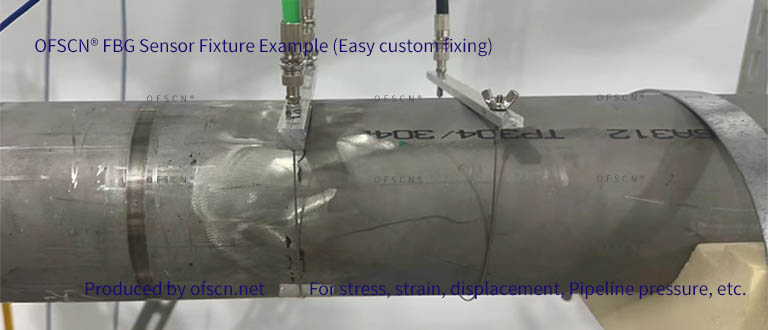
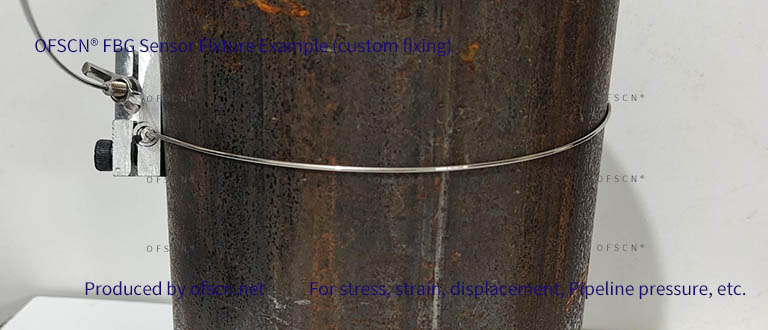
For tubular Fiber Bragg Grating sensors, such as the OFSCN® Alloy Tube Packaged Fiber Bragg Grating strain sensor, dedicated OFSCN® Installation Fixtures can be used for mechanical anchoring. These fixtures feature screw holes and can be locked into pre-existing threaded holes on the machine using ordinary bolts or screws. The sensor’s steel tube is then clamped into the fixture’s groove. This perfectly addresses the rigid requirement of “fixing sensors using existing threaded holes when welding or gluing on precision machine surfaces is not feasible.”
Below are structural displays of relevant installation fixtures and sensors provided by OFSCN®:


2. Typical Product Applications
For bolted installation on specific rotating equipment or pipelines:
- For temperature measurement in high-temperature and high-pressure pipelines, the OFSCN® 300°C Fiber Bragg Grating Temperature Sensor can be installed within a customized bolt sheath.
- For surface strain monitoring, it is recommended to use the OFSCN® Installation Fixture with threaded fastening holes for dual-end alignment and locking, ensuring the accuracy and long-term stability of strain wavelength calibration.