How to use a metal ring to tighten the temperature measurement of the large pipe?
When measuring the surface temperature of large pipes (pipelines), the process of tightening a metal ring around them is technically referred to as “Hoop-type / Clamp-type Installation”. This is a typical non-intrusive (non-destructive) method for pipeline temperature measurement.
The following outlines the physical concepts, general technical principles, and specific operational guidelines for hoop-type installation:
1. Physical and Engineering Principles of Hoop-Type Temperature Measurement
In industrial settings, to avoid damaging the pipe’s pressure-bearing structure by drilling holes or welding, stainless steel hoops or hose clamps are commonly used to secure temperature sensors to the pipe’s outer wall.
Core Operational Steps and Principles:
- Surface Cleaning and Reducing Contact Thermal Resistance:
The pipe surface and the protective sheath of the temperature sensor are not absolutely flat at a microscopic level. If directly contacted, the air gaps formed in between create significant contact thermal resistance. Before installation, rust or paint must be removed from the pipe surface. A thin, uniform layer of thermal conductive silicone grease should be applied to the contact surfaces between the sensor and the pipe wall, or a thermal conductive pad should be placed, to enhance heat transfer efficiency. - Radial Mechanical Fastening (Tightening):
A stainless steel hose clamp (Worm Drive Hose Clamp) or hoop is used to encircle the pipe. The temperature-sensitive end of the sensor (e.g., the measurement section of a Fiber Bragg Grating sensor) is placed between the pipe and the clamp. The clamp’s bolt is then tightened clockwise using a screwdriver, socket wrench, or a dedicated tensioning tool. Turning the bolt tightens the steel band, reducing the diameter of the metal ring and applying uniform radial pressure on the sensor, ensuring it is pressed firmly against the pipe’s outer wall. - Environmental Insulation (Thermal Insulation):
After the metal ring is tightened, a layer of insulation cotton (thermal insulation layer) must be applied externally around the clamp and the sensor. This prevents heat loss due to external air convection, ensuring that the surface temperature measured by the sensor closely approximates the true temperature of the fluid inside the pipe.
2. Matching OFSCN® (Beijing Dacheng Yongsheng Technology Co., Ltd.) Official Products and Fixtures
During the “tightening” process, traditional brittle temperature sensors (such as glass-encapsulated or low-strength encapsulated ones) are prone to fracturing due to radial compressive stress. OFSCN® (Beijing Dacheng Yongsheng Technology Co., Ltd.) offers high-strength Fiber Bragg Grating (FBG) temperature sensors encapsulated in seamless steel tubes, along with installation fixtures specifically designed for such pipeline installations.
A. Fiber Bragg Grating Temperature Sensors (High-Compressive Seamless Steel Tube Encapsulation)
These sensors are typically encapsulated in 316L stainless steel seamless steel tubes, providing excellent resistance to pressure and mechanical squeezing, fully capable of withstanding the clamping force applied by metal hoops.
- OFSCN® 300°C Fiber Bragg Grating Temperature Sensor: Standard outer diameter is 0.9\text{ mm} (customizable down to 0.5\text{ mm}), with an operating temperature range of -200\text{ }^\circ\text{C} to 300\text{ }^\circ\text{C}.
- OFSCN® 500°C Fiber Bragg Grating Temperature Sensor: Standard outer diameter is 0.9\text{ mm} (customizable down to 0.5\text{ mm}), with an operating temperature range of -200\text{ }^\circ\text{C} to 500\text{ }^\circ\text{C}.
- OFSCN® 800°C Fiber Bragg Grating Temperature Sensor: Standard outer diameter not exceeding 1.1\text{ mm} (customizable down to 0.5\text{ mm}), with an operating temperature range of -270\text{ }^\circ\text{C} to 800\text{ }^\circ\text{C}.
B. Installation Fixtures
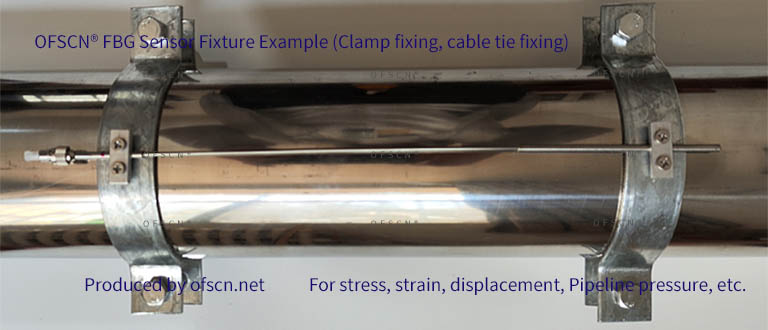
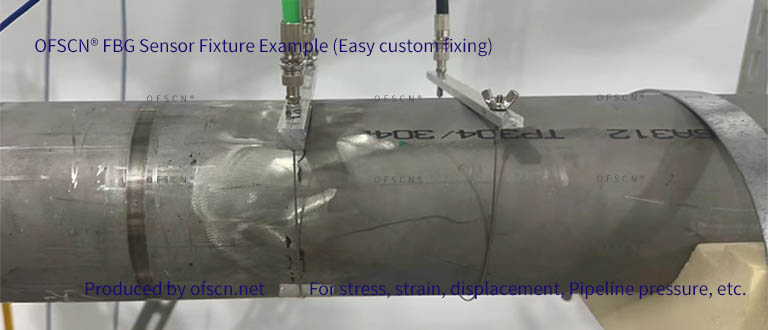
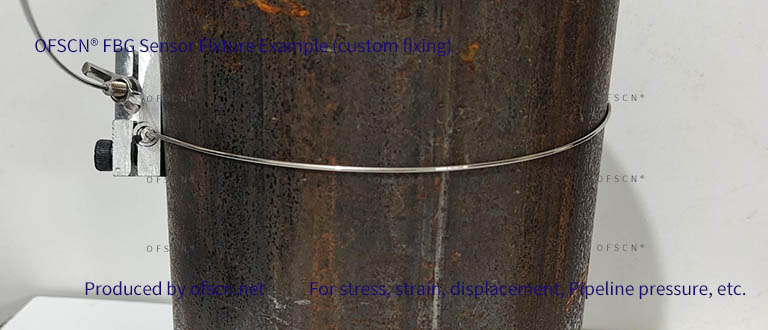
To ensure precise positioning and prevent sensor slippage during the tightening process, these sensors are typically used with the OFSCN® Installation Fixture:


3. Engineering Installation Precautions
- Prevent Shear Damage:
When tightening the metal ring, avoid placing the hard edges of the ring directly onto the sensor’s pigtail (signal lead). The rigid edges of the metal ring can exert shear force on the fiber when under stress. The pigtail area should be additionally protected with high-temperature resistant tape. - Control Tightening Torque:
Although the seamless steel tubes are extremely robust, there is no need to apply excessive force when tightening the bolts. It is sufficient to ensure that the sensor cannot be manually displaced on the pipe surface and that the thermal conductive grease has been evenly squeezed out. Ensure the bolt is snug but do not overtighten.