How to prevent optical fibers from fading under radiation by changing the glass composition?
The phenomenon of “fading” or “darkening” of optical fibers in a radiation environment is known in optical engineering as Radiation-Induced Attenuation (RIA). The fundamental physical cause is the creation of light-absorbing “color centers” in the glass matrix by high-energy radiation.
By altering the glass formulation and microstructure, color center precursors can be effectively eliminated, and radiation-induced attenuation suppressed. The specific engineering and physical mechanisms are as follows:
I. Mechanism of Fiber “Discoloration/Color Center” Generation Under Radiation
When high-energy ionizing radiation (such as \gamma rays, X-rays, neutron flux, etc.) penetrates the silica (\text{SiO}_2) glass network, the high-energy particles knock electrons out of the lattice, breaking chemical bonds and forming free radicals and dangling bonds.
These lattice defects that have captured electrons or holes are “color centers” (e.g., E' centers, non-bridging oxygen hole centers NBOHC, etc.). Color centers exhibit strong absorption bands in the ultraviolet, visible, and near-infrared regions, leading to a sharp decrease in fiber transmittance, macroscopically observed as glass fading, darkening, or even blackening.
II. Core Technical Approaches to Eliminate Color Centers by Modifying Glass Formulation
1. Replacing Germanium-Doped Core with Pure Silica Core (PSC)
- Physical Mechanism: Standard single-mode fibers typically dope the core with germanium (\text{Ge}) to increase the refractive index. However, defect bonds like \text{Ge-Si} or \text{Ge-Ge} are highly susceptible to breaking under radiation, generating numerous Ge(1), Ge(2), and Ge(E') color centers.
- Formulation Improvement: Completely eliminate germanium doping in the core and use pure silica (pure silica core) as the core material. By removing germanium precursor defects, the color center generation rate in the fiber under irradiation can be reduced by one to two orders of magnitude.
2. Doping the Cladding with Fluorine (F) Element
- Physical Mechanism: The refractive index of a pure silica core is low. To maintain the total internal reflection light guiding structure of the fiber, the refractive index of the cladding needs to be reduced.
- Formulation Improvement: Introduce fluorine (\text{F}) doping into the cladding or at the core-cladding interface. Fluorine not only effectively lowers the cladding refractive index but also acts as a glass network terminator and stress reliever, eliminating strained bonds in the glass and significantly suppressing the formation of \text{Si-}E' color centers under radiation.
3. Strict Control of Impurity Defects (e.g., Low Chlorine Formulation)
- Physical Mechanism: Chlorine (\text{Cl}) atoms remaining during the Vapor Axial Deposition (VAD/MCVD) process for fiber fabrication can form very strong precursor absorption color centers under radiation.
- Formulation Improvement: Employ dechlorination and low-chlorine formulation processes to reduce Chlorine impurities in the glass matrix to extremely low levels, preventing the formation of additional radiation absorption peaks.
4. Hydroxyl (-\text{OH}) Control and Hydrogen Loading Passivation
- Physical Mechanism: Retain or pre-introduce appropriate amounts of hydroxyl (-\text{OH}) in the glass formulation, or pre-dissolve hydrogen gas (\text{H}_2) in the fiber matrix.
- Formulation Mechanism: When radiation breaks chemical bonds and creates non-bridging oxygen hole centers (\text{Si-O}\bullet), free hydrogen radicals rapidly passivate them through combination:\text{Si-O}\bullet + \text{H}\bullet \rightarrow \text{Si-OH}This reaction converts color centers that strongly absorb light into stable \text{Si-OH} structures with no strong absorption in the transmission window, achieving “self-healing” of color centers.
III. Related Specialty Fiber Technologies
In specialty fiber engineering applications, for scenarios requiring consideration of extreme environments such as high temperatures and high radiation, customized drawing is typically based on the aforementioned pure silica core formulation. Beijing Dacheng Yongsheng Technology Co., Ltd.'s (OFSCN®) related specialty fiber products support custom pure silica core formulations:
-
OFSCN® 300℃ SM Polyimide Optical Fiber (Supports custom pure silica core formulation)
-
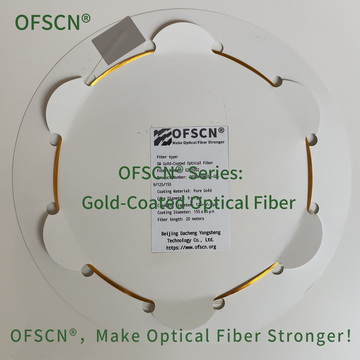
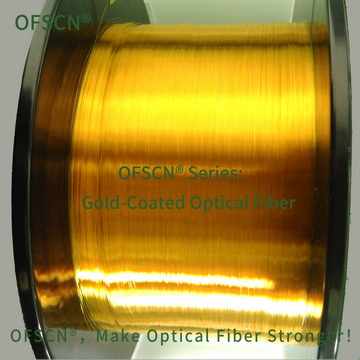
OFSCN® Gold-coated Optical Fiber (Supports custom pure silica core formulation)