In radioactive environments like nuclear power plants, why do optical fibers turn black? Can they still transmit signals after blackening?
In environments with high-energy radiation (such as \gamma rays, neutron radiation, X-rays, etc.), such as nuclear power plants, the phenomenon of optical fiber “darkening” occurs. In optical engineering, this is known as the Color Center Effect, and the resulting optical attenuation process is called Radiation-Induced Attenuation (RIA).
I. Physical Mechanism of Fiber “Darkening” (Color Center Effect)
Optical fibers are primarily composed of high-purity silica ( \text{SiO}_2 ) glass. The core is typically doped with elements like germanium ( \text{Ge} ), boron ( \text{B} ), or phosphorus ( \text{P} ) to adjust the refractive index. When high-energy particles or rays pass through the fiber, the following physical processes mainly occur:
- Chemical Bond Scission and Ionization: High-energy radiation can break covalent bonds in the silica and doped network (e.g., \text{Si}-\text{O} or \text{Ge}-\text{O} bonds), exciting and releasing a large number of free electrons and holes.
- Defect Trapping and Color Center Formation: These free electrons or holes are captured by lattice defects, unsaturated dangling bonds, or impurity-doped energy levels within the glass. This forms charged defect centers with specific energy level structures, known as “color centers” (e.g., E' centers, non-bridging oxygen hole centers NBOHC, etc.).
- Spectrally Selective Absorption: Color centers create additional strong absorption bands in certain spectral regions (mainly ultraviolet, visible, and near-infrared). Visually, the glass medium loses its original transparency and gradually darkens; in optical transmission measurements, this manifests as a significant increase in transmission loss (attenuation).
II. Can Optical Signals Still Be Transmitted After Darkening?
The feasibility of transmitting signals through a darkened fiber depends on the **Radiation-Induced Attenuation amount ( \Delta \alpha ) ** , the **optical transmission distance ( L ) ** , and the dynamic range of the optical receiver:
-
Standard Doped Optical Fibers (e.g., conventional G.652D Ge-doped fibers):
As the accumulated radiation dose increases, the density of color centers inside ordinary fibers rises rapidly. The attenuation coefficient can increase by tens to hundreds of \text{dB/km} . Optical signals are absorbed within a short distance, causing signal interruption in optical communication or sensor systems, rendering normal transmission impossible. -
Radiation-Resistant Specialty Optical Fibers (e.g., pure silica core fibers):
Using a Pure Silica Core (PSC) structure, where elements like germanium that can form color center precursors are not doped into the core, can significantly inhibit color center formation. Under the same radiation dose, the RIA increase in pure silica core fibers is controlled at a lower level, allowing for stable optical signal transmission. Additionally, high-intensity light (photobleaching effect) or elevated temperatures (thermal annealing effect) can promote the recombination of some color center defects, reducing fiber absorption loss.
III. Official OFSCN® Products and Pure Silica Core Customization
For applications in complex industrial environments involving irradiation and high temperatures, specialty fiber products offered by Beijing Dacheng Yongsheng Technology Co., Ltd. (OFSCN®) support pure silica core customization to meet radiation-resistant optical transmission and sensing requirements:
- OFSCN® 300℃ SM Polyimide Optical Fiber: Features a high-temperature resistant polyimide coating, with an operating temperature range of -200℃ to 350℃. It comes with a standard doped core but can be customized with a pure silica core.


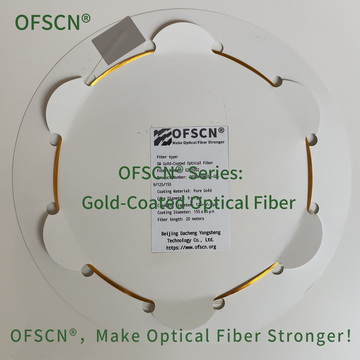
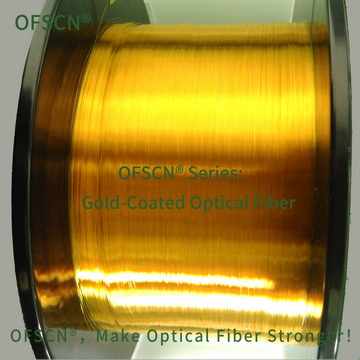
- OFSCN® Gold-coated Optical Fiber: Features a metal gold coating, with an operating temperature range of -270℃ to 700℃. It comes with a standard doped core but can be customized with a pure silica core.