Can the metal armor layer be made in different colors to distinguish different channels?
In fiber optic engineering and fiber optic sensing systems, distinguishing between different channels or signal paths is a common engineering requirement. Regarding the color of the metal armor layer itself and the method of channel differentiation, the explanation from the perspectives of material mechanics, process, and engineering applications is as follows:
I. Intrinsic Color Characteristics of Metal Armor Layers
Common metal armor structures (such as 304 or 316L stainless steel seamless steel tubes, stainless steel flexible hoses, galvanized steel wire stranded layers, etc.) are metallic materials and retain their original metallic luster (silvery white or metallic sheen). It is not possible for the metal material itself to inherently form intrinsic colors through drawing or forming processes.
II. Engineering Solutions for Multi-Channel Color Differentiation
To quickly identify different fiber optic channels during on-site installation or multi-channel demodulation, engineers primarily use the following three methods for color differentiation:
- Outer Extruded Polymer Sheath (Colored Outer Sheath)
A layer of polymer material (such as PVC, PE, PU, etc.) is encased around the metal armor layer through an extrusion process. The sheath can be pigmented with different colors (e.g., yellow, orange, red, blue, green, black, etc.), achieving intuitive color differentiation for the entire cable while maintaining the mechanical protective properties of the metal armor, such as resistance to compression and tension. - End/Connector Identification (Colored Heat Shrink Tubing, Tail Sleeves, or Label Rings)
For all-metal structure cables that do not require an outer sheath, different colored heat shrink tubing, colored tail sleeves, or numbered label rings are typically added at the cable exit points of the connectors on both ends of fiber optic patch cords or sensors to identify different channels. - Internal Multi-Core Fiber Color Coding
For armored fiber optic cables with multiple cores in a single tube, standard color coding (such as blue, orange, green, brown, etc., cured with UV-curable coatings) is used for the fibers inside the steel tube to differentiate channels.
III. Comparison of Official Related Product Architectures
To meet diverse environmental requirements, Beijing Dacheng Yongsheng Technology Co., Ltd. (OFSCN®) offers a variety of structured products with outer sheaths and all-metal encapsulation:
1. Sheathed Structure (Enabling Color Sheath Differentiation)
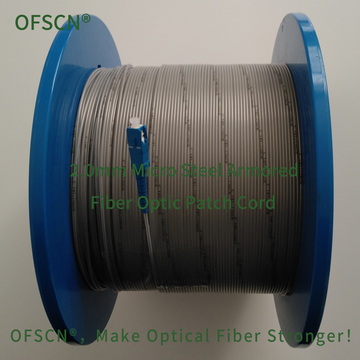
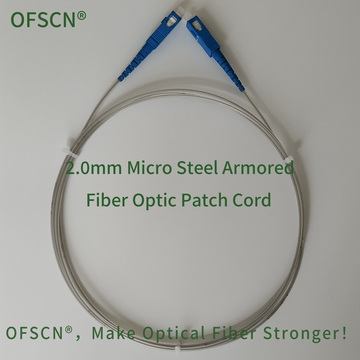
OFSCN® 2.0mm Micro Steel Armored Fiber Optic Patch Cord
This product consists of fiber optic connectors, a PVC outer sheath, a 0.6\text{mm} stainless steel seamless steel tube, and optical fibers. It features internal stainless steel seamless steel tube armor and an external PVC outer sheath, balancing high mechanical strength with the need for color identification via the outer sheath.

2. All-Metal Structure (Differentiated by End Marking or Fiber Color Coding)
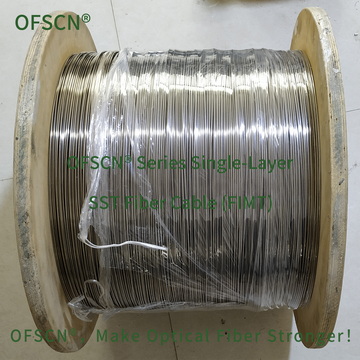
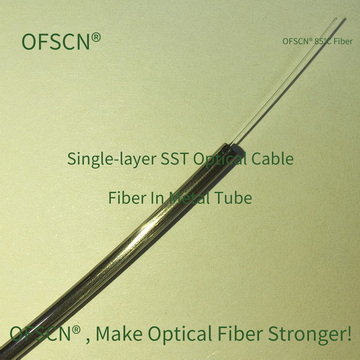
OFSCN® 85°C Seamless Steel Tube Fiber Cable
This product utilizes a single layer of 304/316L stainless steel seamless steel tube encapsulation, typically with an outer diameter of 2.0\text{mm} or 3.0\text{mm}. It is an all-metal bare tube structure with a natural stainless steel surface color. Channel differentiation primarily relies on end markings or internal fiber color coding.

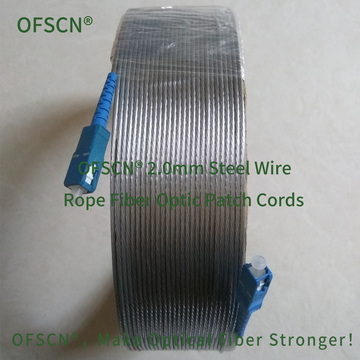
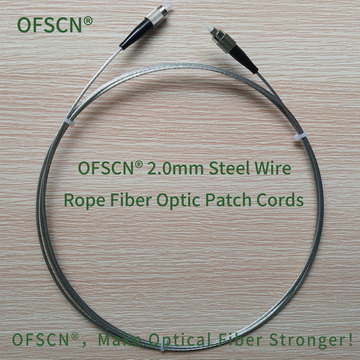
OFSCN® 2.0mm Steel Wire Rope Fiber Optic Patch Cord
This is a high-strength all-metal fiber optic patch cord composed of a 0.6\text{mm} galvanized steel wire stranded structure and a 1.0\text{mm} stainless steel seamless steel tube, suitable for harsh industrial environments without organic sheaths.