Why are some tubes shiny and others black?
tool_0:
tool_0:
Fiber sensors and fiber optic cables exhibit different external colors (e.g., a “shiny” bare metal or a “black” jacket), primarily determined by the outermost structural material and environmental requirements.
I. Differences in Physical and Engineering Principles
1. Shiny Appearance (All-Metal/Bare Metal Seamless Steel Tube Structure)
- Material Composition: The outermost layer is directly exposed stainless steel (e.g., 304, 316L stainless steel) or elastic alloy seamless steel tubing, without any plastic coating or jacketing.
- Appearance Characteristics: Retains the inherent reflective luster of the metal material, presenting a metallic sheen.
- Application Advantages:
- Extreme High-Temperature Resistance: Polymer jackets melt and fail at high temperatures. The all-metal structure can withstand extreme temperatures (e.g., 100^\circ\text{C} to 800^\circ\text{C} ).
- Miniaturized Dimensions: Without a plastic layer, the outer diameter of the tube can be very small (e.g., outer diameters of 0.5\text{ mm} , 0.6\text{ mm} , 0.9\text{ mm} , or 1.2\text{ mm} ).
- Mechanical Protection: Offers good compressive strength, suitable for direct burial or applications requiring protection against rodent damage and splash impacts.
2. Black Appearance (Polymer Jacket/Polymer Outer Sheath)
- Material Composition: Beyond the internal metal seamless tube or armored structure, an additional layer of polymer outer sheath (such as Polyethylene PE, Polyvinyl Chloride PVC, Polyurethane PU, or black polymer material) is extruded.
- Appearance Characteristics: The surface exhibits a matte black or semi-gloss plastic jacket layer.
- Application Advantages:
- Chemical Protection and Waterproofing: Effectively isolates against corrosion from acid-base solutions, moisture, and salt spray.
- UV Resistance and Aging Protection: Black jackets typically contain carbon black, providing excellent resistance to UV aging, making them suitable for long-term outdoor or underground installations.
- Friction Buffering and Bending Protection: Enhances flexibility and handling during routine installation work, often used in normal or medium-low temperature environments (e.g., -40^\circ\text{C} to 85^\circ\text{C} ).
II. OFSCN® Official Product Examples
1. Bare Metal Encapsulation (“Shiny” Appearance)
-
OFSCN® 300°C Fiber Bragg Grating Temperature Sensor: Encapsulated in a single layer of stainless steel seamless steel tubing, with a temperature resistance up to 300^\circ\text{C} , and a default outer diameter of 0.9\text{ mm} .
-
OFSCN® 300°C Seamless Steel Tube Fiber Cable: Encapsulated in 316L stainless steel seamless steel tubing, this is an all-metal structural sensing fiber optic cable.
-
OFSCN® 2.0mm Steel Wire Rope Fiber Optic Patch Cord: An all-metal fiber optic patch cord composed of galvanized steel wire rope and a stainless steel seamless steel tube.

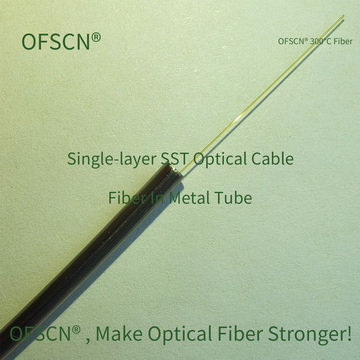

2. Black Jacket Encapsulation (“Black” Appearance)
-
OFSCN® 3.0mm Steel Wire Rope Fiber Optic Patch Cord: Contains a stainless steel seamless steel tube and steel wire rope structure internally, with an outer black PE jacket, offering high tensile and compressive strength.
-
OFSCN® 2.0mm Micro Steel Armored Fiber Optic Patch Cord: The inner layer uses a 0.6\text{ mm} stainless steel seamless steel tube to protect the fiber, with an outer black PVC jacket.

