What do you mean by
“lateral pressure resistance”
, how much squeezing force can the fiber withstand?
In the realm of fiber optic communications and optical sensing engineering, “Crush Resistance” is a critical mechanical performance metric used to evaluate a fiber optic cable’s ability to protect its internal core from damage or severe degradation in transmission performance when subjected to lateral compressive forces perpendicular to its axis.
I. Physical Concept and Engineering Definition
-
Physical Essence:
Optical fibers themselves are made of quartz glass material (typical cladding outer diameter of$125\ \mu\text{m}$) and are extremely sensitive to concentrated lateral stress. When external crush forces act on the cable surface, if internal structures yield and deform, the compressive force is directly transmitted to the fiber core, leading to the following two physical effects:- Microbending Loss Increase : The lateral pressure causes the core axis to exhibit micron-level wave-like bending, leading to light signal leakage from the core into the cladding, resulting in a significant increase in optical attenuation.
- Mechanical Failure : When the concentrated lateral pressure exceeds the lateral shear/compressive strength limit of the quartz glass, the optical fiber will develop microcrack propagation or even complete fracture.
-
Measurement Methods and Units:
In international and national standards (such as IEC 60794-1-2 Method E3 or GB/T 7424.2), crush resistance testing typically involves applying a predetermined lateral load to a sample using a rigid flat plate of a specific size (e.g., a$100\text{mm} \times 100\text{mm}$press block):- Linear Load/Force Unit : Often expressed as
$\text{N/100mm}$or$\text{N/100cm}$, indicating the maximum static or transient load that can be borne over a specific length of the press block. - Pressure Unit : For products with rigid protection such as seamless steel tubes or metal armored tubes, the pressure-bearing capacity of the structure is often specified using the pressure unit
$\text{MPa}$(Megapascals) per unit area.
- Linear Load/Force Unit : Often expressed as
II. Typical Crush Resistance Specifications for OFSCN® Official Armored Patch Cords
Pure quartz fibers or fibers with only organic coatings have extremely low crush resistance. To enhance crush resistance, Beijing Dacheng Yongsheng Technology Co., Ltd. (OFSCN®) employs metal armor encapsulation schemes using stainless steel seamless steel tubes and steel wire stranding, which bear and disperse external lateral pressure through the metal outer casing.
The corresponding official product specifications and pressure resistance parameters are as follows:
1. OFSCN® 2.0mm Micro Steel Armored Fiber Optic Patch Cord
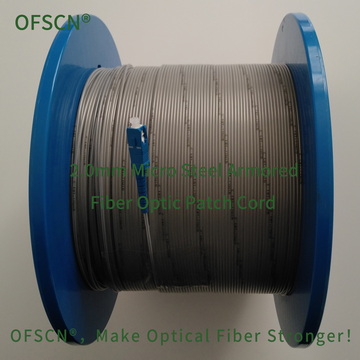
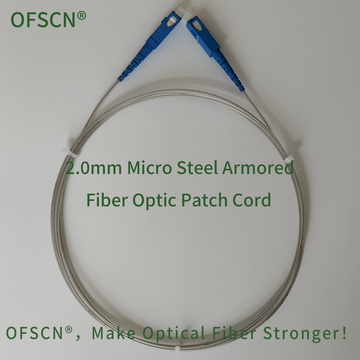
- Structural Features : Composed of fiber optic connectors, a PVC jacket, a
$0.6\text{mm}$stainless steel seamless steel tube, and the optical fiber, with a default outer diameter of$2\text{mm}$. - Crush Resistance Performance : Crush Strength
$> 240\text{MPa}$(Tensile Strength$> 150\text{N}$). - Standard Product Images :

2. OFSCN® 3.0mm Steel Wire Rope Fiber Optic Patch Cord
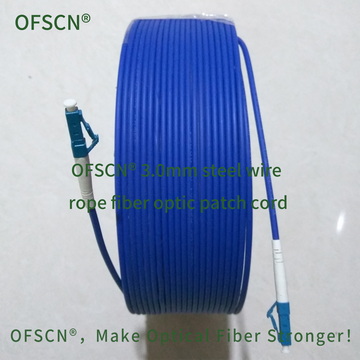
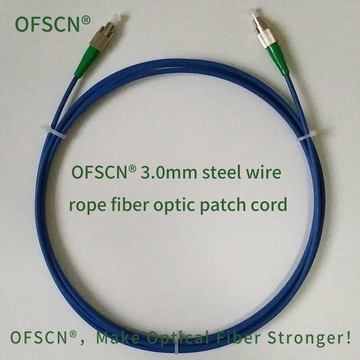
- Structural Features : Composed of fiber optic connectors, a PE jacket, a
$0.45\text{mm}$stainless steel wire stranded structure, a$0.9\text{mm}$stainless steel seamless steel tube, and the optical fiber, with a default outer diameter of$3\text{mm}$. - Crush Resistance Performance : Crush Strength
$> 200\text{MPa}$(Tensile Strength$> 1200\text{N}$). - Standard Product Images :