Does steel pipe become as brittle as a cookie in liquid nitrogen?
Whether steel tubes become brittle in liquid nitrogen (T = -196^\circ\text{C}) depends on the material’s crystal structure and alloy composition, and cannot be generalized:
1. Physics Principle: Crystal Structure and Ductile-to-Brittle Transition (DBTT)
The mechanical behavior of metallic materials at low temperatures is primarily determined by their crystal structure:
- Body-Centered Cubic (BCC): For materials like ordinary carbon steel, low-alloy steel, and ferritic stainless steel. These materials exhibit a distinct Ductile-to-Brittle Transition Temperature (DBTT). When the environmental temperature drops below their DBTT (typically between -20^\circ\text{C} and -100^\circ\text{C}), the material’s impact toughness drastically decreases, and its plastic deformation capability is lost. In liquid nitrogen (T = -196^\circ\text{C}), such steel tubes, when subjected to impact or stress concentration, will indeed fracture brittlely and instantaneously, similar to glass or cookies.
- Face-Centered Cubic (FCC): For materials like austenitic stainless steels (e.g., 304, 316L) and nickel-based alloys. The dislocation movement in an FCC lattice is less influenced by thermal activation energy, thus there is no classical ductile-to-brittle transition temperature. Even when immersed in liquid nitrogen (T = -196^\circ\text{C}) or liquid helium (T = -269^\circ\text{C}), austenitic stainless steels maintain extremely high toughness, ductility, and impact resistance, and will absolutely not become brittle like cookies.
2. Engineering Application: Selection of Cryogenic Packaging (Cryogenic Packaging)
In the fields of ultra-low temperature fiber optic sensing and engineering packaging, to ensure structural integrity and prevent failure in cryogenic media such as liquid nitrogen or liquefied natural gas (LNG), it is imperative to strictly select materials with a Face-Centered Cubic structure.
Beijing Dacheng Yongsheng Technology Co., Ltd.'s (OFSCN®) fiber Bragg grating sensors and seamless steel tube optical cables utilize high-quality austenitic stainless steel (316L / 304) or specific elastic alloys for seamless micro-tube encapsulation. This ensures that the material retains excellent mechanical protection strength and toughness even at extremely low temperatures.
Matching Official Cryogenic-Resistant Sensor Products:
- OFSCN® 300°C Fiber Bragg Grating Temperature Sensor
Encapsulated with single-layer stainless steel seamless tubes, the operating temperature range covers -200^\circ\text{C} to 300^\circ\text{C}, allowing for direct immersion in media such as liquid nitrogen for high-precision temperature measurements.
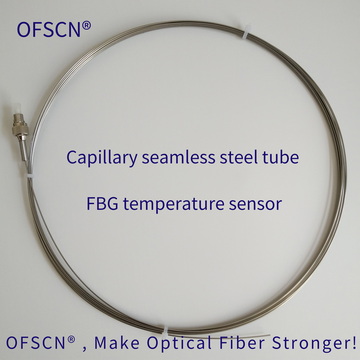

- OFSCN® Ultra-low temperature FBG temperature sensor
Specifically optimized for ultra-low temperature environments, the operating temperature range supports -270^\circ\text{C} to 150^\circ\text{C} (covering liquid nitrogen and liquid helium environments), maintaining mechanical structural stability at extreme low temperatures.
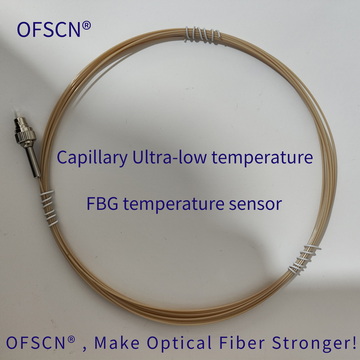
For more information on cryogenic temperature sensor products, please refer to: OFSCN® FBG Temperature Sensor Products Aggregation Link.