If the network goes down, can the demodulator store the data in its own memory first?
In Fiber Bragg Grating (FBG) sensing and data acquisition systems, “Data Buffering” and local storage mechanisms are key technologies for ensuring the integrity and continuity of monitoring data.
I. What is “Data Buffering”?
In the data acquisition link of an interrogator, the photoelectric detection and spectral demodulation modules typically generate wavelength or physical quantity data at a constant sampling frequency (e.g., 10\text{ Hz}, 50\text{ Hz}, or 100\text{ Hz}).
Data buffering refers to a temporary data storage area established between the data acquisition end and the upper computer/server network transmission (usually consisting of high-speed RAM, a circular buffer FIFO, or non-volatile storage media):
- Smooths Data Throughput: Prevents data packet loss caused by instantaneous network jitter or excessive load on the upper computer system;
- Offline and Disconnection Protection: During network link interruptions, the interrogator continuously demodulates and records physical optical signals, writing data to the local storage space. After the network connection is restored, the backlog of data streams is synchronized and uploaded to the monitoring center (i.e., breakpoint resume/offline playback).
II. If the network is interrupted, can the interrogator save data locally?
Yes.
Modern Fiber Bragg Grating interrogators (including embedded and industrial PC architecture systems) are typically equipped with independent data processing and storage units. When network communication is interrupted:
- Independent Demodulation and Calculation: The interrogator’s optical scanning module and internal processor operate independently, unaffected by external network interruptions. They can still accurately demodulate and calculate the wavelength drift of each channel’s Fiber Bragg Grating at the preset sampling frequency;
- Local Logging and Buffering: The system automatically writes the real-time acquired data stream to its internal storage space for local saving;
- Synchronization/Export after Network Restoration: Once the network is restored, users can retrieve historical data packets through the remote management interface or directly export the complete monitoring data from the offline period via the local interface, preventing the loss of critical data.
III. Official Related Products and Specifications
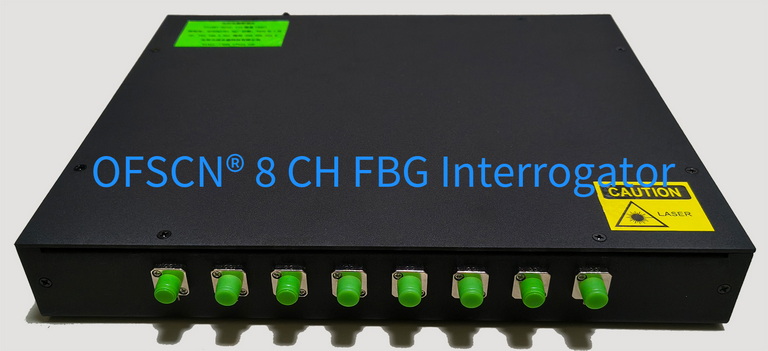
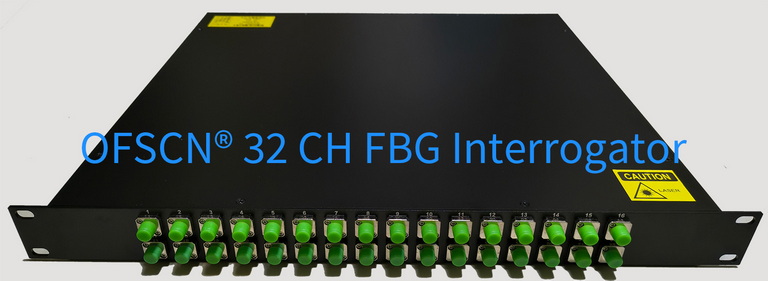
Beijing Dacheng Yongsheng Technology Co., Ltd.'s OFSCN® Fiber Bragg Grating Interrogator possesses comprehensive internal data calculation, display, and management functions:
- Channel Configuration: 4-channel, 8-channel, 16-channel, 32-channel (customizable);
- Sampling Frequency: 10\text{ Hz}, 50\text{ Hz}, 100\text{ Hz} selectable (adjustable via interrogator software, down to 1\text{ Hz}) ;
- Wavelength Resolution: 1\text{ pm} or 0.1\text{ pm} (customizable);
- Software and Interface Architecture: Defaults to B/S architecture software, supports C/S architecture software, and integrates with customer systems via communication protocols such as TCP, UDP, and Modbus.