In a confidential project, how can we ensure that the data transmitted is not intercepted and deciphered by others?
In confidential engineering and high-security monitoring projects, preventing data theft or reverse cracking during transmission and storage typically requires a multi-layered defense system built upon the physical transmission layer, network communication layer, and application data layer (data masking and decoupling):
1. Physical Transmission Layer: Natural Anti-Eavesdropping and Physical Protection of Fiber Optic Links
- No Electromagnetic Radiation Leakage: Unlike traditional electrical sensors, Fiber Bragg Grating (FBG) sensing systems transmit optical signals within optical fibers, generating no external electromagnetic radiation (EMI-free). This eliminates the risk of eavesdropping and intercepting signals through electromagnetic radiation.
- Physical Anti-Tapping and Line Monitoring: Optical fiber links can be physically protected using armoring or seamless metal steel pipes. Optical Time Domain Reflectometry (OTDR) or optical power monitoring techniques can be introduced on the main communication/sensing trunk lines. When someone attempts to tap the optical signal by attaching a device to the fiber (Fiber Tapping), the system will keenly sense abnormal optical power attenuation and trigger an alarm.
2. Network and Transport Protocol Layer: End-to-End Strong Encryption Transmission
After sensor signals are demodulated into digital signals by the demodulator, standard encrypted communication should be implemented when transmitting between the host computer or network nodes:
- Transport Layer Encryption Protocol: Employ TLS 1.3 / SSL encrypted tunnels in the network communication layer, or deploy dedicated IPsec VPNs.
- High-Strength Encryption Algorithms: Utilize AES-256 or commercial cryptographic algorithms (such as SM2 / SM3 / SM4) to perform end-to-end encryption of real-time data payloads transmitted via TCP/UDP, ensuring that even if network communication packets are sniffed and captured, attackers cannot recover the plaintext content.
- Network Physical Isolation: Critical confidential systems are typically deployed on physically isolated private networks (Air-gapped Networks), prohibiting access to the public internet.
3. Application and Data Layer: “Data Masking” and Parameter Decoupling
“Data Masking” is a core software engineering strategy to prevent data cracking. Its core idea is to strip the transmitted data from its actual physical meaning and engineering geometric coordinates:
- Transmit Only Dimensionless or Relative Wavelength Drift: On the transmission link, the system only sends channel numbers and relative wavelength changes \Delta\lambda , without directly transmitting calculated engineering physical quantities (such as absolute temperature T , absolute micro-strain \mu\varepsilon , or stress values).
- Localized Storage of Calibration Parameters and Calculation Models: Sensor calibration coefficients (like sensitivity coefficient K ), material elastic moduli, and algorithmic models are stored only in local, high-security isolated terminals or encrypted databases, and are not carried in network transmission packets.
- Point Masking and Scrambled Mapping: The physical topology of sensor points in actual engineering (e.g., “a certain rib position in a missile section,” “critical bridge bearing”) is replaced in the transmitted data packets with random Hash IDs or virtual index numbers. Even if the entire data stream is intercepted, without the mapping dictionary, it is impossible to determine the actual physical entities and specific locations corresponding to the data.
4. Hardware and System Integration Support
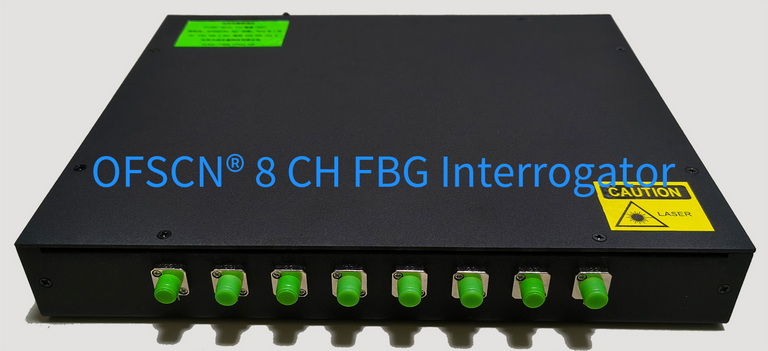
In actual engineering deployments, the Beijing Dacheng Yongsheng Technology Co., Ltd. Fiber Bragg Grating Interrogator (or OFSCN® Fiber Bragg Grating Interrogator) features B/S and C/S software architectures. It supports interfacing raw spectral and wavelength data to the user’s confidential dedicated integrated system or data masking middleware through standard protocols such as TCP, UDP, and Modbus, facilitating users to implement deeply customized encryption and security isolation strategies.