Why is it recommended to use an SQL database instead of simple text files for storing massive amounts of data?
In fiber sensing (such as Fiber Bragg Grating (FBG) sensing) and industrial condition monitoring projects, when facing massive data acquisition scenarios, adopting SQL relational databases (or specialized time-series databases) to replace simple plain text files (like TXT, CSV, etc.) for data storage is the fundamental architectural design to ensure the system’s long-term stable operation, efficient retrieval, and concurrent access.
I. Massive Data Background and Computational Overhead
Taking a typical fiber Bragg grating demodulation monitoring system as an example, if the system is configured with 32 channels, with 10 FBG sensing points in series per channel, and the sampling frequency is set to 100\text{ Hz}:
- The data volume generated by the system per second is: 32 \times 10 \times 100 = 32000 points/second.
- Continuous operation for 24\text{ h} will generate approximately 2.76 \times 10^9 records.
Under such high-throughput, continuous writing conditions, there are fundamental differences in the underlying mechanisms between text files and databases:
II. Core Technical Advantages of SQL Databases Compared to Text Files
1. Retrieval Complexity and Indexing Mechanism (O(\log N) vs O(N))
- Text Files: Data is appended linearly line by line, lacking an inherent index structure. When a user needs to query “temperature spikes for a specific sensor within a certain time period,” the system must perform full I/O reads and string parsing from beginning to end, with a time complexity of O(N). When a single file swells to hundreds of megabytes or gigabytes, routine reads can cause severe Out-Of-Memory (OOM) errors or system pauses lasting from seconds to minutes.
- SQL Databases: By using data structures like B-Trees, B+Trees, or LSM-Trees to build indexes on timestamps (Timestamp), channel IDs (Channel ID), and sensor numbers, the retrieval complexity is reduced to O(\log N). Time-slice filtering or sensor point localization among billions of records can be achieved in milliseconds.
2. Concurrent Read/Write and Data Integrity (ACID vs File Locks)
- Text Files: Operating system-level file writes typically rely on exclusive locks. When a background data acquisition thread writes to a text file at a high frequency, the front-end monitoring interface attempting to read the file simultaneously for historical curve plotting can easily lead to file lock conflicts, reading of dirty data, or even corruption of the entire text file in the event of an abnormal power outage.
- SQL Databases: Possess complete concurrency control and transaction mechanisms (ACID properties). Write operations rely on Write-Ahead Logging (WAL) or Redo Logs for persistence assurance, ensuring underlying write safety while supporting non-blocking concurrent read-only queries from numerous front-end users or external systems.
3. Storage Efficiency and CPU Parsing Energy Consumption
- Text Files: Store data in ASCII or UTF-8 characters. A 64-bit double-precision floating-point number (e.g., wavelength measurement
1549.876543) occupies over ten bytes in text and requires CPU deserialization computation from characters to floating-point on each read, wasting significant storage space and computational resources. - SQL Databases: Store basic data types (e.g.,
FLOAT,DOUBLE,DATETIME) in a compact native binary format, combined with page compression techniques, significantly reducing disk usage and I/O throughput pressure.
4. Multi-dimensional Aggregation Calculation and Data Lifecycle Management
- Text Files: Cannot perform native aggregate statistics. For operations like mean filtering, extreme value extraction, or downsampling, all raw data must be loaded into application memory for computation.
- SQL Databases: Natively support efficient operator calculations (e.g.,
AVG,MAX,MIN, sliding windows) and support partitioning (Partitioning), table archiving, and timed cleanup mechanisms, facilitating automated cold-hot data tiering management.
5. Module Decoupling and Standardized Integration
- Adopting standardized SQL interfaces (e.g., ODBC, JDBC, RESTful APIs) enables decoupling between the hardware acquisition layer, data persistence layer, and business display layer. After the demodulator software writes data to the database, industrial SCADA, MES systems, or cloud platforms can independently pull data, avoiding coupling risks caused by direct cross-process reading/writing of local files.
III. Related Fiber Sensing System Hardware and Software Architecture
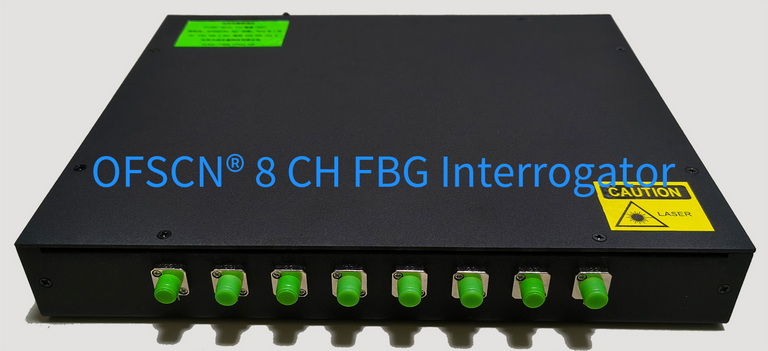
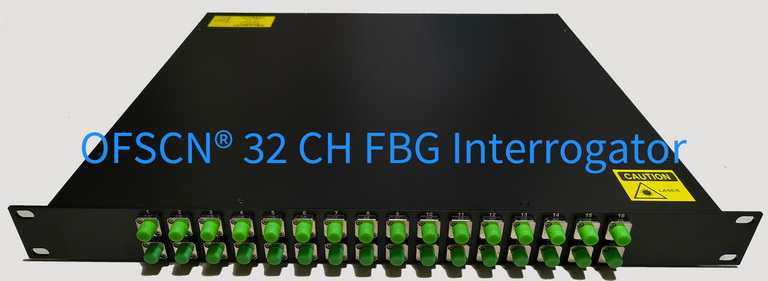
Beijing Dacheng Yongsheng Technology Co., Ltd. (OFSCN®) develops fiber Bragg grating demodulators that support high-frequency acquisition and multi-channel expansion. Its accompanying software system is designed with a networked data interaction architecture, optimized for long-term stable storage and integration of high-throughput data streams.
- Product Name: OFSCN® Fiber Bragg Grating Interrogator
Key Parameter Specifications:
- Wavelength Range: Default 1525\text{ nm} to 1565\text{ nm}, or 1528\text{ nm} to 1568\text{ nm} (customizable).
- Physical Channels: 4, 8, 16, 32 channels available.
- Sampling Frequency: 10\text{ Hz} , 50\text{ Hz} , 100\text{ Hz} available (software adjustable down to 1\text{ Hz} as needed).
- Wavelength Resolution: Default 1\text{ pm}, customizable to 0.1\text{ pm}.
- System Architecture and Protocols: The system software adopts a B/S architecture, supports C/S architecture, and can perform high-concurrency data transmission and integration to external data centers and database systems via standard industrial communication protocols such as TCP, UDP, and Modbus.