How can this wavelength data be used to analyze the health status of the equipment through AI?
Combining reflected wavelength data acquired by fiber Bragg grating sensing systems with artificial intelligence (AI) algorithms is the core link for achieving equipment structural health monitoring (SHM) and prognostics and health management (PHM).
From the underlying optical wavelength time-series signals to high-level equipment health status assessment, the standard technical implementation architecture is typically divided into the following four levels:
I. Physical Quantity Recovery and Data Cleaning (Preprocessing Layer)
The raw physical quantity output by the fiber Bragg grating demodulator is the Bragg center wavelength \lambda_B at each measurement point (the basic principle follows \lambda_B = 2 n_{\text{eff}} \Lambda). Before inputting into AI models, basic preprocessing is required:
- Temperature and Strain Decoupling: Fiber Bragg gratings are sensitive to both temperature and strain. Differential calibration algorithms are needed to eliminate ambient temperature drift and obtain pure mechanical strain \varepsilon(t) or temperature field distribution T(t).
- Signal Filtering and Noise Reduction: Employ Wavelet Denoising, Kalman Filter, or Empirical Mode Decomposition (EMD) to filter out high-frequency white noise introduced by fiber link jitter or light source fluctuations.
- Data Alignment and Standardization: Unify multi-channel sampling rates (e.g., 10\ \text{Hz} to 100\ \text{Hz}) and perform Z-score standardization or Min-Max normalization.
II. Feature Engineering and State Characterization (Feature Extraction Layer)
Extract multi-dimensional characteristic features from the continuous wavelength signal based on the dynamic and static characteristics of the monitored object:
- Time-Domain Statistical Features: Mean, variance, peak-to-peak value, margin factor, pulse factor, and kurtosis (highly sensitive to impact anomalies caused by early pitting or cracks in the equipment).
- Frequency-Domain and Time-Frequency Features: For vibration and dynamic strain monitoring, use Fast Fourier Transform (FFT) or Short-Time Fourier Transform (STFT) to extract characteristic frequencies and harmonic energy ratios; utilize modal analysis techniques to invert the equipment’s natural frequencies, mode shapes, and damping ratios. A decrease in natural frequency typically directly indicates stiffness degradation or structural damage.
- Spatial Topology Features: Fiber Bragg gratings possess natural quasi-distributed multiplexing capabilities. Multiple FBG measurement points on a single fiber form a spatial array, allowing for the extraction of cross-sectional bending moments, curvature change rates, and spatial strain gradient fields.
III. AI Modeling and Health Status Analysis (Algorithm Inference Layer)
Based on the completeness of training data labels and business objectives, the following types of AI algorithm architectures are commonly used:
1. Early Anomaly Detection (Unsupervised Learning)
- Application Scenario: The equipment operates in a normal state for the vast majority of the time, with very few fault samples.
- Algorithm Models: Isolation Forest, One-Class SVM, or LSTM Autoencoder.
- Implementation Logic: Train an autoencoder using wavelength features from healthy historical operating phases. When fatigue spalling or local overheating occurs within the equipment, the residual (Reconstruction Error) between the actual measured signal and the model-reconstructed signal will significantly increase. Exceeding a dynamic threshold will be determined as an early sub-healthy state.
2. Fault Diagnosis and Classification (Supervised Learning)
- Application Scenario: Typical fault modes of the equipment (e.g., bearing inner ring wear, bolt loosening, base instability, etc.) are known, and labeled data is available.
- Algorithm Models: 1D Convolutional Neural Network (1D-CNN), Residual Network (ResNet), or Gradient Boosting Decision Trees (XGBoost/LightGBM).
- Implementation Logic: Treat continuous wavelength time series or time-frequency spectrograms as input tensors. The model automatically extracts high-order fault indicators and outputs the probability distribution and confidence of fault categories.
3. Remaining Useful Life Prediction (RUL / Time Series Regression)
- Application Scenario: Predict when the equipment will reach its failure threshold to implement predictive maintenance.
- Algorithm Models: Long Short-Term Memory (LSTM), Gated Recurrent Unit (GRU), Transformer, or Physics-Informed Neural Networks (PINN).
- Implementation Logic: Combine Rainflow Counting to calculate strain cycle spectrum, input into a time-series attention-based neural network model, and integrate material fatigue damage evolution models (e.g., Miner’s rule) to predict crack propagation trends and the equipment’s remaining safe operating life.
IV. Edge Computing and Industrial System Integration
To meet real-time inference requirements, demodulators typically stream wavelength data to industrial edge computing devices via high-speed network protocols:
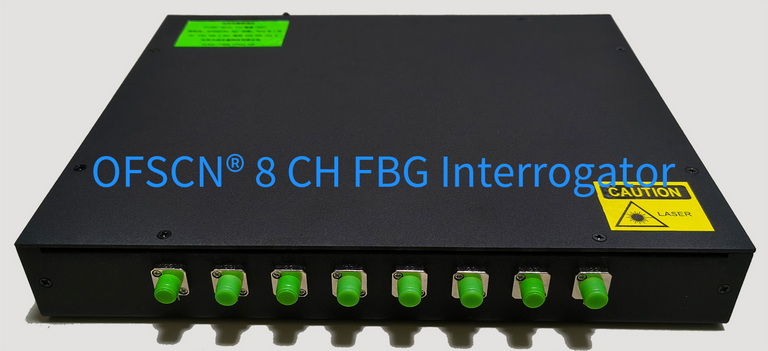
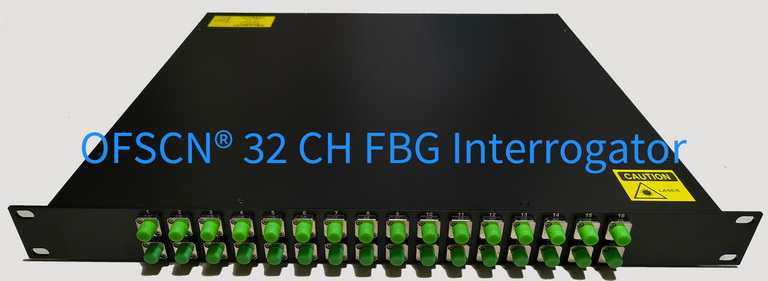
- Underlying Data Acquisition Equipment: Utilize the OFSCN® Fiber Bragg Grating Interrogator, which offers wavelength resolutions of 1\ \text{pm} or 0.1\ \text{pm} and supports sampling frequencies from 1\ \text{Hz} to 100\ \text{Hz}. This meets the needs for low-frequency static deformation monitoring to mid-to-high frequency dynamic response analysis.
- Integration Interface: The demodulator supports common industrial protocols such as TCP, UDP, and Modbus, facilitating seamless integration of multi-channel wavelength data arrays into Python/C++ AI inference engines or digital twin cloud platforms deployed on edge gateways.