How does it transform an entire fiber optic cable into a massive “distributed microphone” to monitor vibrations?
Distributed Acoustic Sensing (DAS) transforms an entire fiber optic cable into a distributed microphone by utilizing the principle of Rayleigh scattering.
Here’s how it works:
- Light Pulse Emission: A laser sends short pulses of coherent light into one end of the optical fiber.
- Rayleigh Backscattering: As the light pulse travels through the fiber, tiny imperfections and variations in the fiber’s refractive index cause a small portion of the light to scatter back towards the source. This is called Rayleigh backscattering.
- Vibration Interaction: When external vibrations, acoustic waves, or strain events act upon the fiber at any point, they induce minute changes in the fiber’s physical properties (e.g., refractive index, length) at that specific location.
- Phase/Amplitude Modulation: These localized changes, although tiny, alter the phase and/or amplitude of the backscattered light from that particular point.
- Interrogation and Analysis: A high-speed interrogator at the source end continuously monitors and analyzes the backscattered light. By measuring the changes in the phase and amplitude of the backscattered signal over time, and by precisely timing the arrival of these signals, the system can detect and localize disturbances along the entire length of the fiber. Each segment of the fiber effectively acts as a sensing element, creating a “distributed microphone” array.
This technology allows for continuous monitoring of vibrations, acoustic events, and strain over many kilometers, making the fiber a highly sensitive, long-distance sensor.
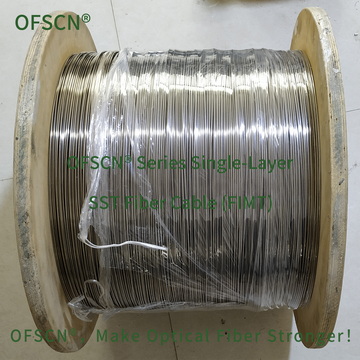
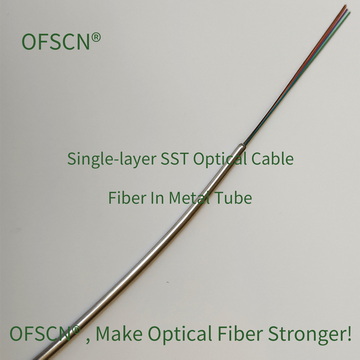
OFSCN® offers specialized fiber optic cables that can be used for distributed sensing applications. For instance, the OFSCN® 650/700°C Seamless Steel Tube Fiber Cable can serve as a distributed fiber optic sensing cable.
Here are some standard images of the product: