Why is the Full Width at Half Maximum (FWHM) of the spectrum crucial for demodulation accuracy?
The Full Width at Half Maximum (FWHM) of a Fiber Bragg Grating (FBG) spectrum is a critical parameter for demodulation accuracy because it directly impacts the precision with which the Bragg wavelength shift can be determined.
A narrower FWHM, often referred to as 3dB bandwidth in technical specifications, indicates a sharper and more well-defined reflection peak. This sharper peak allows the FBG interrogator to more accurately track subtle shifts in the Bragg wavelength, which in turn translates into higher resolution and accuracy in measuring the physical parameter (e.g., strain or temperature) being monitored. If the FWHM is broad, the peak is less distinct, making it harder for the interrogator to pinpoint the exact center wavelength, leading to reduced measurement accuracy.
For instance, OFSCN® Fiber Bragg Grating Interrogators are designed to precisely detect these wavelength shifts. When FBG grating lengths are 8mm or 10mm, the 3dB bandwidth is typically less than 0.4 nm, which is crucial for achieving high demodulation accuracy in various applications. The 3dB bandwidth can also be customized within a certain range depending on the grating length.
Below is a standard image of our FBG interrogator:
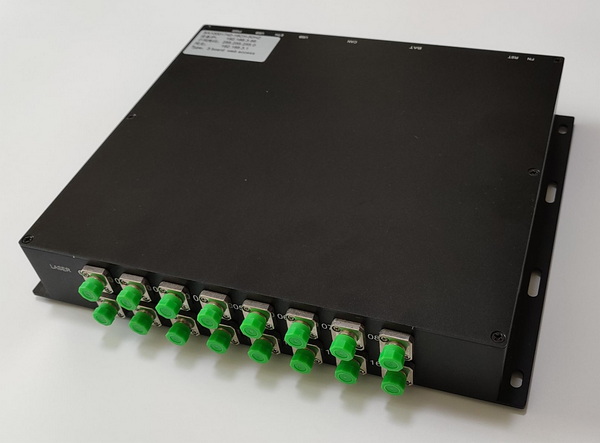
You can find more detailed information about our interrogators on our website:
OFSCN® Fiber Bragg Grating Interrogator