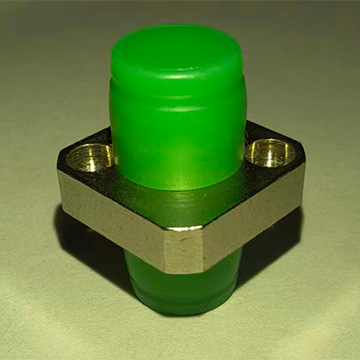
If the jumper is clean but the signal is poor, how should the inside of the adapter be cleaned?
In fiber optic sensing and communication links, even if the ferrule end-face has been cleaned, if there is contamination inside the fiber optic adapter (flange, Adapter), during the process of inserting the jumper into the alignment sleeve, dust, grease, or debris from the inner wall of the sleeve will re-contaminate the fiber end-face, or hinder the precise physical contact (Physical Contact) between the two ferrules, thereby introducing Fresnel reflection and significant additional insertion loss (e.g., insertion loss \text{IL} > 1\ \text{dB} or even higher).
The internal core of a fiber optic adapter is the alignment sleeve (usually an open-ended zirconia ceramic \text{ZrO}_2 sleeve). Its cleaning method differs from that of exposed jumper end-faces. The specific engineering operation specifications are as follows:
I. Engineering Cleaning Methods for Adapter Internal Contamination
1. Using a One-Click Fiber Cleaner (One-Click Cleaner / Push-Type Cleaner)
This is the most standard and efficient cleaning method for field operations and instrument ports:
- Specification Matching: Select a cleaning pen of the corresponding caliber according to the adapter specifications. Use the 2.5\ \text{mm} specification for FC, SC, ST interfaces; use the 1.25\ \text{mm} specification for LC, MU interfaces.
- Operating Procedure:
- Insert the cleaning pen’s guide tip directly into the depth of the adapter interface;
- Keep the axial direction straight, gently push the cleaning pen forward, and listen for the “click” sound to trigger the mechanical advance;
- The micro-fiber tape at the tip will rotate and rub against the inner wall of the alignment sleeve and the deep-seated mating end-face, removing dust and particles;
- It is recommended to clean continuously for 2 \sim 3 times.
2. Using a Dedicated Lint-Free Swab with High-Purity Isopropyl Alcohol (Wet Wipe + Dry Wipe Method)
For stubborn grease or adherent particles, dry cleaning pens may not be able to remove them completely. A “wet wipe + dry wipe” combination should be used:
- Material Preparation: Fiber optic specific lint-free swabs (strictly matching 2.5\ \text{mm} or 1.25\ \text{mm} bore diameter, absolutely do not use civilian medical cotton swabs), high-purity isopropyl alcohol (optical grade IPA, purity \ge 99.7\% ).
- Operating Procedure:
- Wet Wipe: Lightly dip the swab head with isopropyl alcohol (slightly damp is sufficient, absolutely no liquid dripping), slowly insert it to the bottom of the adapter sleeve, and rotate it clockwise by 360^\circ in the same direction for wiping;
- Dry Wipe: Immediately insert a new dry swab and rotate it at the same depth to absorb residual solvent and dissolved contaminants, avoiding the formation of residue rings after drying.
3. Removing the Adapter for Air Blowing or Ultrasonic Cleaning (Offline State)
If the adapter is not in a fixed rack state or can be detached from both ends:
- Use canned, filtered, high-pressure dry duster gas (Optical Grade Air Duster) to blow through both ends of the sleeve to remove free particles;
- If it is a purely passive metal/ceramic flange without optical components, it can be removed and cleaned in an ultrasonic cleaner filled with anhydrous ethanol/isopropyl alcohol, then thoroughly dried before installation.
II. Engineering Taboos for Adapter Cleaning
- Absolutely do not use ordinary cotton swabs or paper towels: Ordinary absorbent cotton fibers are prone to breaking and shedding, which will directly remain in the gaps of the ceramic open-ended sleeve, causing more severe misalignment and loss.
- Absolutely do not use excessive force or angled force: The wall of the ceramic alignment sleeve is very thin and has an elastic opening. Forcibly prying the cleaning rod significantly can easily cause the sleeve to shatter or undergo permanent elastic deformation, destroying the axial alignment accuracy.
- Maintain closed-loop re-testing: After the adapter is cleaned, the jumper ferrule should be wiped again before insertion and mating. Use an optical power meter, fiber Bragg grating demodulator, or OTDR to observe whether the optical power and reflection peaks have returned to normal.
III. Official Product and Configuration Information
General-purpose fiber optic cleaning pens, lint-free swabs, and optical isopropyl alcohol solvents are standard consumable tools and are not part of Beijing Dacheng Yongsheng Technology Co., Ltd. (OFSCN®)'s core product line.
Beijing Dacheng Yongsheng Technology Co., Ltd. (OFSCN®) focuses on high-quality fiber optic connectors and flange assemblies that are resistant to harsh environments. If your link operates long-term in high-temperature and harsh environments, stress relaxation or material degradation of the sleeves in ordinary plastic or standard temperature metal adapters may also lead to poor contact. You can choose high-temperature resistant industrial-grade fiber optic flange assemblies:
- Product Name: OFSCN® High Temperature Resistant Fiber Optic Adapter
- Key Indicators: Temperature resistance range up to 300^\circ\text{C} , uses high-temperature resistant and highly reliable materials, supports alignment of standard fiber optic interfaces such as FC/APC-FC/APC.